- Where to see one
- 37 U.S. zoos in our directory hold jaguar, confirmed against each zoo's own animal list.
- Native range
- Southwestern United States, Mexico, Central America, and South America south to Paraguay and northern Argentina
- Size
- Body length up to 1.85 m (6 ft 1 in), standing 57–81 cm (22.4–31.9 in) at the shoulder; weighs up to 158 kg (348 lb)
About the jaguar
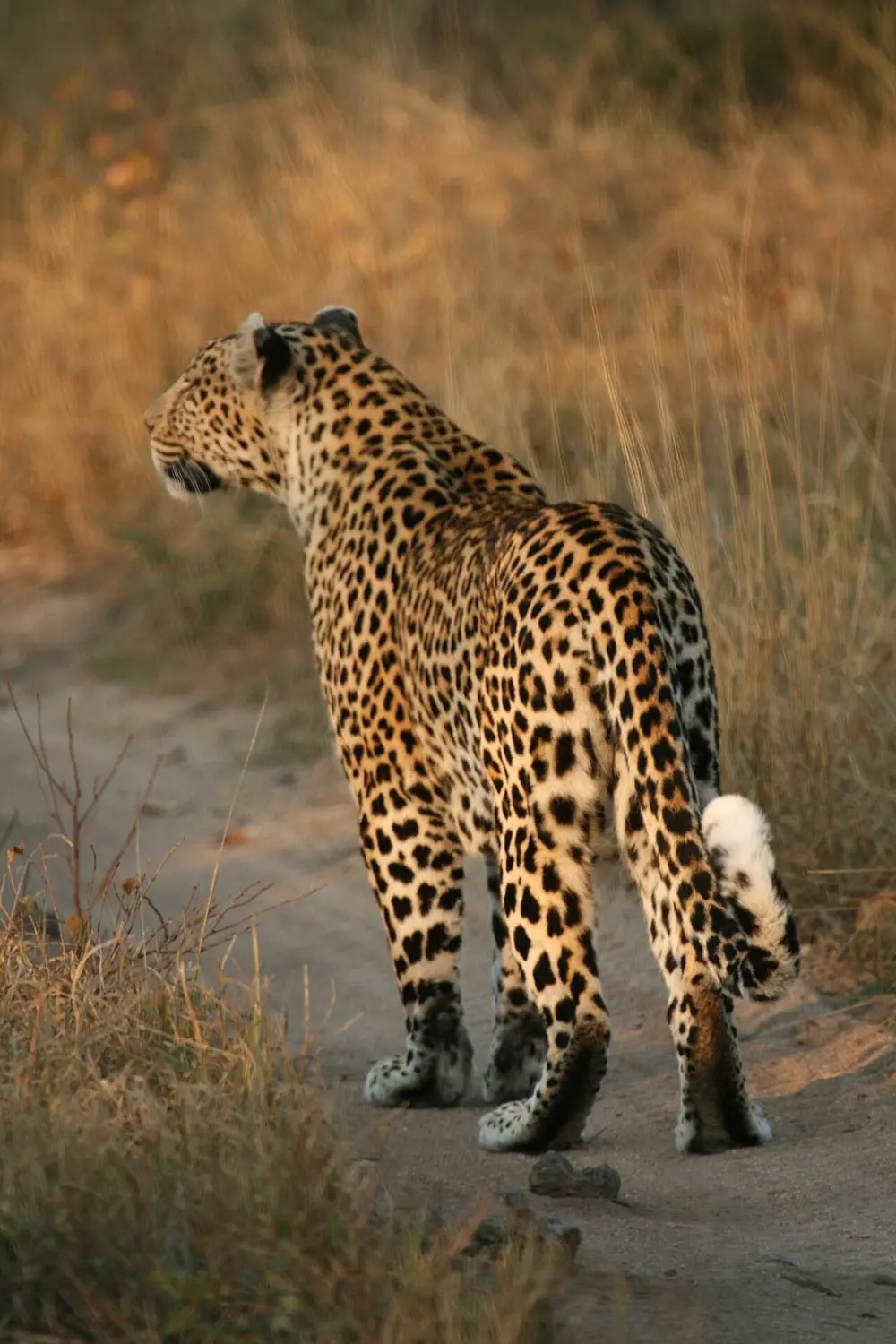
The jaguar is the only living member of the genus Panthera native to the Americas, and it is the biggest cat species found there — the third largest in the world, behind only the tiger and the lion. Its coat ranges from pale yellow to tan or reddish-yellow with a whitish underside, patterned in black spots that turn into rosettes along the sides; some individuals are melanistic, giving rise to the animals commonly called black panthers. The rosettes typically enclose one or more smaller dots, a pattern that distinguishes the jaguar from the visually similar leopard, which has smaller, more numerous rosettes without the central spot. Jaguars also tend to be more robust than leopards, with stockier limbs and a squarer head.
Size varies considerably by sex and region. Most jaguars weigh between 56 and 96 kg, though exceptionally large males have been recorded at up to 158 kg, and the smallest females, from Middle America, weigh as little as 36 kg. Females run 10 to 20 percent smaller than males on average. Body length from nose to the base of the tail spans 1.12 to 1.85 meters, with a comparatively short tail of 45 to 75 cm — the shortest of any big cat relative to body size. Jaguars generally grow larger moving from north to south: those in Mexico's Chamela-Cuixmala Biosphere Reserve average around 50 kg, while jaguars in Venezuela and Brazil average about 95 kg in males and 56–78 kg in females. The species also carries an unusually powerful bite, the third-strongest of any felid after the tiger and lion, which lets it pierce turtle and tortoise shells and kill mammalian prey with a single bite through the skull between the ears.
Ancestors of the modern jaguar are believed to have entered the Americas from Eurasia during the Early Pleistocene by way of the Bering land bridge, with the oldest North American jaguar fossils dating to roughly 850,000 to 820,000 years ago. Today the species ranges from the southwestern United States through Mexico and Central America into the Amazon basin and south to Paraguay and northern Argentina, occupying a variety of forested and open terrain but favoring tropical and subtropical moist broadleaf forest, wetlands, and wooded country.
Behavior and diet
Diet
Carnivorous; opportunistic stalk-and-ambush predator
The jaguar is largely solitary and is described as an opportunistic stalk-and-ambush predator, and as a keystone species it is thought to play a role in regulating prey populations and stabilizing the ecosystems it inhabits — though some researchers question how strong that keystone effect really is. It is mostly active at night and during twilight, but this pattern shifts by region: jaguars in the Amazon rainforest and the Pantanal are often active by day, while those in the Atlantic Forest stay mainly nocturnal, tracking the activity patterns of their prey. Jaguars are unusually strong swimmers for a big cat, recorded crossing distances of at least 1.3 km between islands and shore, and they play and hunt in water, possibly more than tigers do. They also climb trees, though less often than cougars, with which they share range across parts of Mexico.
Melanistic, or black, jaguars occur more often in tropical rainforest than in open habitat and tend to be more active during the day, suggesting their dark coats provide extra camouflage in deep, heavily shadowed vegetation. The trait comes from deletions in the melanocortin 1 receptor gene and is inherited as a dominant allele. Documented sightings of black jaguars include a 2004 camera-trap photograph in Mexico's Sierra Madre Occidental — the first confirmed record in northern Mexico — along with individuals photographed in Costa Rica and eastern Panama.
Range and habitat
Habitat
Tropical and subtropical moist broadleaf forest, wetlands, and wooded regions
At the turn of the 20th century the jaguar's historic range covered an estimated 19 million square kilometers, from the southern United States through Central America to southern Argentina. By the turn of the 21st century that range had shrunk to about 8.75 million square kilometers, with the steepest losses in the southern United States, northern Mexico, northern Brazil, and southern Argentina. The jaguar is now considered locally extinct in El Salvador and Uruguay. Its present range still touches the United States only marginally: 62 sightings were reported in Arizona, New Mexico, and Texas during the 20th century, and eight individual jaguars were photographed in the southwestern U.S. between 1996 and 2024, including one male tracked at 23 locations in Arizona's Santa Rita Mountains between 2012 and 2015.
The species prefers dense forest — dry deciduous, tropical and subtropical moist broadleaf, rainforest, and cloud forest across Central and South America — along with seasonally flooded wetlands and dry grassland farther north. It has been recorded at elevations up to 3,800 meters but avoids montane forest, and it favors riverine habitat and swamps with heavy vegetation cover. GPS-collared jaguars studied in the Mayan forests of Mexico and Guatemala preferred undisturbed dense habitat away from roads, with females avoiding even low levels of human activity while males proved more tolerant. In the United States, jaguars persisted in California until about 1860 and in Texas until 1948, when the last confirmed individual was shot near Kingsville; the species was considered extirpated from the U.S. by the late 1960s, though a handful of wandering males have been documented in Arizona since.
Conservation status
The jaguar has been listed as Near Threatened on the IUCN Red List since 2002, with the wild population thought to have been declining since the late 1990s. It is threatened by habitat loss and fragmentation, poaching for the trade in its body parts, and killing in conflicts with ranchers across Central and South America. Conservation planning has identified 51 priority areas, known as Jaguar Conservation Units, spread across 36 geographic regions from Mexico to Argentina, each intended to support at least 50 breeding individuals. The species also carries deep cultural significance, having featured prominently in the mythology of Indigenous peoples across the Americas, including the Aztec and Maya civilizations.
Where to see jaguar in the U.S.
37 zoos across 16 states
Find the closest one
Rank the 33 zoos holding jaguar by how far they are from you. Your location is used in your browser to sort this list and is never sent to us.
4 more zoos hold jaguar but have no coordinates on file yet, so they aren't ranked here. They're in the full list below.
Arizona· 3
California· 6
Florida· 6
Kansas· 1
Louisiana· 3
Maryland· 1
Massachusetts· 2
New Jersey· 2
New Mexico· 1
North Carolina· 1
Oklahoma· 1
Pennsylvania· 1
Tennessee· 2
Texas· 5
Washington· 1
Wisconsin· 1
AZAThe Association of Zoos and Aquariums. Accredited members have passed an independent inspection of animal care and welfare, safety, conservation and education, repeated every five years. Many smaller facilities never apply, so “not accredited” isn't a verdict on its own. What accreditation means · How we check this
Built from each zoo's own published animal list.
Jaguar: common questions
Is the jaguar endangered?
It is classified as Near Threatened, one step below Vulnerable, with populations thought to have declined since the late 1990s due to habitat loss and conflict with people.
How big does a jaguar get?
Body length reaches up to 1.85 m (6 ft 1 in), with most individuals weighing 56–96 kg and exceptionally large males topping out around 158 kg (348 lb).
What does a jaguar eat?
It is a carnivorous, opportunistic stalk-and-ambush predator whose powerful bite can pierce turtle shells and deliver a fatal bite through the skulls of mammalian prey.
Where do jaguars live in the wild?
From the southwestern United States and Mexico through Central America into South America, as far south as Paraguay and northern Argentina, favoring dense tropical forest and wetlands.
Which U.S. zoos have jaguars?
Fourteen zoos in the Feather & Fang directory, including the San Diego Zoo, Houston Zoo, and Phoenix Zoo.