Panamanian Golden Frog
Atelopus zeteki
Also known as Panamanian Frog, Panemanian Golden Frog
- Where to see one
- 27 U.S. zoos in our directory hold panamanian golden frog, confirmed against each zoo's own animal list.
- Native range
- Panama (Coclé and Panamá provinces)
- Size
- Females 45–63 mm (1.8–2.5 in) long, 4–15 g (0.14–0.53 oz); males 35–48 mm (1.4–1.9 in), 3–12 g (0.11–0.42 oz)
- Lifespan
- 12 years
Conservation status
Critically Endangeredassessed 2019
IUCN Red List category CR — step 5 of 7.
Critically Endangered (CR), possibly extinct in the wild
About the Panamanian golden frog
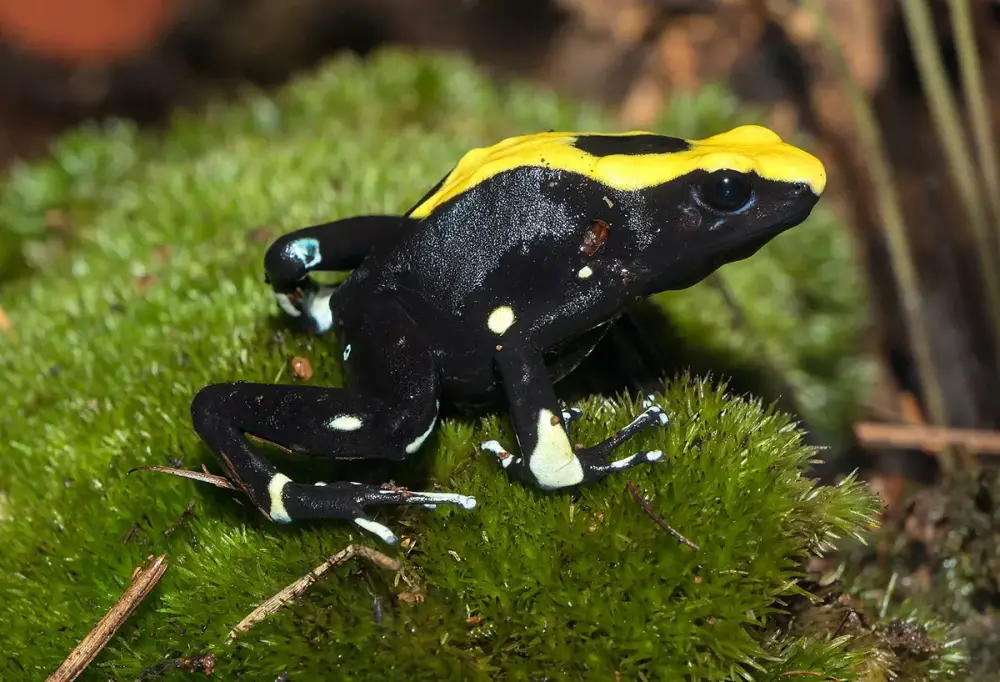
The Panamanian golden frog is not, despite the name, a frog at all — it's a toad, a member of the family Bufonidae, first described as a subspecies of Atelopus varius before being split into its own species, Atelopus zeteki. It's a national symbol of Panama, and its skin ranges from light yellow-green to a bright, almost lacquered gold, sometimes marked with black spots on the back and legs. Females run larger than males: 45 to 63 mm (1.8 to 2.5 in) long and 4 to 15 g (0.14 to 0.53 oz), against 35 to 48 mm (1.4 to 1.9 in) and 3 to 12 g (0.11 to 0.42 oz) for males.
The species is endemic to Panama, historically found close to mountain streams on the eastern side of the Tabasará mountain range, in Coclé and Panamá provinces. Its range once reached as far east as the town of El Copé, in western Coclé, before a fungal disease collapsed that population in 2004.
That coloring isn't just decoration. The Panamanian golden frog carries a mix of toxins — steroidal bufadienolides and guanidinium alkaloids of the tetrodotoxin class — including zetekitoxin AB, a blocker of voltage-dependent sodium channels far more potent than its chemical relative saxitoxin. The toxin is water-soluble and affects nerve cells on contact; in tests on mice, large doses proved fatal within 20 to 30 minutes, with death preceded by convulsions as the circulatory and respiratory systems shut down. The bright gold-and-black pattern functions as a warning to predators, though at least one predator, the colubrid snake Erythrolamprus epinephalus, is able to metabolize the toxin anyway.
Behavior and diet
Diet
Tadpoles graze on algae
Development runs through four stages: larva (tadpole), juvenile, subadult, and adult. Tadpoles emerge from their eggs after 2 to 10 days, living entirely in water at depths of 5 to 35 cm (2.0 to 14 in) and temperatures between 20.4 and 21.3°C (68.7 to 70.3°F). They cling to surfaces with suction from their flattened bellies, rest in shallow pools below cascades, and feed on algae for 6 to 7 months while growing and developing. Juveniles stay amphibious but rarely range more than 2 m from their home stream; subadults have full adult ranges but are more greenish and darker-patterned than the gold, sometimes spotted adults.
This is an unusually vocal-and-visual toad. It's "earless" — it lacks a tympanum — yet it still responds to throat-sound vocalizations from other members of its species and can locate where a sound comes from, a form of directional hearing that doesn't rely on an eardrum. Because the rushing noise of its mountain streams drowns out calls, the species also communicates by semaphore: individuals wave their forefeet at rivals and prospective mates. Adult males are territorial and largely solitary, staying near breeding streams and defending their patch with vocalizations and foot-waving; if a threat persists, the display escalates in frequency and volume. Adult males are active on the ground by day and climb into trees at night, likely as a defense against nocturnal predators, since hearing or feeling a predator's weight on a branch beats relying on toxin alone.
Breeding pairs come together when a male uses a soft call to entice a female, then grabs and holds on as she passes; a receptive female tolerates this amplexus, which can last from a few days to a few months, while an unreceptive one arches her spine to buck him off. Oviposition usually happens in a shallow stream. Outside the breeding season, males stay near the water while females retreat into the forest.
Range and habitat
Habitat
Streams along the mountainous slopes of Panama's Cordilleran cloud forests
The Panamanian golden frog is endemic to Panama, restricted historically to streamside habitat on the eastern slopes of the Tabasará range in Coclé and Panamá provinces, at the edge of the country's Cordilleran cloud forests. That range contracted sharply after 2004, when the fungal disease chytridiomycosis wiped out the population around El Copé in western Coclé. Vital streamside habitat continues to be lost to small farms, commercial agriculture, woodlot operations, livestock grazing, industrial expansion, and real estate development.
The species was last filmed in the wild in 2006, by the BBC Natural History Unit for David Attenborough's Life in Cold Blood; the filming location was kept secret to protect the remaining animals from poachers. Individuals are now held in captive-breeding programs at more than 50 institutions across North America and Panama, including the El Valle Amphibian Conservation Center (EVACC), established in Panama in 2005.
Conservation status
The Panamanian golden frog is listed as Critically Endangered on the IUCN Red List, flagged as possibly extinct in the wild, in a 2019 assessment by the IUCN SSC Amphibian Specialist Group. It may have been extinct in the wild since 2007.
Numbers began collapsing in its mountain forests in the late 1990s. The main cause is chytridiomycosis, a disease caused by an invasive fungus that reached El Valle, the frog's home, in 2006. The fungus does better in cold conditions, and infected frogs that fight it off by raising their body temperature can still suffer a relapse. Habitat loss to housing and urbanization, pollution and the pet trade add to the threat.
Ex situ breeding now keeps the species going. One U.S. program begun in 2003 has bred about 500 frogs, but no animals will be released until chytrid is less of a threat, because no remedy yet controls the disease in the wild. Project Golden Frog, a partnership of institutions in Panama and the United States, combines captive breeding, field research and public education.
Where to see panamanian golden frog in the U.S.
27 zoos across 17 states
Find the closest one
Rank the 27 zoos holding panamanian golden frog by how far they are from you. Your location is used in your browser to sort this list and is never sent to us.
Alabama· 1
California· 3
Colorado· 1
District of Columbia· 1
Florida· 2
Georgia· 1
Illinois· 1
Iowa· 1
Maryland· 1
Massachusetts· 3
Michigan· 2
New York· 4
Ohio· 1
Pennsylvania· 2
Tennessee· 1
Texas· 1
Virginia· 1
AZAThe Association of Zoos and Aquariums. Accredited members have passed an independent inspection of animal care and welfare, safety, conservation and education, repeated every five years. Many smaller facilities never apply, so “not accredited” isn't a verdict on its own. What accreditation means · How we check this
Built from each zoo's own published animal list.
Panamanian Golden Frog: common questions
Is the Panamanian golden frog endangered?
Yes. The IUCN lists it as Critically Endangered and possibly extinct in the wild (2019 assessment). It may have been extinct in the wild since 2007 and survives mainly in captive-breeding programs.
How big does a Panamanian golden frog get?
Females reach 45 to 63 mm (1.8 to 2.5 in) and weigh 4 to 15 g (0.14 to 0.53 oz); males are smaller, at 35 to 48 mm (1.4 to 1.9 in) and 3 to 12 g (0.11 to 0.42 oz).
Is the Panamanian golden frog poisonous?
Yes. It produces toxins including zetekitoxin AB, which is water-soluble and blocks nerve signaling; it can be fatal in high enough doses.
How long do Panamanian golden frogs live?
About 12 years.
Where do Panamanian golden frogs live in the wild?
They're endemic to Panama, historically found along mountain streams in the Cordilleran cloud forests of Coclé and Panamá provinces.
Which U.S. zoos have Panamanian golden frogs?
Eighteen U.S. zoos list them, including San Diego Zoo, Zoo Atlanta, and the Houston Zoo.