- Where to see one
- 12 U.S. zoos in our directory hold dyeing poison dart frog, confirmed against each zoo's own animal list.
- Native range
- Eastern Guiana Shield — French Guiana, Guyana, Suriname, and Brazil
- Size
- Typically about 50 mm (2.0 in) snout–vent length; smaller morphs around 3.5 cm (1.4 in), larger ones up to 7 cm (2.8 in)
Conservation status
Least Concernassessed 2023
IUCN Red List category LC — step 1 of 7.
Least Concern (LC), assessed 2023
About the dyeing poison dart frog
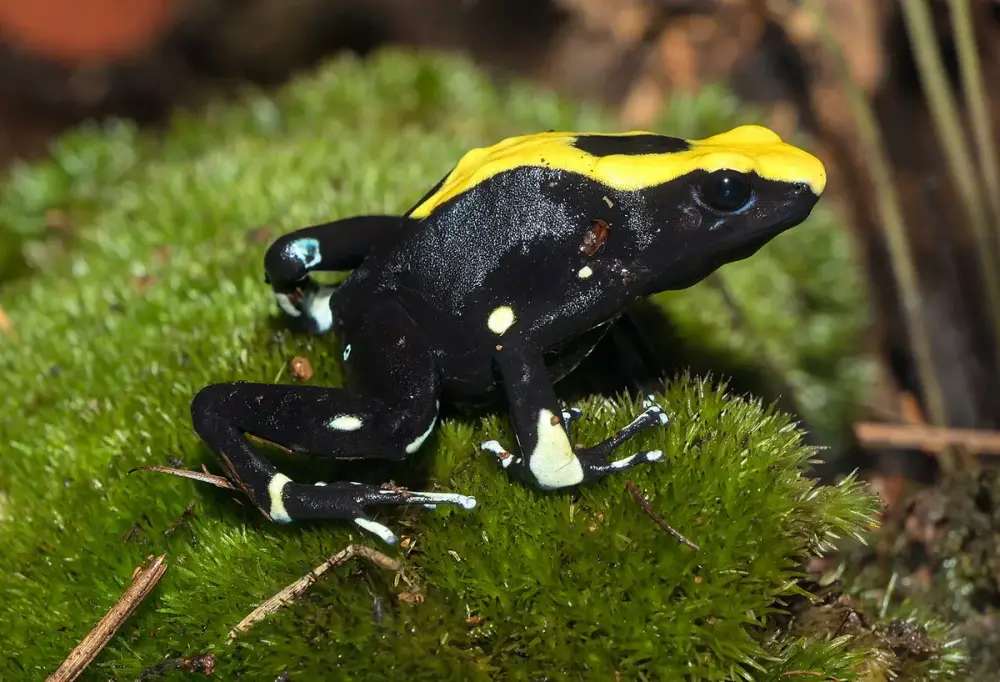
The dyeing poison dart frog, also called the cobalt dyeing poison dart frog or simply "tinc," is among the largest and most variably colored of all poison dart frogs. Most individuals reach a snout–vent length of about 50 mm (2.0 in), though small morphs may top out around 3.5 cm (1.4 in) and the largest variants can reach 7 cm (2.8 in). Its specific name, tinctorius, doesn't actually refer to its own coloring — it comes from a legend among some Indigenous tribes that the frog's poison could be used to make green parrot feathers grow in different colors.
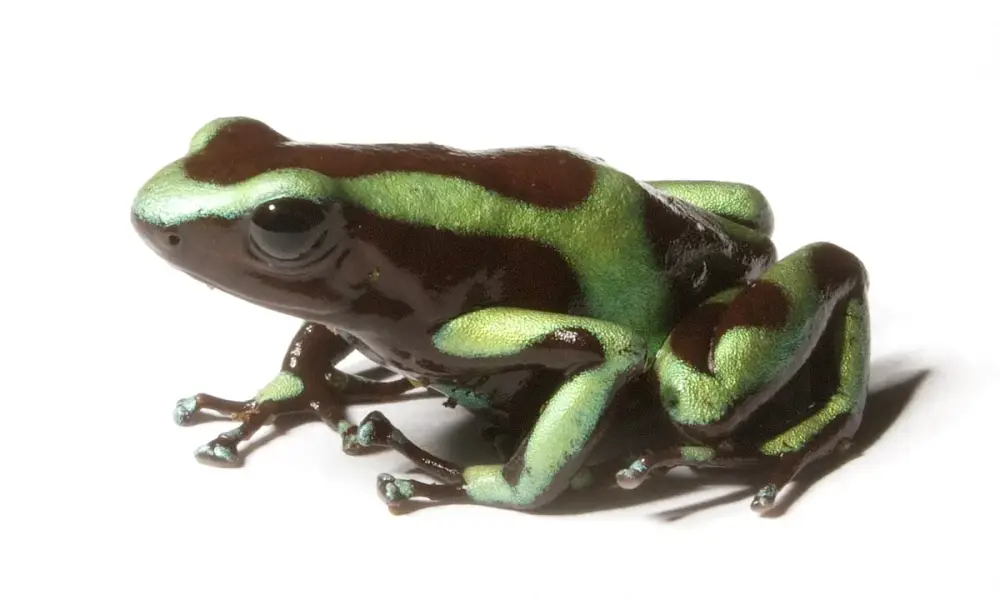
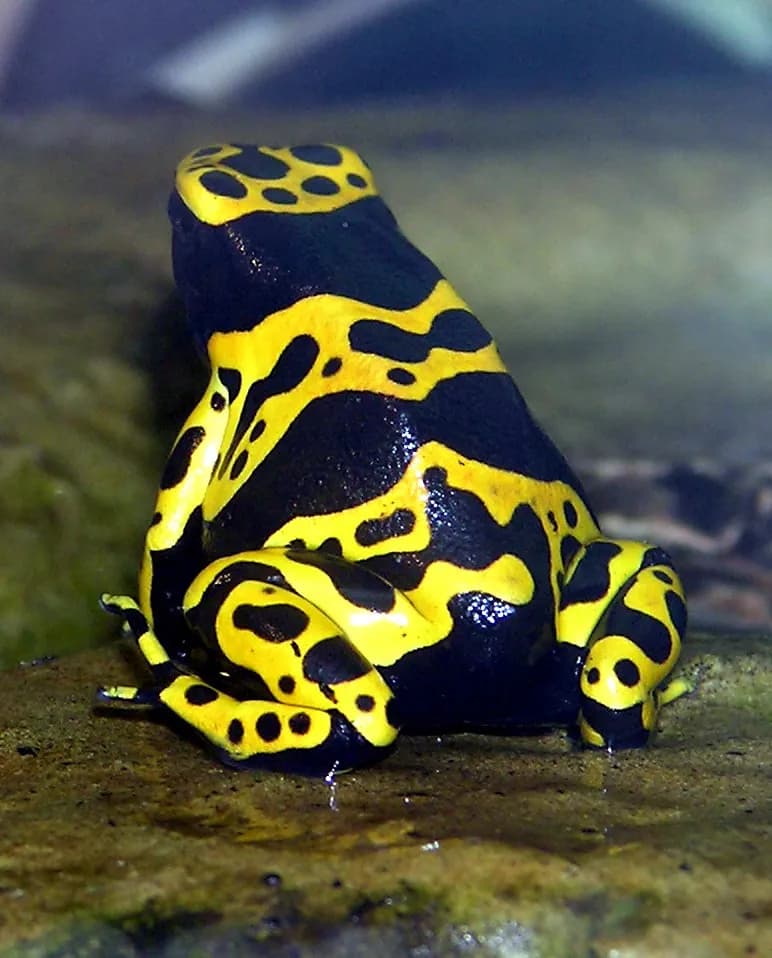
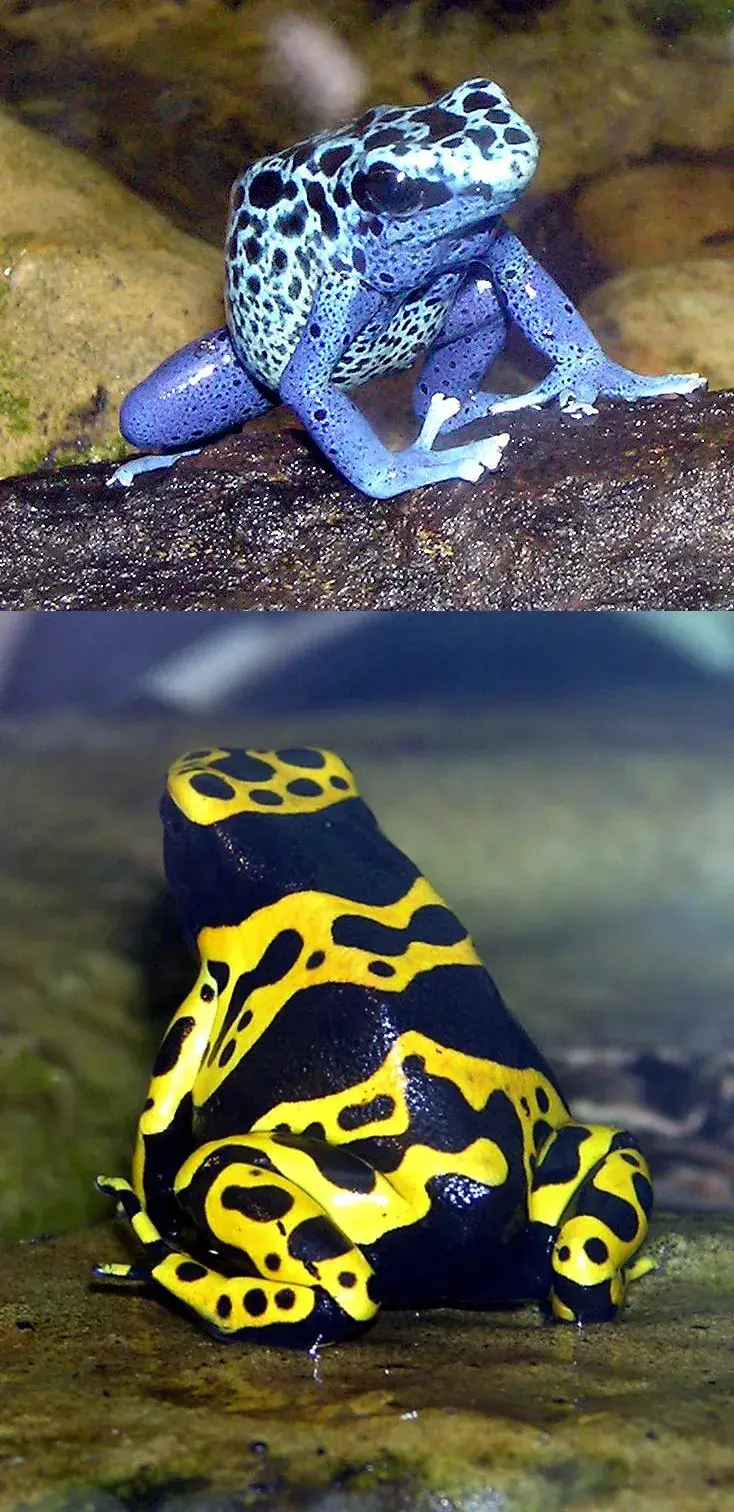
More than 30 recognized color variants, or morphs, exist, each generally tied to a particular locality or region, with individual variation layered on top. The typical pattern is a mostly black body marked with irregular yellow or whitish stripes running along the back, upper flanks, and head, paired with irregular blue stripes on the lower flanks, belly, and throat; the blue itself ranges from pale or sky blue through cobalt, navy, or greenish blue. Some morphs break from that pattern entirely — the body and legs can be primarily blue, as in the "azureus" form from southern Suriname, primarily yellow, as in the "Matécho" morph from Saül, French Guiana, or primarily whitish. Despite this striking visual diversity, genetic differences between the various populations are described as very marginal.
Males and females differ in a few consistent ways. Males are typically smaller and more slender, with larger, heart-shaped toe discs and curved backs, while females have circular toe discs and arched backs. The species is distributed across the eastern portion of the Guiana Shield, found at altitudes up to 600 m (2,000 ft), and is more often encountered on the ground — easier terrain for catching prey — though it will climb trees on occasion.
Behavior and diet
Diet
Small arthropods, largely ants and mites, which supply the alkaloids in its skin
Like other members of its genus, the dyeing poison dart frog does not manufacture its own toxins. Instead, it sequesters noxious alkaloids from a diet of chemical-laden arthropods, mainly ants and mites, and stores them in its skin as a defense. Those alkaloids — among them disubstituted indolizidines, trisubstituted indolizidines, disubstituted decahydroquinolines, and histrionicotoxins — work by interfering with nervous and muscular tissue, blocking calcium, sodium, or potassium channels or nicotinic acetylcholine receptors. In a predator, that interference can cause locomotor problems, convulsions, paralysis, or death. The frog's bright coloring is aposematic, a warning signal: predators that have tasted the pain and cramping caused by its skin secretions learn to associate the pattern with the unpleasant consequence and avoid the frog afterward.
In humans, a documented case from the northwestern Brazilian Amazon shows contact can cause temporary symptoms. It involved two photographers who briefly handled a dyeing poison dart frog with bare hands before rinsing off in a nearby stream. One later felt numbness in his forearm, and the other, who had touched his mouth without washing his hands first, felt slight numbness in his lower lip; both sets of symptoms cleared within about 40 minutes. The account notes that symptoms could have been worse with longer contact or an open wound at the point of contact.
For breeding habitat, the species relies on phytotelmata — small pools of water that collect in plant structures or on fallen trees — as nurseries for tadpole development, which is part of why it favors the canopy gaps created when trees fall in the rainforest.
Range and habitat
Habitat
Tropical primary rainforest, especially treefall canopy gaps
The dyeing poison dart frog occurs in discrete patches across the eastern Guiana Shield, spanning parts of French Guiana, Guyana, Suriname, and Brazil, at elevations up to 600 m (2,000 ft). It favors tropical primary rainforest, particularly areas with canopy gaps created by fallen trees, and while it is mostly found in upland areas such as hills or the base of mountains, populations also exist at sea level. Erosion of the region's highlands over time has helped isolate some populations from one another, contributing to the localized nature of its many color morphs. A study of the species' tadpoles found they can tolerate pools with high water hardness, at elevations up to 15 mi (79,000 ft) and salinity as high as 955 parts per million, underscoring how tolerant the tadpoles are of the sometimes harsh, isolated pools in which they develop.
Conservation status
The dyeing poison dart frog is listed as Least Concern on the IUCN Red List, based on a 2023 assessment by the IUCN SSC Amphibian Specialist Group. The category means the species is not currently considered at risk of extinction.
It does rely on a fairly specific habitat niche: primary rainforest with canopy gaps and the small water pools that form in fallen timber. That ties its long-term wellbeing closely to the health of intact forest in the eastern Guiana Shield.
Where to see dyeing poison dart frog in the U.S.
12 zoos across 10 states
Find the closest one
Rank the 12 zoos holding dyeing poison dart frog by how far they are from you. Your location is used in your browser to sort this list and is never sent to us.
Connecticut· 1
Florida· 2
Illinois· 1
Indiana· 1
Kansas· 1
Massachusetts· 2
New Mexico· 1
New York· 1
Ohio· 1
Pennsylvania· 1
AZAThe Association of Zoos and Aquariums. Accredited members have passed an independent inspection of animal care and welfare, safety, conservation and education, repeated every five years. Many smaller facilities never apply, so “not accredited” isn't a verdict on its own. What accreditation means · How we check this
Built from each zoo's own published animal list.
Dyeing Poison Dart Frog: common questions
Is the dyeing poison dart frog endangered?
No. It is listed as Least Concern on the IUCN Red List (2023 assessment).
How big does a dyeing poison dart frog get?
Most individuals reach about 50 mm (2.0 in) in snout–vent length, with smaller morphs around 3.5 cm (1.4 in) and the largest reaching 7 cm (2.8 in).
What does a dyeing poison dart frog eat?
Small arthropods, largely ants and mites, from which it sequesters the alkaloids that make its skin toxic.
Where do dyeing poison dart frogs live in the wild?
Across the eastern Guiana Shield, in French Guiana, Guyana, Suriname, and Brazil, mainly in primary rainforest with canopy gaps.
Is a dyeing poison dart frog dangerous to touch?
Its skin secretions can cause numbness, pain, or cramping if absorbed, but a documented case of brief hand contact produced only temporary numbness that cleared within about 40 minutes.
Which U.S. zoos have dyeing poison dart frogs?
Nine U.S. zoos list them, including Connecticut's Beardsley Zoo, Brevard Zoo in Florida, and Lincoln Park Zoo in Illinois.