Green-and-Black Poison Dart Frog
Dendrobates auratus
Also known as Green Black Poison Dart Frog, Green-Poison-Frog, Green And Black Poison Frog, Green And Black Dart Frog, Mint Dart Frog
- Where to see one
- 15 U.S. zoos in our directory hold green-and-black poison dart frog, confirmed against each zoo's own animal list.
- Native range
- Southern Central America and Colombia; also introduced to Oahu and Maui, Hawaii
- Size
- Males average 0.75 in (1.9 cm) in snout–vent length; females are slightly larger, averaging 1 in (2.5 cm) or longer
The green-and-black poison frog is a brightly coloured frog native to southern Central America and northwestern Colombia, found in humid lowland and submontane forests from sea level to 1,000 m. Males average about 1.9 cm in length and females about 2.5 cm. It is one of the most variably coloured poison frogs, and some variants lack green or black altogether. The frogs are semi-arboreal, living much of their lives in trees and using the water held in bromeliad leaves. They get their toxins from the ants and mites they eat. Males carry tadpoles on their backs up into the canopy.
About the green-and-black poison dart frog
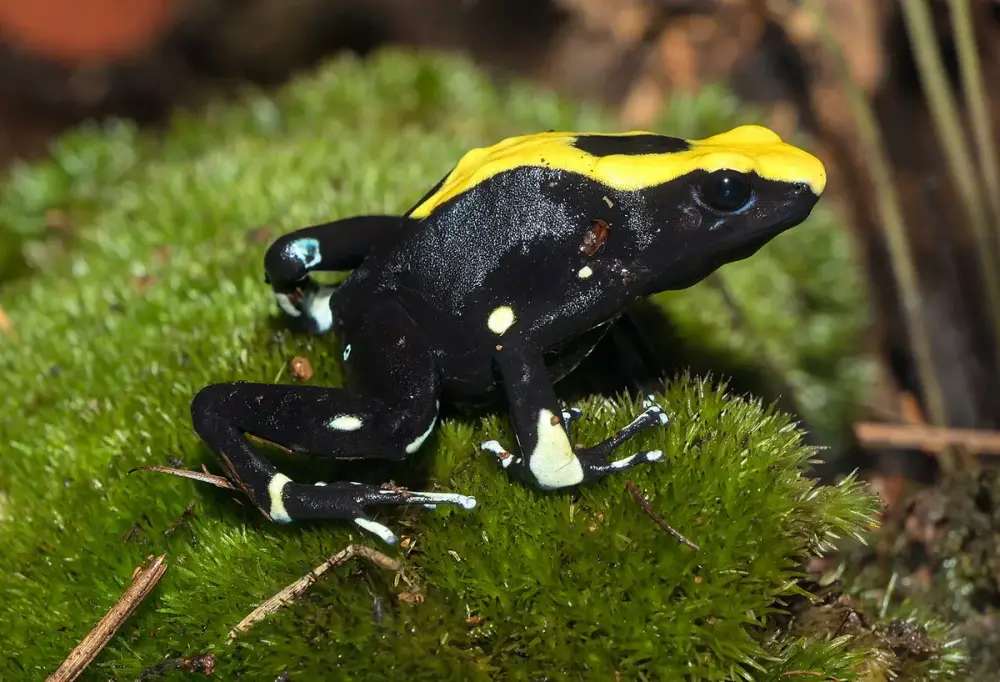
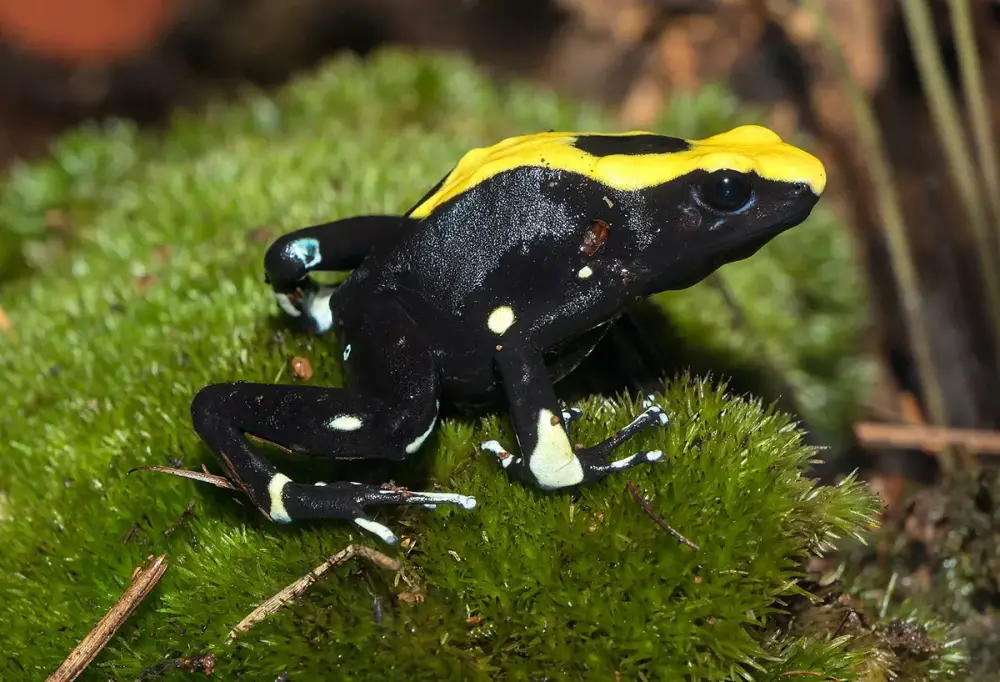
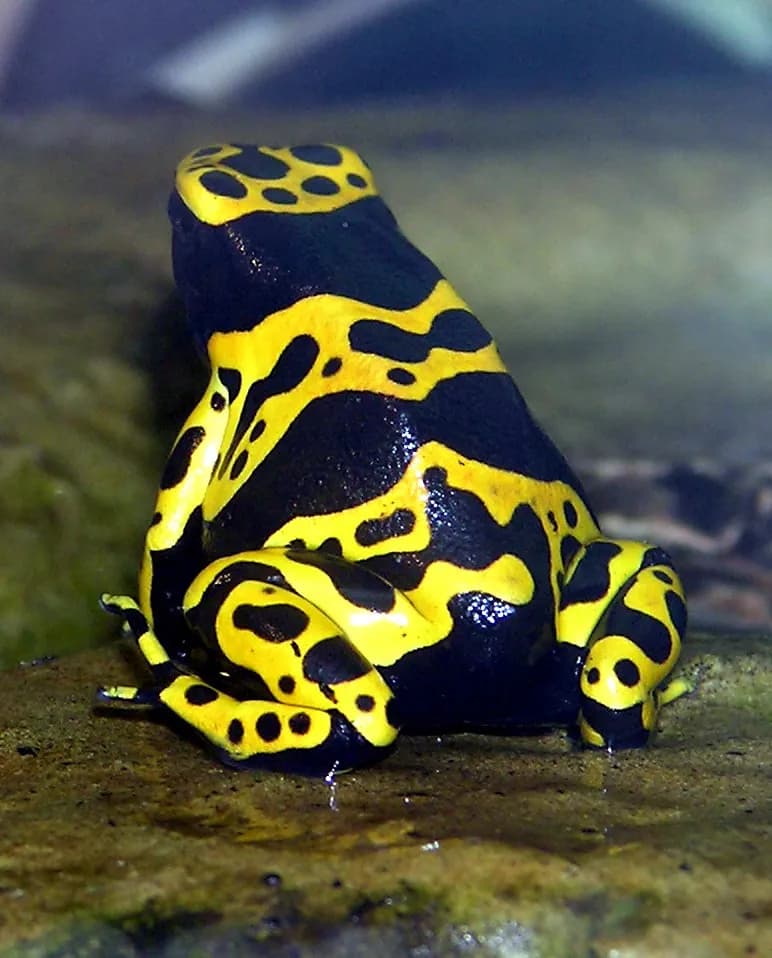
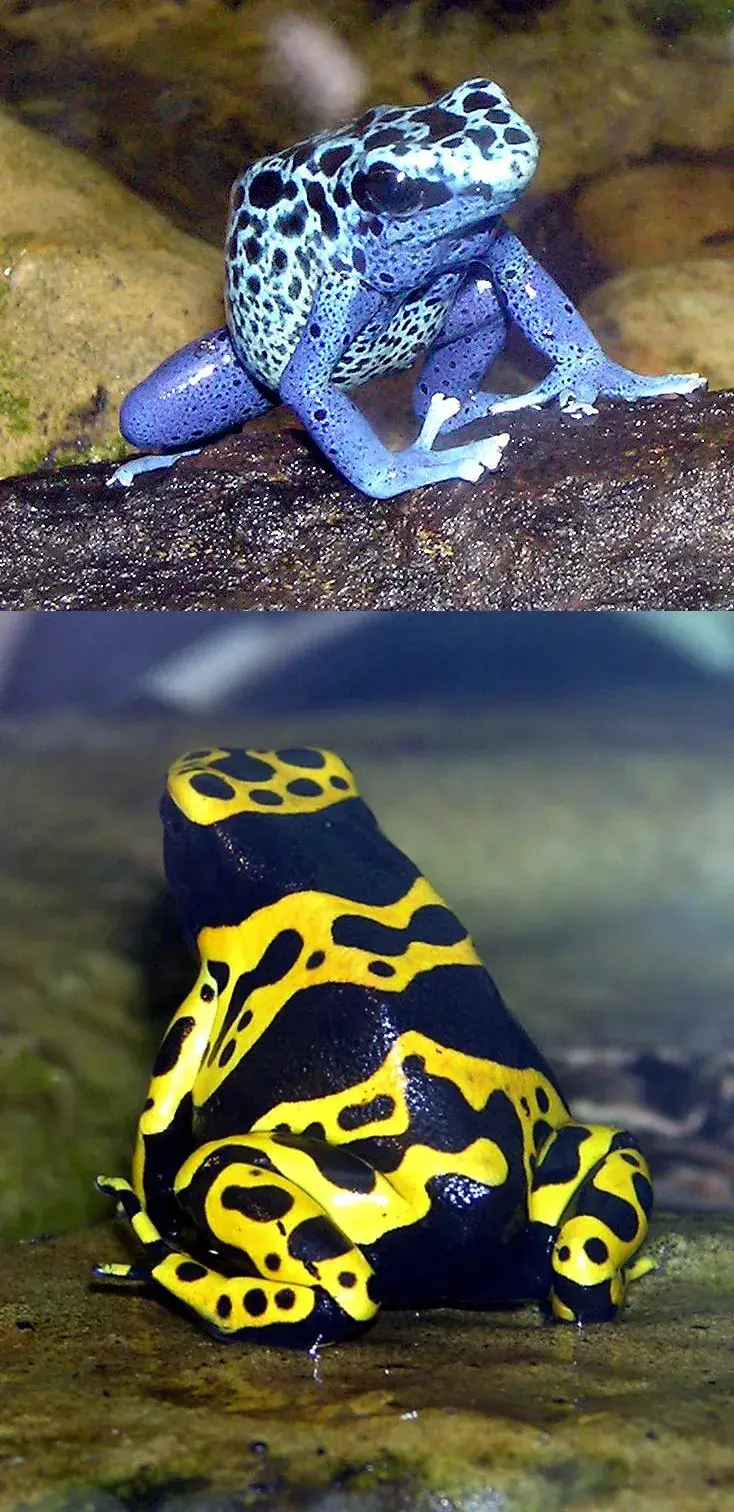
The green-and-black poison dart frog is a small, brightly colored amphibian native to southern Central America and Colombia. It is among the most variably colored of all poison dart frogs, ranking behind only a small handful of other species in the diversity of its patterning. Despite the common name, some individuals show no green or no black at all — the Campana variant, for instance, is brown and cream-white with neither color. Most commonly, though, the frog displays a spotted or banded pattern in vivid mint-green, which can also appear as forest-green, lime, emerald, turquoise, blue, whitish, or pale yellow, mixed with splotches of blackish, brown, or bronzy coloring. The proportion of dark to light coloring varies enormously between individuals and populations, from frogs that are almost entirely black with a few green flecks to those dominated by bright green.
Males measure about 0.75 in (1.9 cm) from snout to vent, while females run slightly larger, at 1 in (2.5 cm) or more. The species was introduced to Oahu, Hawaii, in 1932 in an effort to control mosquito populations, and it later became established on Maui as well.
Like other members of the dendrobatid family, the green-and-black poison dart frog is semi-arboreal, spending much of its life in trees, where it hunts, courts, and sleeps. It relies heavily on the small pools of water that collect in the cupped leaves of bromeliad plants, using them both as a place to rest and as nurseries for its tadpoles.
Behavior and diet
Diet
Ants and mites, along with other small arthropods
The species is not innately poisonous. Instead, like all dendrobatid frogs, it sequesters alkaloid poisons from its diet of arthropods, primarily ants and mites. Hundreds of unique alkaloids have been identified in these frogs, including indolizidines, decahydroquinolines, pumiliotoxins, histrionicotoxins, and coccinellines. These compounds interfere with voltage-gated ion channels and nicotinic acetylcholine receptors, which can lead to numbness, loss of motor control, convulsions, and in cases of extreme intoxication, cardiac arrest. Because the toxicity depends entirely on wild diet, frogs raised in captivity or zoo settings — typically fed crickets and fruit flies — are completely non-toxic.
Because the frog is small and cannot leap easily from branch to branch in the canopy, it returns to the ground to travel, sometimes covering several miles in search of breeding sites, feeding grounds, or places to tend tadpoles. Small, sucker-like discs on its toes create a slight adhesive grip that helps it climb.
Breeding begins with large groups gathering together, where males squabble over small territories before using bird-like calls to attract females; captive females are known to fight amongst themselves in the presence of calling males. Once a female selects a male, he leads her to his chosen egg-laying site, where she lays her eggs and he fertilizes them. The eggs hatch into tadpoles after about 14 days. The parents — typically the male — then carry the tadpoles on their backs, using mucus to keep them attached, and deposit them into the small pools inside bromeliads. Because these pools offer little in the way of nutrients, the tadpoles inside them often turn to cannibalism, feeding on algae, small invertebrates, and each other while a parent guards them.
Range and habitat
Habitat
Humid lowland and submontane forests from sea level to 1,000 m (0–3,280 ft)
The green-and-black poison dart frog occurs in humid lowland and submontane forests at elevations from sea level to 1,000 m, across southeastern Nicaragua's Atlantic slope, eastern Costa Rica's Atlantic slope, southwestern Costa Rica's Pacific slope, widely through Panama, and into far northwestern Colombia's Chocó Department.
An introduced population exists on Oahu, Hawaii, where the species was deliberately released in 1932 to help control mosquitoes; it has since also become established on Maui.
Conservation status
The green-and-black poison dart frog is rated Least Concern (LC) by the IUCN. Specific threats or conservation programs for the species beyond that classification are not detailed here.
Where to see green-and-black poison dart frog in the U.S.
15 zoos across 12 states
Find the closest one
Rank the 15 zoos holding green-and-black poison dart frog by how far they are from you. Your location is used in your browser to sort this list and is never sent to us.
Colorado· 2
Florida· 2
Hawaii· 1
Illinois· 1
Indiana· 1
Michigan· 1
Minnesota· 1
New York· 2
Ohio· 1
Pennsylvania· 1
Virginia· 1
Wisconsin· 1
AZAThe Association of Zoos and Aquariums. Accredited members have passed an independent inspection of animal care and welfare, safety, conservation and education, repeated every five years. Many smaller facilities never apply, so “not accredited” isn't a verdict on its own. What accreditation means · How we check this
Built from each zoo's own published animal list.
Green-and-Black Poison Dart Frog: common questions
Is the green-and-black poison dart frog endangered?
No. It is rated Least Concern (LC) by the IUCN.
How big does a green-and-black poison dart frog get?
Males average about 0.75 in (1.9 cm) in snout–vent length, while females are slightly larger at around 1 in (2.5 cm) or more.
What does a green-and-black poison dart frog eat?
In the wild it eats ants and mites, along with other small arthropods; the alkaloids in this diet are what give it its toxicity. Zoo frogs are fed crickets and fruit flies and are non-toxic.
Where do green-and-black poison dart frogs live in the wild?
They live in humid lowland forests of Nicaragua, Costa Rica, Panama, and northwestern Colombia, plus an introduced population on Oahu and Maui, Hawaii.
Which U.S. zoos have green-and-black poison dart frogs?
Five zoos in our directory keep the species, including the Cheyenne Mountain Zoo, the Cincinnati Zoo and Botanical Garden, and the Elmwood Park Zoo.