- Where to see one
- 25 U.S. zoos in our directory hold axolotl, confirmed against each zoo's own animal list.
- Native range
- Lakes Xochimilco and Chalco in the Valley of Mexico
- Size
- Sexually mature adults range 15 to 45 cm (6 to 18 in), most commonly close to 23 cm (9 in)
- Lifespan
- 10 to 15 years in the wild
Conservation status
IUCN Red List category CR — step 5 of 7.
About the axolotl
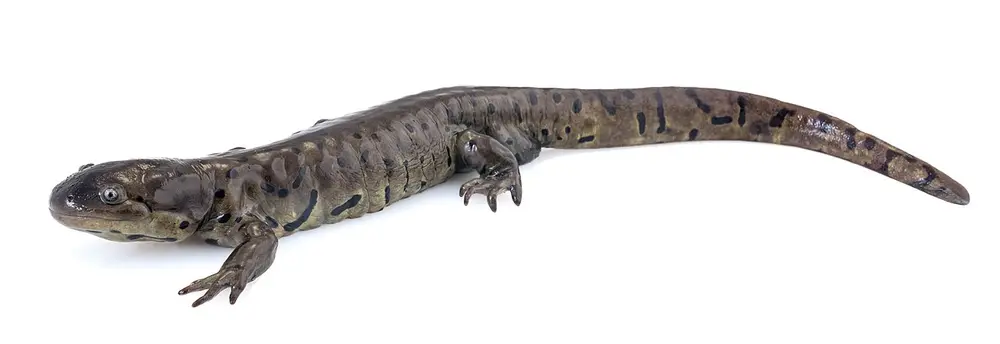
The axolotl is a species of mole salamander native to a system of interconnected wetlands and lakes in the highlands of Mexico. Its name comes from the Nahuatl āxōlōtl, a word connected to Xolotl, the Aztec god associated with fire, lightning, death, and twins. What sets the axolotl apart from most amphibians is neoteny: it reaches sexual maturity without undergoing metamorphosis, so adults remain fully aquatic and keep their external gills for life, rather than losing them and moving onto land the way most salamanders do. This makes axolotls easy to confuse with the larval stage of other neotenic mole salamanders, particularly the tiger salamander, or with unrelated aquatic species like mudpuppies.
A sexually mature adult, reached at 18 to 27 months of age, ranges from 15 to 45 cm (6 to 18 in) in length, with about 23 cm (9 in) most common and anything over 30 cm (12 in) considered rare. Axolotls have wide, lidless-eyed heads, underdeveloped limbs with long thin digits, and three pairs of feathery external gill stalks behind the head used to move oxygenated water; four gill slits behind the external gills are lined with rakers that filter out food particles. They feed mainly by suction, closing their gill slits with interlocking rakers as they gulp in prey, and their teeth remain barely visible vestiges rather than developing fully as they would after metamorphosis. Males are identified by swollen, papillae-lined cloacae, and gravid females by noticeably wider bodies.
The wild-type color is brown or tan with gold speckling and an olive undertone, which the animal can subtly shift by adjusting its pigment cells, likely for camouflage. Four pigmentation genes produce common mutant colors when altered: leucistic (pale pink body, black eyes), xanthic (grey body, black eyes), albinistic (pale pink or white body, red eyes), and melanistic (black or dark blue body with no gold speckling). The axolotl's genome, sequenced in 2018, was the largest animal genome completed at the time — about ten times the size of the human genome, though it encodes a similar number of proteins, with the size difference coming mostly from large stretches of repetitive sequence.
Behavior and diet
Diet
Carnivorous; mollusks, worms, aquatic insects, crayfish, small fish, and other salamanders
The trait most associated with the axolotl is its regenerative ability: rather than healing by scarring, it can regrow entire lost limbs and its tail over a period of months, and in some cases regenerate tissue of the eye, heart, and even non-vital parts of the brain. It can also accept and fully integrate transplanted organs from other individuals, including eyes and brain tissue. Regeneration requires three things: formation of a wound epithelium that seals the injury, nerve signaling, and the presence of cells from the limb's different structural axes; a growth structure called the apical ectodermal cap sends the hormonal signals that activate the blastema cells responsible for rebuilding the limb. This ability declines with age but never fully disappears, and is greatly reduced if the animal has undergone metamorphosis.
Axolotls remain neotenic because they lack the thyroid-stimulating hormone that would trigger the thyroid to produce the thyroxine needed for metamorphosis, so wild and pet axolotls alike keep their gills and stay aquatic for life. The trait can be reversed under laboratory conditions by administering thyroid hormones such as thyroxine or triiodo-L-thyronine, after which the animal develops eyelids, resorbs its gills and fins, gains muscle tone in its limbs, and becomes less water-permeable — changes that let it live on land, resembling the related plateau tiger salamander, though with longer toes.
In the wild, the axolotl is carnivorous, eating mollusks, worms, aquatic insects, other arthropods such as crayfish, small fish, and even other salamanders, including its own species. It locates food by smell and "snaps" at potential prey, sucking it in with vacuum force. Wild axolotls reach sexual maturity at around 1.5 years old, with a generation length of about 5.5 years, and live 10 to 15 years.
Range and habitat
Habitat
Freshwater lakes and interconnected wetland canals
Axolotls are native only to Mexico's Central Valley, historically inhabiting the smaller lakes of Xochimilco and Chalco and presumed to have once lived in the larger lakes of Texcoco and Zumpango as well. The desiccation of these lakes, begun by the Aztecs and accelerated through the 20th century, destroyed much of the species' habitat, with the area now largely occupied by Mexico City. The wild axolotl favors a system of water channels and deep-water lakes with abundant aquatic vegetation, in water that rarely rises above 20°C (68°F) and can fall to 6–7°C (43–45°F) or lower in winter. The species' natural habitat is now essentially limited to Lake Xochimilco, itself reduced mostly to a network of canals, though a population has also been confirmed in the artificial lake at Chapultepec.
Conservation status
The axolotl is Critically Endangered (CR), with a wild population estimated at only 50 to 1,000 adult individuals. It is listed under CITES Appendix II. The introduction of invasive fish species, tilapia and carp, has been named as a major driver of the decline. Population surveys in Lake Xochimilco found roughly 6,000 axolotls per square kilometer in 1998, dropping to 1,000 in 2003 and 100 in 2008; a four-month search in 2013 turned up no wild individuals at all, though two were spotted a month later in the canal network. Poor water quality — low nitrogen-to-phosphorus ratios, high chlorophyll levels, and pesticide runoff from agriculture — has been linked to higher mortality and more developmental abnormalities among axolotl embryos and larvae, and the shrinking population has caused a significant loss of genetic diversity. A large captive population exists worldwide, used extensively in scientific research and increasingly kept in zoos, aquariums, and home aquariums.
Where to see axolotl in the U.S.
25 zoos across 16 states
Find the closest one
Rank the 23 zoos holding axolotl by how far they are from you. Your location is used in your browser to sort this list and is never sent to us.
2 more zoos hold axolotl but have no coordinates on file yet, so they aren't ranked here. They're in the full list below.
California· 4
Colorado· 1
Connecticut· 1
Illinois· 4
Indiana· 1
Iowa· 1
Michigan· 1
Minnesota· 1
Missouri· 1
New Jersey· 1
New York· 2
Ohio· 1
Pennsylvania· 2
Tennessee· 2
Texas· 1
Virginia· 1
AZAThe Association of Zoos and Aquariums. Accredited members have passed an independent inspection of animal care and welfare, safety, conservation and education, repeated every five years. Many smaller facilities never apply, so “not accredited” isn't a verdict on its own. What accreditation means · How we check this
Built from each zoo's own published animal list.
Axolotl: common questions
Is the axolotl endangered?
Yes. It is Critically Endangered, with a wild population estimated at only 50 to 1,000 adults left in its native lakes.
How big does an axolotl get?
Sexually mature adults range from 15 to 45 cm (6 to 18 in) long, with about 23 cm (9 in) being most typical.
What does an axolotl eat?
It is carnivorous, eating mollusks, worms, aquatic insects, crayfish, small fish, and even other salamanders.
How long do axolotls live?
Wild axolotls live 10 to 15 years.
Where do axolotls live in the wild?
Only in Lake Xochimilco and, historically, Lake Chalco, in the Valley of Mexico.
Which U.S. zoos have axolotls?
Thirteen zoos in our directory, including the San Diego Zoo, the Detroit Zoo, and the Nashville Zoo at Grassmere.