- Where to see one
- 29 U.S. zoos in our directory hold spotted turtle, confirmed against each zoo's own animal list.
- Native range
- Southern Canada (Ontario, with sightings in Quebec) and the eastern United States, from Maine to Florida and west to central Indiana and Ohio
- Size
- Carapace 3.5–12.5 cm (1.4–4.9 in) overall, reaching 8–12 cm (3.1–4.7 in) at adulthood
Conservation status
Endangeredassessed 2011
IUCN Red List category EN — step 4 of 7.
Endangered (EN), assessed in 2011
About the spotted turtle
The spotted turtle is the only species in the genus Clemmys, a small, semi-aquatic turtle first described in 1792 and given its current name in 1828. It wasn't always alone in its genus — the bog turtle, wood turtle, and western pond turtle were all once classified as Clemmys species too, until genetic analysis showed the spotted turtle was distinct enough to stand on its own. The other three were reassigned, the bog and wood turtles to the genus Glyptemys and the western pond turtle to Actinemys.
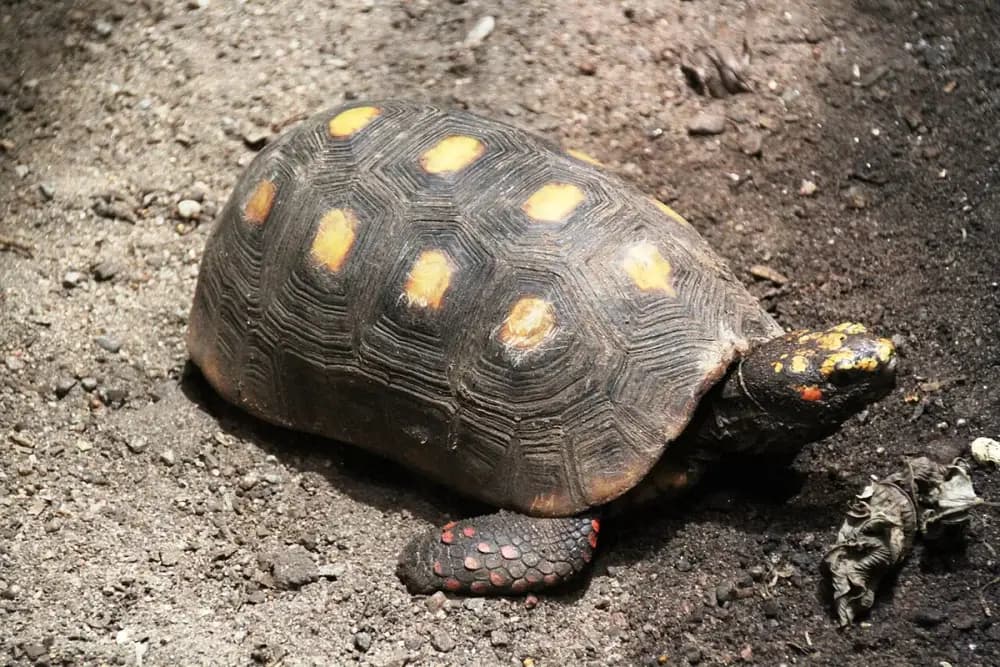
Its upper shell, or carapace, is smooth, broad, and low, without the raised ridge (a "keel") some turtles have, and its base color ranges from black to bluish black, scattered with anywhere from zero to about one hundred small yellow spots. Spots appear on the head, neck, and limbs as well as the shell, and interestingly, the left side of the carapace tends to carry more spots than the right. The lower shell, or plastron, is yellow or orange-yellow with a black spot on each section, though this tends toward solid black as the animal ages. The head is black with a notched upper jaw and a large orange blotch on each side.
Males and females look different once they reach sexual maturity. Males have a tan chin, brown eyes, a concave plastron, and a long, thick tail; females have a yellow chin, orange eyes, a flat or convex plastron, and a shorter, thinner tail. Females also average slightly larger than males and tend to carry more spots. Hatchlings look much like small adults, though with only one spot per shell segment.
Behavior and diet
Diet
Omnivorous — aquatic plants, algae, insect larvae, worms, slugs, crustaceans, tadpoles, salamanders, and small fish
Spotted turtles are creatures of temperature. They go inactive during the depths of winter and the height of summer, but are tolerant of drought and become active very early in spring, often while the water is still cold — activity peaks in April and May in the northern part of the range. When summer water temperatures climb above 30 °C (86 °F), the turtles aestivate, burrowing into leaf litter, marsh edges, open fields, or muskrat burrows for long stretches. Researchers have debated why: the traditional idea is that they're avoiding heat, but data from Ontario and elsewhere suggests avoiding predators and conserving energy may matter just as much. Home ranges are small, typically 0.5 to 3.5 hectares (1.2 to 8.6 acres), and the turtles are vulnerable during their frequent trips onto land — raccoons in particular are effective predators, and many individuals carry scars from past close calls. Muskrats take a toll during winter dormancy as well.
The species feeds only in the water, at temperatures above 14.2 °C (57.6 °F) — roughly mid-March through September in its range — hunting by pushing its head into aquatic plants to root out prey. Its diet mixes plant material (aquatic vegetation, green algae, and, in at least one recorded instance, wild cranberries) with animal food: insect larvae, worms, slugs, millipedes, spiders, crustaceans, tadpoles, salamanders, and small fish, eaten alive or dead. A Pennsylvania study found that sexual maturity doesn't arrive until age 8. Courtship runs from March to June and starts with one or more males chasing a female for 15 to 30 minutes, biting at her tail and legs; when two males pursue the same female, they sometimes break off to fight each other before the loser retreats. Clutches range from one to eight eggs, averaging three to four, laid in well-drained, sunlit soil and buried using the hind feet. Incubation takes 70 to 83 days, and the temperature during that period determines the hatchling's sex — cooler nests produce males, warmer ones produce females.
Range and habitat
Habitat
Shallow, freshwater wetlands — swamps, bogs, fens, marshes, wet meadows, woodland streams, and vernal pools
The spotted turtle's range runs from southern Maine, Quebec, and Ontario south through the eastern United States to Florida, and west to central Indiana and Ohio, with additional disjunct populations in central Illinois, central Georgia, North Carolina, and South Carolina. In Indiana and Illinois it's confined to the northern part of each state, while in Michigan it turns up across most of the Lower Peninsula; in Ohio it's restricted to the northern two-thirds of the state, in a highly fragmented distribution.
It occupies a range of shallow, soft-bottomed freshwater habitats — swamps, bogs, fens, marshes, woodland streams, wet pastures, tide-influenced brackish streams, ditches, vernal pools, and sedge meadows — generally avoiding artificial reservoirs and deep, open water. An ideal habitat combines shallow, slow-moving water with muddy soil, sedge tussocks, water lilies, sphagnum moss, and cattails; the species' yellow spots may help camouflage it among duckweed, which it's often found near. Despite being aquatic, the spotted turtle spends real time on land, basking on grass and, in the case of nesting females, traveling onto land to lay eggs, sometimes near man-made dikes or muskrat nests.
Conservation status
The spotted turtle is listed as Endangered on the IUCN Red List, in an assessment published in 2011. It is federally endangered in Canada, is under review in the United States for protection under the Endangered Species Act, and has protected or special-concern status in many of the states where it occurs.
Habitat destruction and conversion, collection for the pet trade, and road and mower deaths are driving declines. Road deaths hit especially hard because the turtles crossing roads are often pregnant females looking for nest sites, and the species' low reproductive rate makes losses hard to replace. Because they live in water, spotted turtles also disappear quickly where water quality declines.
Population data from Canada paints a cautious picture. In Ontario, 104 spotted turtle sites have been documented, concentrated around Georgian Bay, the north shore of Lake Erie, and southeastern Ontario, but 36 of those sites no longer have turtles. Canada's overall population is estimated at only 1,000 to 2,000 individuals, and most known populations are small, isolated, and under 200 individuals each. Because the species relies on temperature-dependent sex determination, some researchers have also raised concern that rising temperatures could skew future sex ratios.
Where to see spotted turtle in the U.S.
29 zoos across 17 states
Find the closest one
Rank the 29 zoos holding spotted turtle by how far they are from you. Your location is used in your browser to sort this list and is never sent to us.
California· 1
Connecticut· 1
District of Columbia· 1
Florida· 3
Georgia· 1
Illinois· 3
Indiana· 1
Kansas· 1
Kentucky· 1
Maryland· 2
Massachusetts· 2
Michigan· 3
New Jersey· 1
New York· 3
Oklahoma· 1
Pennsylvania· 2
Virginia· 2
AZAThe Association of Zoos and Aquariums. Accredited members have passed an independent inspection of animal care and welfare, safety, conservation and education, repeated every five years. Many smaller facilities never apply, so “not accredited” isn't a verdict on its own. What accreditation means · How we check this
Built from each zoo's own published animal list.
Spotted Turtle: common questions
Is the spotted turtle endangered?
Yes. It is listed as Endangered on the IUCN Red List (2011), and Canadian population data shows small, fragmented, and declining populations, with an estimated 1,000 to 2,000 individuals left in that country.
How big does a spotted turtle get?
Its carapace ranges from about 3.5 to 12.5 cm (1.4–4.9 in) overall, typically reaching 8 to 12 cm (3.1–4.7 in) at adulthood.
What does a spotted turtle eat?
It's omnivorous, eating aquatic plants and algae alongside insect larvae, worms, slugs, crustaceans, tadpoles, salamanders, and small fish — always in the water.
Where do spotted turtles live in the wild?
Southern Canada (mainly Ontario) and the eastern United States, from Maine to Florida and west to central Indiana and Ohio, in shallow freshwater wetlands like bogs, marshes, and woodland streams.
How is a spotted turtle's sex determined?
By incubation temperature rather than genetics — cooler nest temperatures produce males and warmer temperatures produce females.
Which U.S. zoos have spotted turtles?
Eighteen U.S. zoos currently list one, including the Maryland Zoo in Baltimore, the Virginia Living Museum, and Lincoln Park Zoo.