- Where to see one
- 24 U.S. zoos in our directory hold leopard tortoise, confirmed against each zoo's own animal list.
- Native range
- Eastern and southern Africa, from Sudan to the southern Cape Province
- Size
- Typical adults about 16 in (40 cm) and 29 lb (13 kg); larger toward the northern and southern ends of the range, up to 44 lb (20 kg); exceptional individuals reach 28 in (70 cm) and 88 lb (40 kg)
- Lifespan
- Sexual maturity at 12–15 years; may live 80 to 100 years
About the leopard tortoise
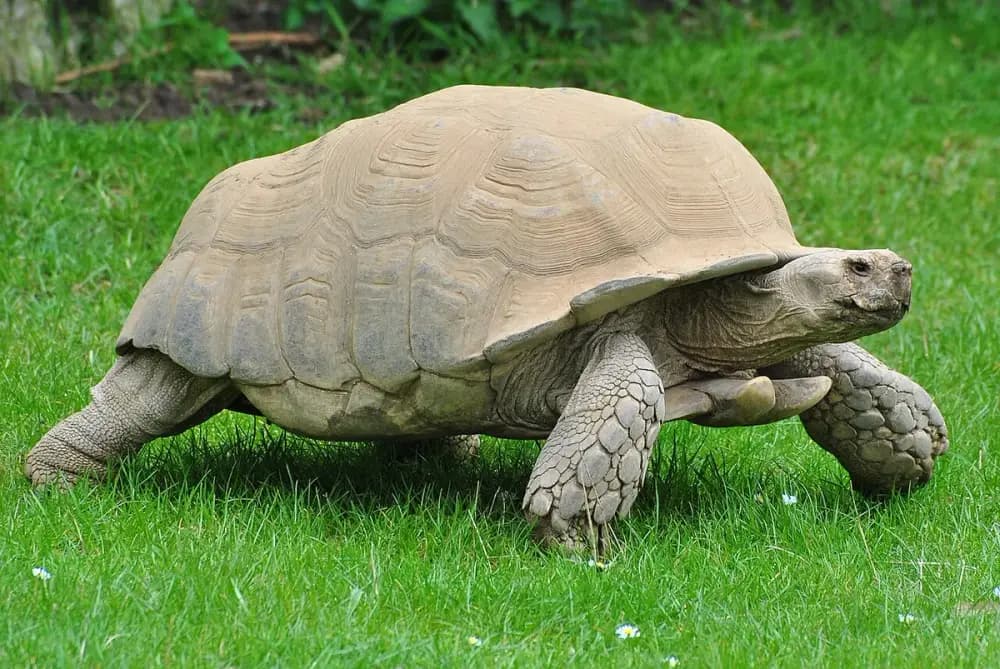
The leopard tortoise is a large, boldly marked tortoise of the African savanna, found from Sudan south to the Cape Province at the continent's southern tip. It's the fourth-largest tortoise species in the world and the only living member of the genus Stigmochelys, a name built from Greek words for "mark" and "tortoise." The species name pardalis comes from the Latin for "leopard," a reference to the spotted pattern across its shell. That taxonomy took a while to settle: over the decades, scientists have placed the species in four different genera — Geochelone, Stigmochelys, Centrochelys, and Psammobates — before the current classification took hold. Researchers once also recognized two subspecies, but more recent work found the differences between them don't hold up.
The carapace, or upper shell, is high, domed, and nearly vertical along its sides. Juveniles and young adults wear a striking pattern of black blotches, spots, dashes, and stripes over a yellow background, which is where the "leopard" name comes from; as tortoises mature, those markings tend to fade into a plainer brown or gray. The head and limbs stay a fairly uniform yellow, tan, or brown throughout the tortoise's life.
Leopard tortoises are grazers by nature, favoring open, semiarid, thorny-to-grassland habitat, and in extreme heat or cold they will shelter in burrows abandoned by foxes, jackals, or aardvarks rather than digging their own — the only digging a leopard tortoise does on its own is to make a nest for eggs.
Behavior and diet
Diet
Herbivorous — grasses, forbs, thistles, succulents, and fruit
As grazers, leopard tortoises eat a wide range of plants: forbs, thistles, grasses, and succulents, along with berries and other fruit when they're available. They will also gnaw on bones, ash, or even hyena feces to get calcium, which their bodies need for both bone growth and eggshell formation. Because tortoise digestion doesn't break down every seed a tortoise swallows, the species plays a real role in dispersing seeds across the landscape as it moves and defecates. Leopard tortoises are normally active by day but slow down during hot weather or the dry season.
The species doesn't reach sexual maturity until 12 to 15 years of age, and individuals may live 80 to 100 years. During the breeding season, males compete for females by ramming and butting rivals, then trail females — sometimes over long distances — often ramming a female into submission before mating; males grunt while mating. Nesting runs from May to October, when a female digs a hole and lays a clutch of five to 30 eggs, and a single female may lay five to seven clutches in one season. Incubation is slow, taking eight to 15 months depending on temperature. Eggs and hatchlings face a long list of predators, including rock monitors, puff adders, jackals, and crows, while adult leopard tortoises have few natural predators — though lions and hyenas have occasionally been recorded killing one.
Range and habitat
Habitat
Savanna, grassland, thorn-scrub, and mesic brushland, from sea level to 9,500 ft (2,900 m)
Leopard tortoises range widely across the arid and savanna regions of eastern and southern Africa, from South Sudan and Somalia through East Africa down to South Africa and Namibia, though the species is largely absent from the humid forest belt of Central Africa. Within that range it occupies the broadest variety of habitats of any African tortoise — grassland, thorn-scrub, mesic brushland, and savanna — and turns up at elevations anywhere from sea level up to 9,500 ft (2,900 m).
Conservation status
The leopard tortoise is listed as Least Concern and remains common across most of its range. Agricultural burning, hunting for consumption, and commercial collection for the pet trade are all recognized pressures, but none has yet driven a significant population decline. Captive breeding has increasingly replaced wild collection to supply the pet trade — most tortoises exported from Kenya and Tanzania today are captive-bred rather than wild-caught. The species has been listed under Appendix II of CITES since 1975, and in 2000 the United States banned leopard tortoise imports outright, a measure aimed at keeping out heartwater, an infectious disease carried by tortoise ticks that could threaten the U.S. livestock industry.
Where to see leopard tortoise in the U.S.
24 zoos across 17 states
Find the closest one
Rank the 22 zoos holding leopard tortoise by how far they are from you. Your location is used in your browser to sort this list and is never sent to us.
2 more zoos hold leopard tortoise but have no coordinates on file yet, so they aren't ranked here. They're in the full list below.
California· 1
Delaware· 1
Florida· 4
Georgia· 1
Idaho· 1
Illinois· 2
Kansas· 1
Kentucky· 1
Maryland· 1
Michigan· 1
Mississippi· 1
New York· 2
Oregon· 1
Pennsylvania· 1
Texas· 3
Virginia· 1
Wisconsin· 1
AZAThe Association of Zoos and Aquariums. Accredited members have passed an independent inspection of animal care and welfare, safety, conservation and education, repeated every five years. Many smaller facilities never apply, so “not accredited” isn't a verdict on its own. What accreditation means · How we check this
Built from each zoo's own published animal list.
Leopard Tortoise: common questions
Is the leopard tortoise endangered?
No. It's classified as Least Concern and remains common across most of its range, though it does face pressure from burning, hunting, and the pet trade.
How big does a leopard tortoise get?
Typical adults reach about 16 inches (40 cm) and 29 pounds (13 kg), with larger individuals toward the edges of the range weighing up to 44 pounds (20 kg); exceptional tortoises can reach 28 inches (70 cm) and 88 pounds (40 kg).
What does a leopard tortoise eat?
It's a herbivore, grazing on grasses, forbs, thistles, and succulents, and eating fruit when it's available. It will also gnaw bones or ash to get calcium.
How long do leopard tortoises live?
They reach sexual maturity between 12 and 15 years old and may live 80 to 100 years.
Where do leopard tortoises live in the wild?
They range across the savannas and arid grasslands of eastern and southern Africa, from Sudan and Somalia down to South Africa and Namibia.
Which U.S. zoos have leopard tortoises?
Six zoos in our directory list the leopard tortoise, including Brevard Zoo and the Central Florida Zoo and Botanical Gardens in Florida, and the Oregon Zoo.