Desert Tortoise
Gopherus agassizii
Also known as California Desert Tortoise
- Where to see one
- 23 U.S. zoos in our directory hold desert tortoise, confirmed against each zoo's own animal list.
- Native range
- Mojave and Sonoran Deserts of the southwestern United States and northwestern Mexico
- Size
- 10 to 14 inches (25 to 36 cm) in shell length; 8 to 15 pounds (3.5 to 7 kg)
- Lifespan
- 70 to 80 years on average
Conservation status
IUCN Red List category CR — step 5 of 7.
About the desert tortoise
The desert tortoise is native to the Mojave and Sonoran Deserts of the southwestern United States and northwestern Mexico, with a distribution that runs through western Arizona, southeastern California, southern Nevada, and southwestern Utah. It's the official state reptile of both California and Nevada. Its scientific name honors the Swiss-American zoologist Jean Louis Rodolphe Agassiz.
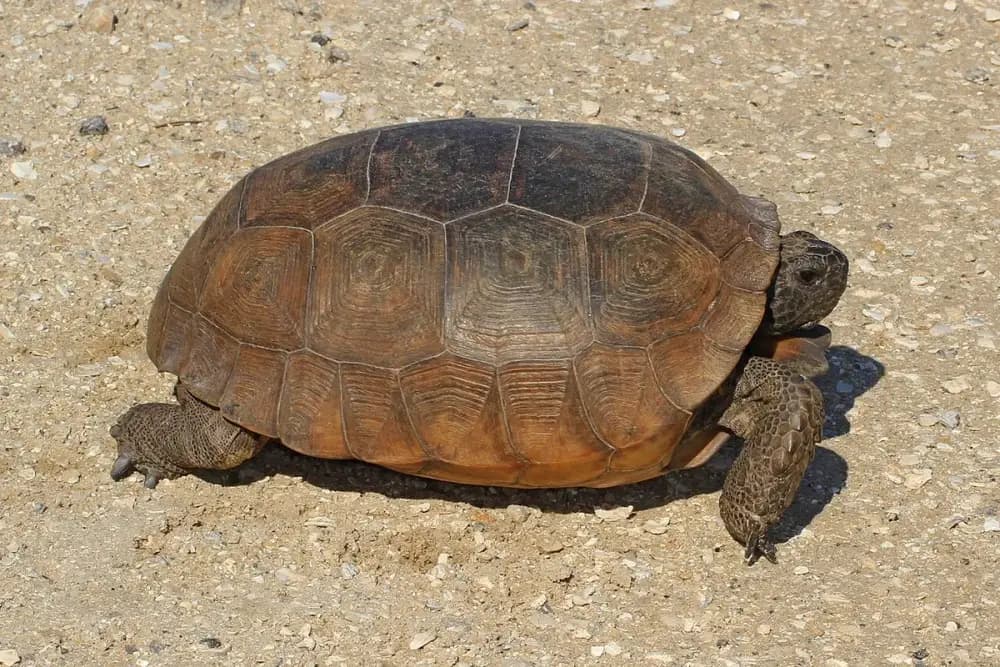
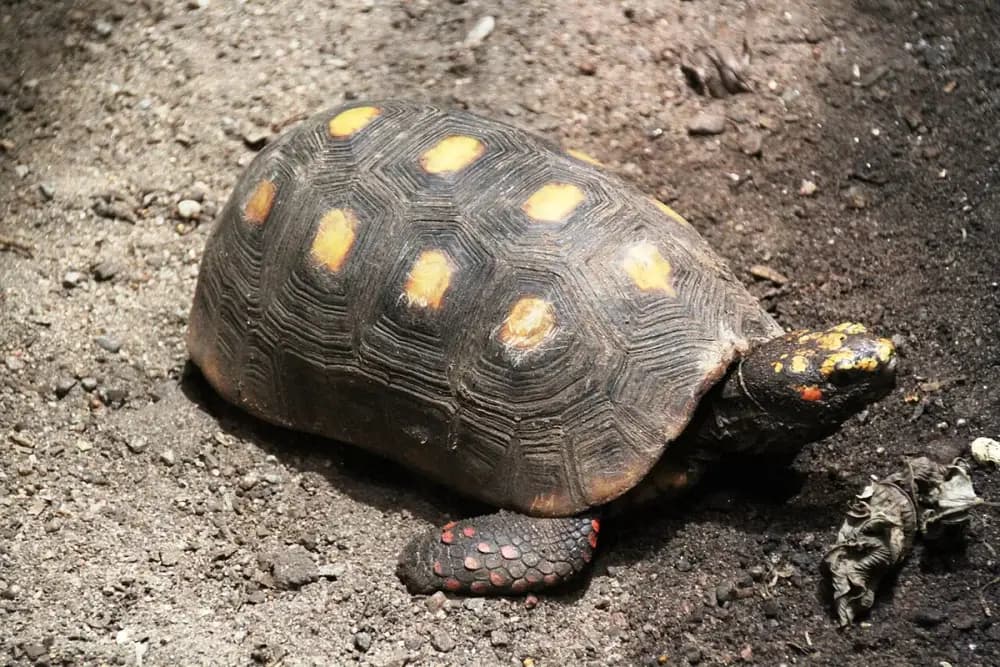
Adults reach 10 to 14 inches (25 to 36 cm) in shell length, with males slightly larger than females, and weigh 8 to 15 pounds (3.5 to 7 kg). Their shells are high-domed and range from greenish-tan to dark brown, and that dome shape isn't just cosmetic — it leaves room for the tortoise's lungs, which helps with thermoregulation. Males can be distinguished from females by a longer gular horn (a projection at the front of the shell), a concave plastron, and a larger tail. The front limbs carry sharp, claw-like scales and are flattened into effective digging tools, while the back legs are longer and thinner.
Taxonomically, the desert tortoise used to cover a much larger range than it does today. In 2011, DNA, geographic, and behavioral evidence led researchers to split the species in two along the Colorado River: Agassiz's desert tortoise (Gopherus agassizii) to the west, and Morafka's desert tortoise (Gopherus morafkai) to the east, in Arizona, Sonora, and Sinaloa. That split cut the range of G. agassizii by about 70%. A further 2016 genetic study split off a third species, Goode's thornscrub tortoise (G. evgoodei), from the Sonoran and Sinaloan populations. What's generally meant by "desert tortoise" today, and the animal covered here, is specifically Agassiz's desert tortoise.
Behavior and diet
Diet
Herbivore — grasses, herbs, wildflowers, and new cactus growth, fruit, and flowers
Desert tortoises are built around avoiding extremes. At least 95% of their lives are spent underground in burrows, rock shelters, or shallow depressions called pallets, which let them regulate body temperature and cut down on water loss. Ground temperatures in their habitat can top 60°C (140°F), and their burrows offer an escape from that heat as well as protection from freezing during winter dormancy, which typically runs from November through February or March. A single tortoise may use 5 to 25 burrows in a year, sometimes reusing the same one for several consecutive years, and burrows are often shared with other wildlife — ground squirrels, woodrats, peccaries, burrowing owls, quail, rattlesnakes, Gila monsters, beetles, spiders, and scorpions have all been found sharing tortoise burrows, with sharing more common between the sexes than within them. One burrow has been recorded hosting up to 23 tortoises at once.
As herbivores, desert tortoises eat mostly grasses, along with herbs, annual wildflowers, and new cactus growth, fruit, and flowers. They also ingest rocks and soil, which may aid digestion or supply calcium and other minerals. Much of their water intake comes from moisture in the plants they eat during spring, but they're also equipped with a large urinary bladder that can hold water, urea, uric acid, and nitrogenous waste equal to over 40% of the tortoise's body weight — a reserve that helps them survive a year or more without drinking. During heavy rain, they'll drink directly from puddles and can increase their body weight by up to 40%. If threatened, a tortoise may empty its bladder as a defense mechanism, though this leaves it vulnerable to dehydration afterward.
Mating occurs in spring and autumn. Males develop chin glands that swell during breeding season, and courtship involves a male circling and biting at a female's shell before mounting her. Females lay four to eight hard-shelled eggs, typically in June or July, which hatch in August or September after an incubation period of 90 to 135 days; some eggs overwinter and hatch the following spring. Incubation temperature affects both hatch rate and the sex of hatchlings — temperatures below 31°C (88°F) produce all-male clutches. Growth is slow: it typically takes 16 years or more to reach about 20 cm (8 in) in length, and tortoises don't reach reproductive maturity until 15 to 20 years old, though some 10-year-old females have been found capable of reproducing.
Range and habitat
Habitat
Desert flats, rocky foothills, alluvial fans, washes, and canyons, with extensive time spent in burrows
Desert tortoises are found through western Arizona, southeastern California, southern Nevada, and southwestern Utah, plus an isolated population in the Black Mountains of northwestern Arizona. They occupy elevations from below sea level in Death Valley up to 1,600 m (5,300 ft) in Arizona, though they're most common between roughly 300 and 1,050 m (1,000 to 3,500 ft). Preferred terrain ranges from sandy flats to rocky foothills, with a particular affinity in the Mojave Desert for alluvial fans, washes, and canyons that offer suitable soil for digging burrows.
Soil matters a great deal to this species: it needs to crumble easily enough to dig but hold together well enough not to collapse. Desert tortoises favor sandy loam with some gravel and clay, and avoid soils that are too sandy, too salty, or prone to flooding. Population density varies enormously across the range, from under 8 per square kilometer in parts of southern California to over 500 per square kilometer in the western Mojave, though most areas fall under 150 per square kilometer. Individual home ranges typically span 4 to 40 hectares (10 to 100 acres), with males generally ranging farther than females, and tortoises show strong fidelity to a home range once established.
Conservation status
The desert tortoise is Critically Endangered (CR), a serious classification reflecting steep, sustained population losses. Some populations have declined by as much as 90% since the 1980s, and the Mojave population has been listed as threatened under the U.S. Endangered Species Act since 1990, after an earlier emergency listing in 1989. All desert tortoises are protected under U.S. law due to their resemblance to the protected Mojave population, and it is unlawful to touch, harm, harass, or collect wild individuals.
The threats driving this decline include urbanization, disease, habitat destruction and fragmentation, illegal collection and vandalism, and habitat conversion caused by invasive plants such as Sahara mustard, red brome, and filaree species. Natural predators — ravens, Gila monsters, kit foxes, badgers, roadrunners, coyotes, and fire ants — take a toll on eggs and juveniles in particular, and ravens are believed to cause significant juvenile mortality in some areas, especially near urbanized land. Adoption programs exist in several states, including Arizona and Utah, for people who want to take in a captive desert tortoise rather than acquiring one from the wild, which remains illegal.
Where to see desert tortoise in the U.S.
23 zoos across 11 states
Find the closest one
Rank the 23 zoos holding desert tortoise by how far they are from you. Your location is used in your browser to sort this list and is never sent to us.
California· 10
- California Living MuseumBakersfield$12
- CuriOdysseySan Mateo$24.95AZA
- Living Desert Zoo and GardensPalm Desertfrom $44.95AZA
- Los Angeles ZooLos Angeles$27AZA
- Oakland ZooOakland$17–$28AZA
- Sacramento ZooSacramento$17.25–$28AZA
- San Diego ZooSan Diego$73–$78AZA
- San Francisco ZooSan Francisco$32–$34AZA
- Turtle Bay Exploration ParkRedding$22
- Wildlife Learning CenterSylmar$16
Colorado· 1
Idaho· 1
Illinois· 1
Kansas· 1
Minnesota· 1
North Carolina· 1
Oregon· 2
Pennsylvania· 2
Utah· 1
Wisconsin· 2
AZAThe Association of Zoos and Aquariums. Accredited members have passed an independent inspection of animal care and welfare, safety, conservation and education, repeated every five years. Many smaller facilities never apply, so “not accredited” isn't a verdict on its own. What accreditation means · How we check this
Built from each zoo's own published animal list.
Desert Tortoise: common questions
Is the desert tortoise endangered?
Yes. It's classified as Critically Endangered, and the Mojave population is listed as threatened under the U.S. Endangered Species Act.
How big does a desert tortoise get?
Adults reach 10 to 14 inches (25 to 36 cm) in shell length and weigh 8 to 15 pounds (3.5 to 7 kg).
What does a desert tortoise eat?
It's an herbivore, feeding mainly on grasses along with herbs, wildflowers, and new cactus growth, fruit, and flowers.
How long do desert tortoises live?
On average, 70 to 80 years.
Where do desert tortoises live in the wild?
In the Mojave and Sonoran Deserts of the southwestern United States, across parts of Arizona, California, Nevada, and Utah.
Which U.S. zoos have desert tortoises?
Twelve zoos in our directory, including the San Diego Zoo, Los Angeles Zoo, and Oregon Zoo.