- Where to see one
- 15 U.S. zoos in our directory hold northern pintail, confirmed against each zoo's own animal list.
- Native range
- Northern Europe, the Palearctic, and North America, wintering as far south as the equator
- Size
- Males 23–30 in (59–76 cm) long, weighing 0.99–3.00 lb (450–1,360 g); females 20–25 in (51–64 cm) long, weighing 1.001–2.502 lb (454–1,135 g); wingspan 31–37 in (80–95 cm)
- Lifespan
- Maximum recorded age of 27 years and 5 months
Conservation status
IUCN Red List category LC — step 1 of 7.
Least Concern (LC) globally; endangered in Europe
About the northern pintail
The northern pintail, often called simply the pintail, is a duck with one of the widest geographic distributions of any waterfowl species, breeding across northern Europe, the Palearctic, and North America and wintering as far south as the equator. Unusually for a bird with such a large range, it has no recognized geographical subspecies, since the closely related Eaton's pintail — once considered part of the same species — is now classified separately. It was first described by Carl Linnaeus in 1758, and its scientific name, Anas acuta, combines the Latin words for "duck" and "sharpened," a reference to the male's pointed tail.
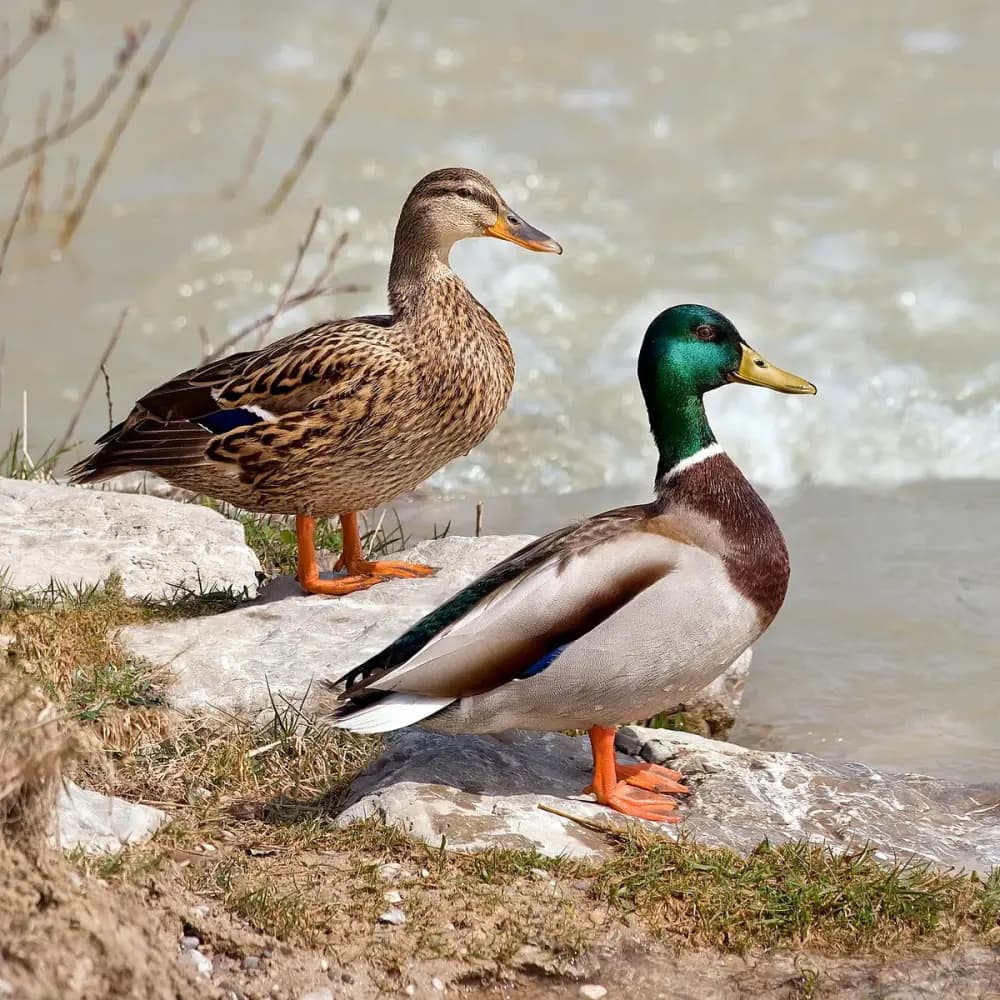
The species gets both its English and scientific names from that tail: in breeding males, the central tail feathers are elongated, reaching up to 3.9 in (10 cm). Males are the more striking sex, with a chocolate-brown head, a white breast, and a thin white stripe running up the side of the neck, set off by grey, brown, and black patterning on the back and sides and a yellow patch near the black underside of the tail. Females are more subdued, mottled in light brown with a greyish-brown head and a shorter pointed tail, but are still identifiable by their long neck and long grey bill. Males are considerably larger than females and, at 23 to 30 in (59–76 cm) long, broadly overlap in size with the mallard, though the pintail is more slender and elongated with a longer neck and tail. In flight, the species moves fast, with wings swept back rather than held straight out, and it swims with its neck held low, close to the water's surface.
Behavior and diet
Diet
Plant material such as seeds and rhizomes, with invertebrates added during the nesting season
The northern pintail feeds by dabbling and upending in shallow water, mostly in the evening or at night, spending much of the daylight hours resting. Its unusually long neck lets it reach food up to 12 in (30 cm) below the surface — deeper than other dabbling ducks such as the mallard can manage. In winter its diet is mostly plant material, including seeds and rhizomes of aquatic plants, along with some grain and other seeds taken from fields, though less often than related Anas ducks. During the breeding season it shifts toward invertebrates such as aquatic insects, mollusks, and crustaceans. Outside the breeding season the species is highly gregarious, forming large mixed flocks with other ducks.
Pairs typically form during migration or even while still on the wintering grounds, making the northern pintail one of the earliest duck species to breed each spring. Courtship involves the male swimming close to the female with his head down and tail raised, whistling; where several males compete for one female, they chase her in flight until a single drake remains. Breeding runs from April to June. The nest is a shallow, down-lined scrape hidden in vegetation on dry ground, often well away from water. The female lays seven to nine cream-colored eggs, roughly 2.2 by 1.5 in (55 by 38 mm), one per day, and can lay a replacement clutch as late as the end of July if predators destroy the first. She alone incubates the eggs for 22 to 24 days. The precocial chicks are led to water soon after hatching and feed on dead insects at the surface, fledging 46 to 47 days later; only about three-quarters survive to fledging, and no more than half of those live long enough to breed themselves.
Range and habitat
Habitat
Open wetlands, wet grasslands, lake shores, and tundra when breeding; estuaries, brackish marshes, and coastal lagoons in winter
The northern pintail breeds across northern parts of the Palearctic as far south as Poland and Mongolia, and in Canada, Alaska, and the midwestern United States, then winters mainly south of that range, reaching nearly to the equator in Panama, northern sub-Saharan Africa, and tropical South Asia; small numbers also winter on the Hawaiian Islands. In parts of its range, including Great Britain and the northwestern United States, the species can be present year-round. Ringing recoveries show it is capable of long transoceanic movement, with birds tracked between Labrador and England and Japanese-ringed birds recovered across the U.S. from Utah to Mississippi.
Breeding habitat consists of open, unwooded wetlands such as wet grasslands, lake shores, and tundra. In winter the pintail uses a broader range of open habitats, including sheltered estuaries, brackish marshes, and coastal lagoons, and forms large mixed flocks with other duck species outside the breeding season.
Conservation status
The IUCN classifies the northern pintail as Least Concern (LC) globally, given its very large range — an estimated 41,900,000 km² (16,200,000 sq mi) — and a population of roughly 4.8 to 4.9 million birds. The picture is less secure regionally: the species is considered endangered in Europe, and breeding populations have declined across much of the Palearctic, including Russia, where the species has its stronghold. In North America, the breeding population fell from more than 10 million birds in 1957 to 3.5 million by 1964; it has since recovered somewhat but remained about 30 percent below the long-term average as of 1999. Named threats include hunting, avian disease — an estimated 1.5 million waterbirds, mostly northern pintails, died from avian botulism in Canada and Utah in 1997 alone — lead poisoning from ingested shot and fishing sinkers, and the conversion of wetlands and grassland to cropland, which destroys nesting habitat and, because the species breeds so early, exposes many nests to destruction by spring farming activity.
Where to see northern pintail in the U.S.
15 zoos across 12 states
Find the closest one
Rank the 14 zoos holding northern pintail by how far they are from you. Your location is used in your browser to sort this list and is never sent to us.
1 more zoo holds northern pintail but has no coordinates on file yet, so it isn't ranked here. It's in the full list below.
California· 1
Connecticut· 2
District of Columbia· 1
Illinois· 2
Kansas· 1
Louisiana· 2
Maryland· 1
Massachusetts· 1
Missouri· 1
New York· 1
Oregon· 1
Wisconsin· 1
AZAThe Association of Zoos and Aquariums. Accredited members have passed an independent inspection of animal care and welfare, safety, conservation and education, repeated every five years. Many smaller facilities never apply, so “not accredited” isn't a verdict on its own. What accreditation means · How we check this
Built from each zoo's own published animal list.
Northern Pintail: common questions
Is the northern pintail endangered?
Globally it is listed as Least Concern, but it is considered endangered in Europe and has seen significant population declines in parts of its range.
How big does a northern pintail get?
Males run 23 to 30 in (59–76 cm) long and weigh 0.99 to 3.00 lb (450–1,360 g); females are smaller, at 20 to 25 in (51–64 cm) and 1.001 to 2.502 lb (454–1,135 g).
What does a northern pintail eat?
Mostly plant material such as seeds and rhizomes of aquatic plants, with aquatic insects, mollusks, and crustaceans added to the diet during the breeding season.
How long do northern pintails live?
The maximum recorded age is 27 years and 5 months, for a bird ringed in the Netherlands.
Where do northern pintails live in the wild?
They breed in open wetlands across northern Europe, the Palearctic, and North America, then winter in estuaries, marshes, and lagoons as far south as the equator.
Which U.S. zoos have northern pintails?
8 zoos in our directory list the northern pintail, including the Saint Louis Zoo, the Oregon Zoo, and Connecticut's Beardsley Zoo.