Laysan Duck
Anas laysanensis
Also known as Laysan Teal Duck, Layson Teal
- Where to see one
- 6 U.S. zoos in our directory hold laysan duck, confirmed against each zoo's own animal list.
- Native range
- Northwestern Hawaiian Islands: Laysan Island, plus populations moved to Midway and Kure atolls; once the whole Hawaiian chain
- Size
- Teal-sized; 98–402 g (3.5–14 oz)
- Lifespan
- Up to 12 years in the wild, 18 in captivity
- Other names
- Laysan teal, koloa pōhaka
- Clutch size
- About four eggs on Laysan Island
Conservation status
Critically Endangeredassessed 2018
IUCN Red List category CR — step 5 of 7.
The Laysan duck, or koloa pōhaka, is a small, dark brown dabbling duck endemic to the Hawaiian Islands, with a prominent white eye-ring and a short, spatulate bill. Fossils show it once lived across the archipelago, but today it survives only on Laysan Island and two atolls. Having evolved without ground predators, it is a poor flier, walks and runs well, and tends to freeze when pursued. It dabbles in shallows and also sprints along mudflats, snapping up brine flies as swarms rise in front of it. The female hides her nest beneath dense bunchgrass. In 1912 introduced rabbits had left only twelve birds alive.
About the Laysan duck
The Laysan duck is a dark brown dabbling duck found only in the Hawaiian Islands, now surviving on Laysan Island and Midway and Kure atolls. It belongs to the mallard group of dabbling ducks, but it is a poor flyer that walks and runs well. Once found across the whole Hawaiian chain, it nearly went extinct in 1912.
Its scientific name is Anas laysanensis. It is also known as the Laysan teal and by its Hawaiian name, koloa pōhaka. Lionel Walter Rothschild named it in 1892, after Laysan Island in the Northwestern Hawaiian Islands. Although it is part of the mallard clade, recent evidence suggests it descends from an East Asian, southern-hemisphere ancestor of mallards, not from stray migrating mallards as once thought. It is unusual among ducks both genetically and in its behavior.
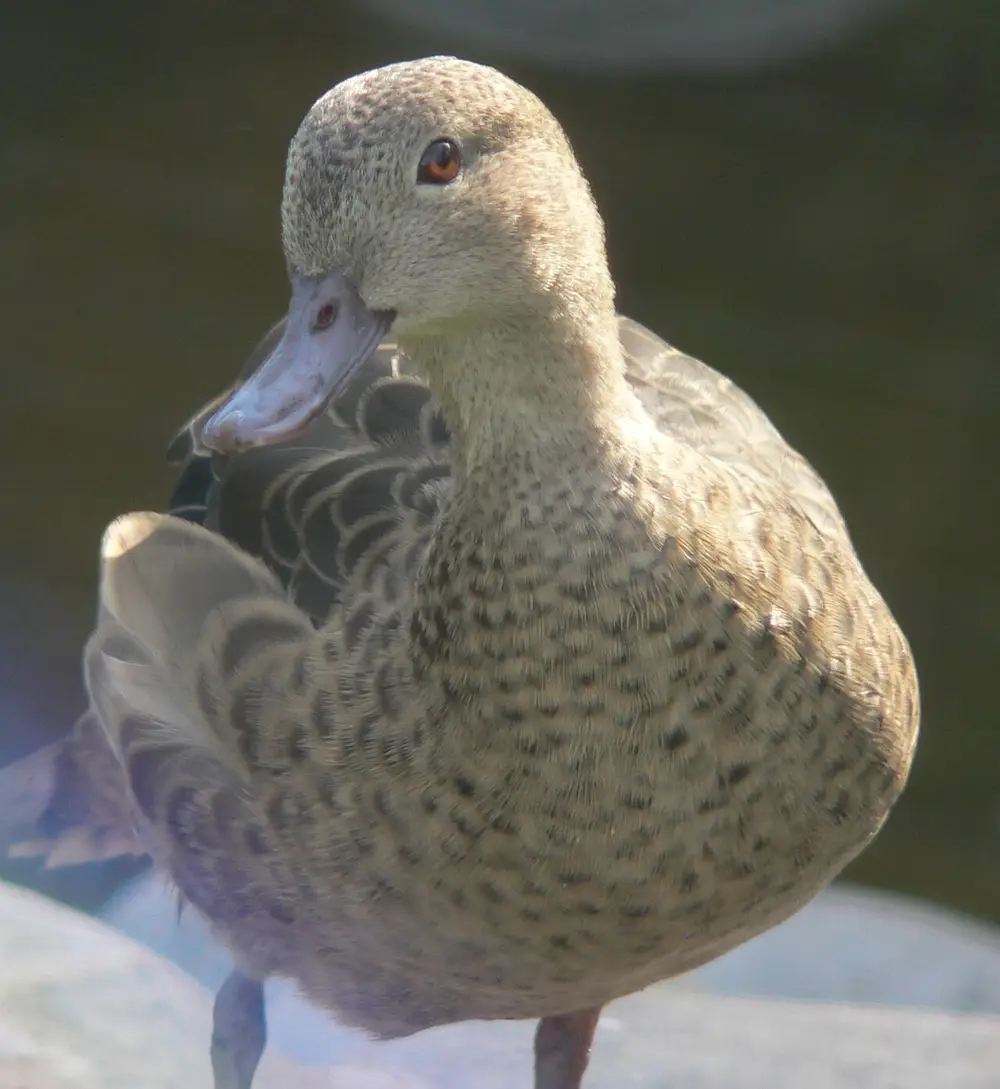
The Laysan duck is teal-sized and dark brown, with a bold white ring around each eye. Older birds commonly have extensive white feathering on the head and neck. Both sexes have an iridescent purplish-green patch on the wing. The legs and feet are orange, usually brighter in males. A ring of fat often circles the neck.
The bill is the easiest way to tell the sexes apart. It is short and spoon-shaped in both, but dark green with black blotches in males and dull orange with black blotches in females. Some males also show faint iridescence on the head and neck and slightly upturned central tail feathers.
Its body reflects life on an island without ground predators. The wings and wing muscles are reduced, and the pelvis is adapted for foraging on foot. Once a year it molts all of its flight feathers at once and cannot fly until they grow back.
Behavior and diet
Diet
Brine flies, moth larvae and other invertebrates, plus algae, leaves and seeds
The Laysan duck is a poor flyer but a good walker and runner. Its wings allow quick take-offs but not long flights, and it has never dispersed between the main islands of the Northwestern Hawaiian Islands, which lie dozens of miles apart. When pursued, it tends to freeze in place rather than flee, a strategy that works against native birds of prey but not against rats, pigs or people.
Its most famous trick is the fly-snapping sprint. With neck stretched out and bill held close to the ground, the duck runs across a mudflat into a swarm of brine flies, snapping them up as they rise in front of it. It also dabbles and filter-feeds in lake shallows, along the shore and in upland vegetation, taking invertebrates, moth larvae and pupae, snails, algae, leaves and seeds. Invertebrates are the main staple.
During the day, especially in the breeding season, Laysan ducks hide in grass and shrubs to avoid frigatebirds and other aerial predators. On Laysan Island they come out into the open to feed on the lake from dusk until dawn, though the pattern shifts from year to year with food supply. Their calls resemble a mallard's but are rarely heard outside courtship.
Pairs form in autumn and nests are built in spring. The female hides a shallow, down-lined bowl on the ground beneath dense vegetation, especially bunchgrass. Eggs are usually laid from April to August, about four per clutch on Laysan Island. The Midway birds lay larger clutches and start breeding younger, presumably thanks to more food. Ducklings feed themselves from their second day, but the hen guards them and leads them to food for 40 to 60 days. Only about 30 percent of ducklings on Laysan Island survive to fledge.
Range and habitat
Habitat
Island lake shores, mudflats, seeps and dense grass and shrubs
Fossil evidence shows that Laysan ducks once lived throughout the Hawaiian archipelago. After Polynesians reached the islands, bringing rats and other mammals, the duck began to decline, and by 1860 it survived only on rat-free Laysan Island. At about 415 hectares (1.6 sq mi), that was the smallest range of any duck species in the world.
On Laysan Island the ducks live around the coast and the inland lake year-round. Because the climate varies little through the year, they do not need to migrate. Since 2004, translocated birds have also lived on Midway Atoll's Sand and Eastern Islands, and a later group was moved to Kure Atoll.
Conservation status
The Laysan duck is listed as Critically Endangered on the IUCN Red List (BirdLife International, 2018).
Domestic rabbits released by guano miners at the end of the 19th century stripped Laysan Island's vegetation, and by 1912 only seven adults and five juveniles remained. Rabbits were eradicated in 1923, and numbers climbed to about 500 by the 1950s. The species was declared federally endangered in 1967. A drought and food shortage during the 1993 El Niño cut the population to about 100, but by 2004 it had grown to an estimated 576.
To guard against a single disaster wiping out the species, 42 ducks were moved to Midway Atoll National Wildlife Refuge in 2004 and 2005. This second population more than doubled within two years. Under a U.S. Fish and Wildlife Service recovery plan, the long-term goal is at least five populations, including predator-controlled sites in the main Hawaiian Islands, supported by reintroduction and captive breeding. The ultimate aim is a population healthy enough to no longer need federal protection under the Endangered Species Act. As the basic criteria of the recovery plan were met, the Laysan duck was down-listed from endangered to threatened after 2019.
Threats remain: introduced species, disease and parasites, pollution and debris washing ashore, drought, storms, tsunamis, and sea level rise, which could destroy much of its low-lying island habitat.
Where to see laysan duck in the U.S.
6 zoos across 4 states
Find the closest one
Rank the 5 zoos holding laysan duck by how far they are from you. Your location is used in your browser to sort this list and is never sent to us.
1 more zoo holds laysan duck but has no coordinates on file yet, so it isn't ranked here. It's in the full list below.
California· 2
Connecticut· 1
Massachusetts· 2
Wisconsin· 1
AZAThe Association of Zoos and Aquariums. Accredited members have passed an independent inspection of animal care and welfare, safety, conservation and education, repeated every five years. Many smaller facilities never apply, so “not accredited” isn't a verdict on its own. What accreditation means · How we check this
Built from each zoo's own published animal list.
Laysan Duck: common questions
Can Laysan ducks fly?
Yes, but poorly. They can take off quickly but cannot fly far, and they spend most of their time walking and running.
What do Laysan ducks eat?
Mainly invertebrates, including brine flies they snap from swarms while running, plus moth larvae, snails, algae, leaves and seeds.
How many Laysan ducks are left?
The population fell to just 12 birds in 1912 and about 100 after a 1993 drought. Laysan Island held an estimated 576 in 2004, with a second population growing on Midway Atoll.
Where do Laysan ducks live?
Only in the Northwestern Hawaiian Islands, on Laysan Island and on Midway and Kure atolls, where birds have been moved.
How long do Laysan ducks live?
Up to 12 years in the wild and up to 18 years in captivity.
Is the Laysan duck related to the mallard?
Yes. It belongs to the mallard clade of dabbling ducks, but it likely descends from an East Asian ancestor of mallards.
Why is the Laysan duck endangered?
Introduced rats, rabbits and other mammals wiped it out across most of Hawaii and stripped its last refuge of vegetation. Its tiny range still leaves it exposed to drought, storms and sea level rise.