- Where to see one
- 6 U.S. zoos in our directory hold madagascar teal, confirmed against each zoo's own animal list.
- Native range
- Endemic to Madagascar: the west coast and the far northeast
- Size
- 40–45 cm (16–18 in) long; 320–405 g (11.3–14.3 oz)
- Population
- About 1,500 birds
- Clutch size
- 3 to 9 eggs in captivity, averaging 6.75
- Other name
- Bernier's teal
Conservation status
Endangeredassessed 2022
IUCN Red List category EN — step 4 of 7.
The Madagascar teal, also called Bernier's teal, is a small brown duck found only on Madagascar, mainly along the west coast and in the extreme north-east. It lives in mangrove forests and favours open, shallow, mostly brackish ponds and lakes. It spends much of the day feeding, wading at the water's edge, filtering mud and dabbling at the surface for invertebrates, plant material and insects. It measures 40 to 45 cm long. All known wild nests have been in holes in grey mangrove trees 1 to 3 m above the water, where the female lays her eggs on the bare floor of the cavity and later covers them with down from her own breast.
About the Madagascar teal
The Madagascar teal (Anas bernieri), also called Bernier's teal, is a small, endangered dabbling duck found only along the west coast of Madagascar, where it lives in mangrove forest. It belongs to the "grey teal" group of ducks centered on Australasia, and its closest living relative is the Andaman teal of the Bay of Bengal.
The German ornithologist Gustav Hartlaub first described it in 1860 as Querquedula bernieri. Both its common and scientific names honor Chevalier Bernier, a French naval surgeon and naturalist who collected nearly 200 specimens of various species while stationed in Madagascar. The genus name Anas is Latin for "duck." No subspecies are recognized.
Genetic studies suggest it may have been the sister species of the Mascarene teal, also called Sauzier's teal, a small duck that lived on nearby Mauritius and Réunion. That bird was hunted heavily and died out on Mauritius around 1700 and on Réunion about a decade later. It was a little larger than the Madagascar teal.
The group includes the grey teal itself, found in open wetlands of Australia and New Zealand, a mottled brown dabbling duck with a crimson eye and white and green flashes on its wings. Like the Madagascar teal, grey teal males and females share the same coloring. Grey teal are nomadic in Australia, quickly moving into new wetlands after rain.
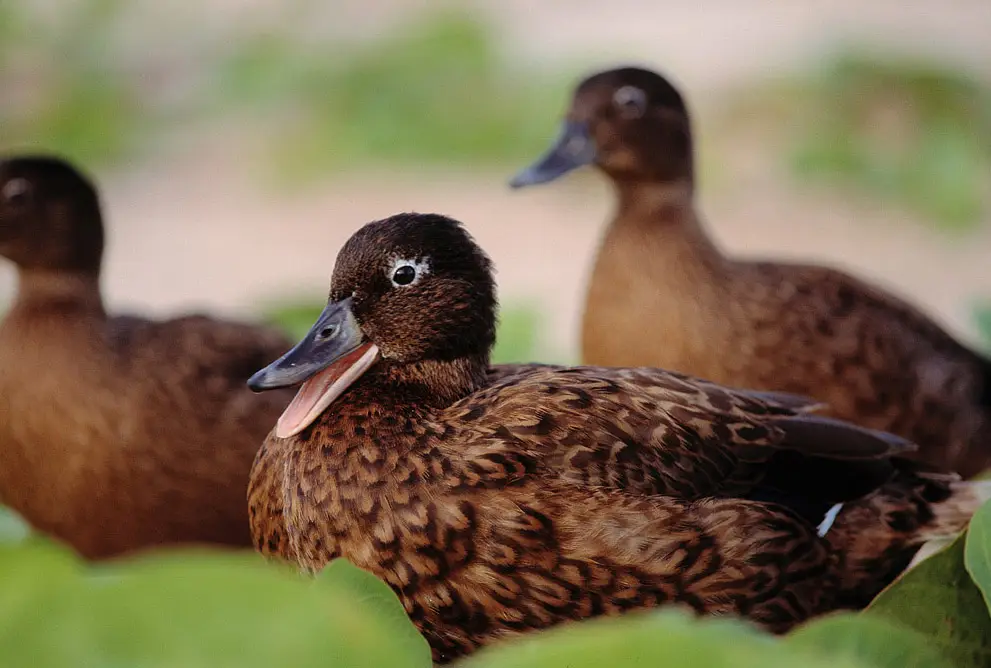
The Madagascar teal is a small duck, 40–45 cm (16–18 in) long and weighing 320–405 g (11.3–14.3 oz). Males average slightly heavier than females, but otherwise adults and young of both sexes look the same. The plumage is mostly warm brown, the bill is reddish, and the legs and feet are a dull reddish-orange.
Behavior and diet
Diet
Invertebrates, insects and plant material
The Madagascar teal spends much of its day actively feeding. It wades at the edges of shallow water, filtering mud through its bill and dabbling at the surface. Its food includes invertebrates, insects and plant material.
The two sexes sound different. The male whistles, while the female gives what has been described as a croaking quack.
All known wild nests have been found in grey mangrove trees, in holes 1–3 m (3.3–9.8 ft) above the water or close to it. In captivity the species also accepts nest boxes. The pair brings in no nesting material. The female lays her eggs straight onto the floor of the cavity and covers them, first with wood shavings or bits of rotting wood and later with down plucked from her own breast.
Captive clutches have ranged from 3 to 9 eggs, averaging 6.75 per female. The eggs are pale buff, smooth and oval, averaging 46 by 34.6 mm (1.81 by 1.36 in), smaller than the eggs of any other grey teal. Only the female incubates. Nesting in tree holes is not unique to this bird among its relatives: the extinct Mascarene teal may have nested in tree holes too, and the grey teal sometimes uses tree holes or rabbit burrows, though it usually nests on the ground near lakes and marshes.
Range and habitat
Habitat
Mangrove forest with open, shallow, mostly brackish ponds and lakes
The Madagascar teal is endemic to Madagascar. Its range takes in the whole west coast and the extreme northeast of the island, though it is known to breed at only a few sites on the central and northwestern coasts.
It lives in mangrove forests and rarely leaves them. Within the mangroves it favors open, shallow ponds and lakes, most of them brackish. Subfossil bones from the Holocene show that the species once lived across a much wider area of the island than it does today. It is not Madagascar's only native duck; Meller's duck also lives on the island and is the larger of the two.
Madagascar teal vs Andaman teal
Studies point to the Andaman teal as the Madagascar teal's closest living relative, although Madagascar and the Andaman Islands in the Bay of Bengal are far apart. Both are small, brown members of the grey teal group.
| Feature | Madagascar teal | Andaman teal |
|---|---|---|
| Scientific name | Anas bernieri | Anas albogularis |
| Range | West coast and far northeast of Madagascar | Andaman Islands (India) and Great Coco Island (Myanmar) |
| Plumage | Mostly warm brown | Dark brown with buff markings; pale face and throat with a white eye-ring |
| Bill | Reddish | Bluish gray |
| Habitat | Mangroves with shallow brackish pools | Inland pools, mangroves and lagoons |
| Nest | Holes in mangrove trees | Grass nests in reed patches |
| Population | About 1,500 | Slightly over 1,000 (2014), increasing |
Other teal include the marbled teal, the puna teal of the Andes and the ringed teal.
Conservation status
The Madagascar teal is listed as Endangered on the IUCN Red List and appears on Appendix II of CITES. It is described as being on the verge of extinction, with only about 1,500 birds left.
The main threat is the loss of the mangrove forests it depends on. Mangroves are being cut for timber and fuel and cleared to expand farming. The teal is also hunted for food. Because the birds rarely leave mangroves and all known wild nests are in mangrove tree holes, losing those forests removes both feeding and nesting habitat.
Captive breeding offers a backstop. The species is now held in wildfowl collections around the world, and several captive breeding programs exist, including one in Jersey that had reared nearly 100 birds after starting in 1995.
Where to see madagascar teal in the U.S.
6 zoos across 6 states
Find the closest one
Rank the 5 zoos holding madagascar teal by how far they are from you. Your location is used in your browser to sort this list and is never sent to us.
1 more zoo holds madagascar teal but has no coordinates on file yet, so it isn't ranked here. It's in the full list below.
California· 1
Connecticut· 1
Kentucky· 1
Minnesota· 1
Oklahoma· 1
Pennsylvania· 1
AZAThe Association of Zoos and Aquariums. Accredited members have passed an independent inspection of animal care and welfare, safety, conservation and education, repeated every five years. Many smaller facilities never apply, so “not accredited” isn't a verdict on its own. What accreditation means · How we check this
Built from each zoo's own published animal list.
Madagascar Teal: common questions
Is the Madagascar teal endangered?
Yes. It is listed as Endangered, with only about 1,500 birds left in the wild, mainly because its mangrove habitat is being destroyed.
Where does the Madagascar teal live?
Only in Madagascar, in mangrove forests along the whole west coast and the far northeast. It favors open, shallow, mostly brackish ponds and lakes within the mangroves.
How big is a Madagascar teal?
It is 40–45 cm (16–18 in) long and weighs 320–405 g (11.3–14.3 oz). Males are slightly heavier than females.
What does the Madagascar teal eat?
Invertebrates, insects and plant material. It wades at the water's edge, filtering mud and dabbling at the surface.
Where do Madagascar teal nest?
In holes in grey mangrove trees, 1–3 m (3.3–9.8 ft) above or near the water. The female lays her eggs on the bare cavity floor and later covers them with her own down.
Why is it also called Bernier's teal?
It is named after Chevalier Bernier, a French naval surgeon and naturalist who collected specimens in Madagascar. His name is also in the scientific name, Anas bernieri.
What is the Madagascar teal's closest relative?
The Andaman teal. Despite living on islands in the Bay of Bengal, it appears to be the Madagascar teal's closest living relative, and both belong to the grey teal group.
Do male and female Madagascar teal look different?
No. Both sexes share the same warm brown plumage and reddish bill, though males are slightly larger.