- Where to see one
- 14 U.S. zoos in our directory hold duck, confirmed against each zoo's own animal list.
- Origin
- Domesticated from the mallard, probably in southern China around 2000 BC
- Size
- From about 0.7 kg (1.5 lb) in small breeds such as the Appleyard to 4.6 kg (10 lb) in large breeds such as the Aylesbury; a wild mallard weighs about 1.1 kg (2.4 lb)
- Lifespan
- About 8–12 years in captivity
- Egg production
- About 200 eggs a year for most breeds; over 300 for the Indian Runner
- Group name
- Flock
Conservation status
Not Evaluated
This species has not been assessed for the IUCN Red List, so it sits outside the threat scale entirely.
Not Evaluated (NE) as a domestic animal; the wild mallard is Least Concern
Domestic ducks are mainly descendants of the mallard, with some contribution from the Muscovy duck, and have been raised for meat and eggs, with a few kept for show or ornament. The mallard was probably domesticated in southern China around 2000 BC and spread outward from there, while the Muscovy duck was domesticated in Mexico and South America. Duck farming is simplified by reliable flocking behaviour and the birds' ability to forage for themselves in wetlands. Domestication changed them: they are mostly promiscuous where wild mallards are monogamous, and they have lost the mallard's territorial behaviour. Over 80% of global duck production is in China.
About the duck
A domestic duck is a duck bred by people for meat, eggs, show or ornament. Almost all domestic ducks descend from the mallard, a wild dabbling duck of wetlands across the Northern Hemisphere, and they are the same species as the mallard. A few breeds come instead from the Muscovy duck of Mexico and South America.
Domestication changed ducks a great deal. Breeds range from tiny ornamental birds to heavy meat ducks four times the weight of a wild mallard, and from upright, flightless egg layers to birds bred for crests, tufts or striking plumage. The White Pekin is a common meat breed, the Indian Runner stands upright and does not fly, and ornamental breeds are shown in competitions.
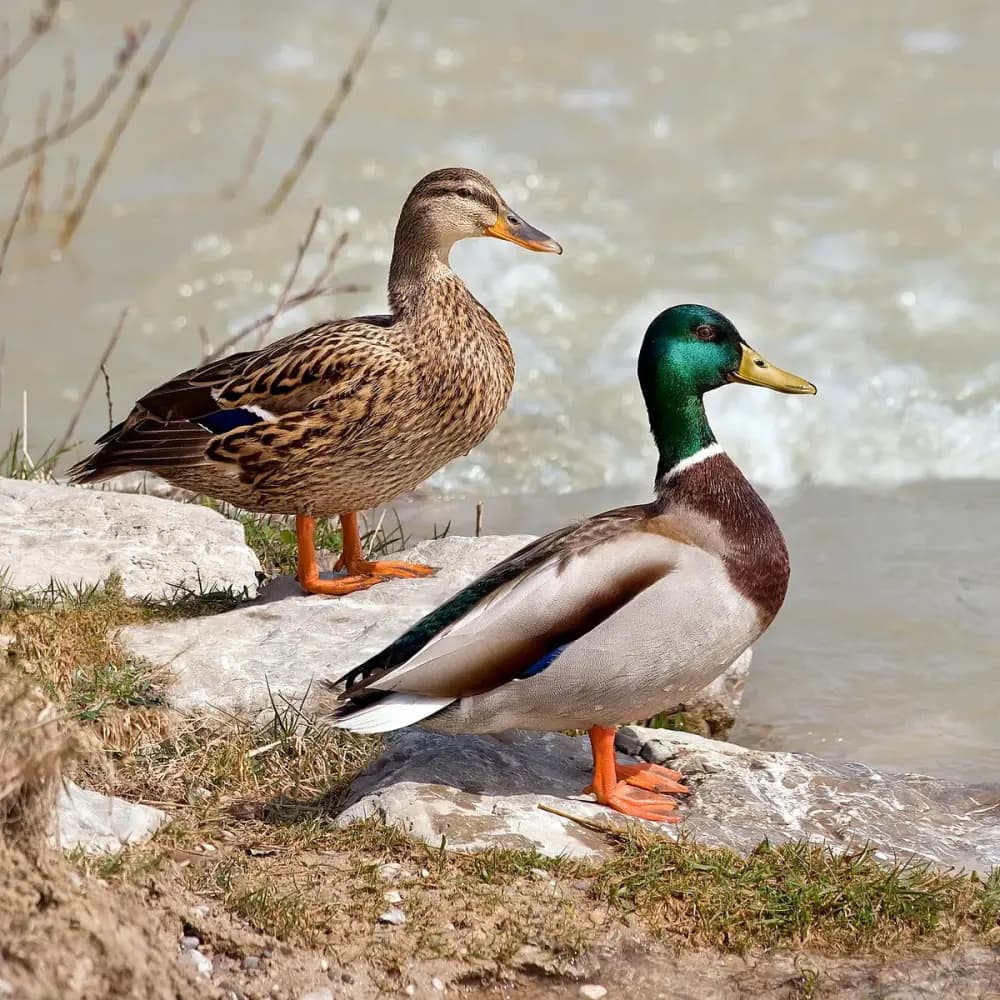
Many domestic ducks still look like their wild ancestor. A wild mallard, Anas platyrhynchos, is 50–65 cm (20–26 in) long with a wingspan of 81–98 cm (32–39 in). The breeding drake has a glossy bottle-green head, a white collar, a purple-tinged brown breast and a yellow-orange bill. The hen is mottled buff and dark brown. Both sexes have an iridescent purple-blue wing patch, the speculum, edged in white. Domestic ducks come in this wild-type pattern as well as white and other colors.
Ducklings hatch yellow below and black above. Hens make the classic loud "quack," often in a run of 2 to 10 calls that fade in volume, while drakes give a deeper, quieter version.
Behavior and diet
Diet
Omnivorous: seeds, plants, roots, insects, snails, crustaceans and worms
Ducks are omnivores and flexible feeders. Mallards eat snails, insects such as beetles, flies and dragonflies, crustaceans, worms, seeds, plant matter, roots and tubers, usually by dabbling at the surface or grazing. Plants make up most of the diet for much of the year, but laying hens switch heavily to animal food: one study found laying females ate about 72% animal matter. Ducks occasionally take frogs and fish.
Domestic ducks behave differently from wild mallards. Mallards usually pair off and defend territories, while domestic ducks are mostly promiscuous, have lost that territorial behavior and are less aggressive. Their reliable flocking and ability to find their own food in wetlands make them easy to farm. Wild mallards are highly gregarious outside the breeding season too, gathering in large flocks known as sordes. When taking off, a mallard's wings make a faint whistling sound.
Many domestic hens are poor at sitting on eggs and raising young, though the Rouen and especially the Muscovy are exceptions. For centuries, farmers have hatched duck eggs under broody hens or, now, in incubators. That creates a problem: ducklings rely on their mother's preen oil to waterproof their feathers until they grow their own, and a chicken makes much less of it.
In East and Southeast Asia, ducks are a working part of rice farming. In rice-duck farming, ducks eat small pests in the paddy, stir the water to limit weeds and fertilize the rice, so the same field produces both rice and ducks. Domestic ducks resist many poultry diseases, including duck plague, but are susceptible to the H5N1 strain of avian influenza.
Range and habitat
Habitat
Farms, ponds and wetlands; wild mallards use fresh- and salt-water wetlands
The domestic duck came from mallards, probably in southern China around 2000 BC, through a single domestication event during the Neolithic. Rice-paddy farmers likely developed it, and it spread from there. The earliest written records come from Han Chinese writings of about 500 BC. Ducks in ancient Rome appear to have been caught from the wild rather than bred, and the Muscovy duck was domesticated separately in Mexico and South America.
Ducks are now farmed worldwide. In 2021, about 4.3 billion ducks were raised and slaughtered for meat, and over 80% of production was in China. That is far fewer than the roughly 73.8 billion chickens slaughtered the same year, but much more than the roughly 750 million geese. Feathers are a by-product of duck farming. Duck eggs are eaten mainly in Asian countries. Farm ducks forage well for themselves in wetlands and other bodies of water, and in East and Southeast Asia they share rice paddies with the crop.
The wild ancestor is widely distributed in both hemispheres. Mallards range across North America from Alaska to Mexico and Hawaii, across Europe and Asia from Iceland to Japan, and in southeastern and southwestern Australia and New Zealand. They live in parks, ponds, rivers, lakes, estuaries and sheltered coasts, preferring water less than 0.9 m (3 ft) deep. Because domestic ducks and mallards are the same species, they often interbreed and produce fully fertile young.
Domestic duck vs mallard
Domestic ducks and wild mallards are the same species and can look alike, but breeding for farm life has changed their size, color and behavior. Other relatives, like the wood duck and the ruddy duck, are entirely separate wild species.
| Feature | Domestic duck | Wild mallard |
|---|---|---|
| Scientific name | Anas platyrhynchos domesticus (informal) | Anas platyrhynchos |
| Weight | About 0.7–4.6 kg (1.5–10 lb), depending on breed | About 1.1 kg (2.4 lb) |
| Plumage | Wild-type, white or other colors | Green-headed drake, mottled brown hen |
| Mating | Mostly promiscuous | Usually monogamous |
| Territorial | No | Yes |
| Flight | Some breeds cannot fly | Flies; strongly migratory in the north of its range |
Conservation status
Domestic ducks are farm animals and are not assessed on the IUCN Red List. Their wild ancestor, the mallard, is listed as Least Concern in BirdLife International's 2025 assessment.
Domestic ducks are anything but scarce: billions are raised every year. Their main health risks are parasites, which can slow growth, and avian influenza. Because domestic ducks interbreed freely with wild mallards, many wild mallards now carry domestic duck genes.
Where to see duck in the U.S.
14 zoos across 11 states
Find the closest one
Rank the 6 zoos holding duck by how far they are from you. Your location is used in your browser to sort this list and is never sent to us.
8 more zoos hold duck but have no coordinates on file yet, so they aren't ranked here. They're in the full list below.
Arkansas· 1
Delaware· 1
Florida· 2
Illinois· 1
Iowa· 2
Kansas· 1
Maine· 1
Michigan· 1
North Carolina· 2
Virginia· 1
Wisconsin· 1
AZAThe Association of Zoos and Aquariums. Accredited members have passed an independent inspection of animal care and welfare, safety, conservation and education, repeated every five years. Many smaller facilities never apply, so “not accredited” isn't a verdict on its own. What accreditation means · How we check this
Built from each zoo's own published animal list.
Duck: common questions
What are domestic ducks descended from?
Mostly from the mallard. A few breeds come from the Muscovy duck, and mulards are hybrids of the two.
How long do ducks live?
About 8 to 12 years in captivity for domestic ducks.
How many eggs does a duck lay?
Most breeds lay around 200 eggs a year. The Indian Runner can lay more than 300.
What do ducks eat?
Ducks are omnivores. They eat seeds, plants, roots, insects, snails, crustaceans and worms, and occasionally frogs or small fish.
Can domestic ducks fly?
Some cannot. The Indian Runner, for example, does not fly, and heavy meat breeds are much bigger than the wild mallard. Pure mallards kept on farms may need their wings clipped.
Why do ducks quack?
The loud quack is mainly the female's call, often given in a fading series of 2 to 10 quacks. Males make a deeper, quieter version.
Can domestic ducks breed with wild mallards?
Yes. They are the same species, so they often mate and produce fully fertile hybrid young.