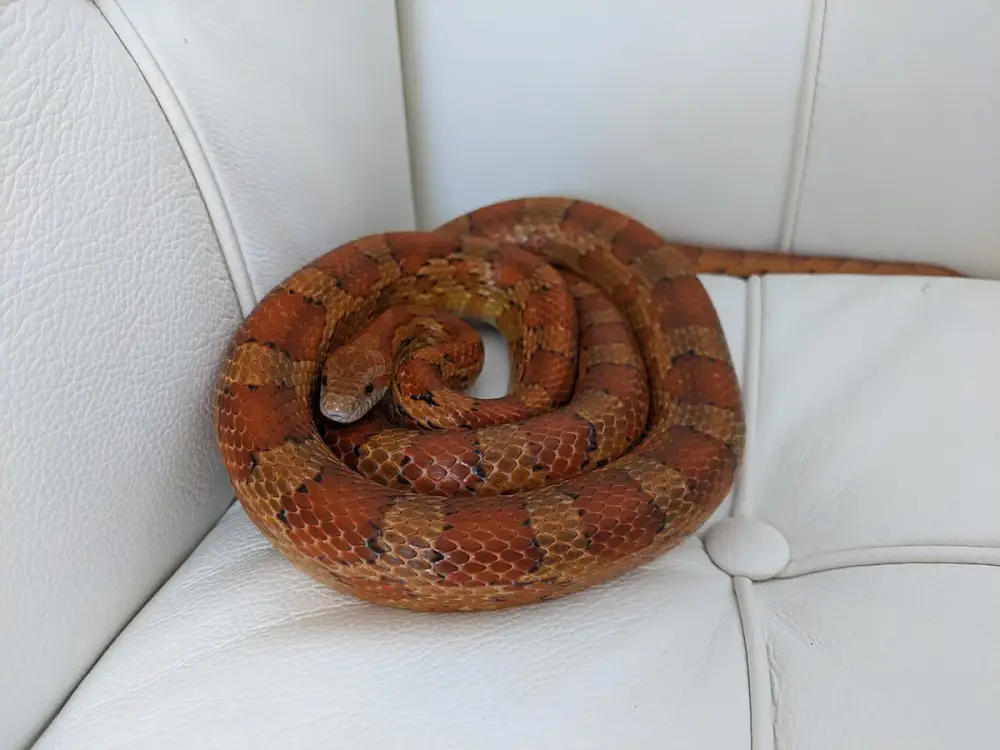
- Where to see one
- 5 U.S. zoos in our directory hold black rat snake, confirmed against each zoo's own animal list.
- Native range
- Central North America, west of the Mississippi River
- Size
- 106.7–183 cm (42–72 in) total length, with a record individual of 218.4 cm (86 in)
- Lifespan
- Up to about 15 years or more in captivity with appropriate care
Conservation status
Least Concernassessed 2019
IUCN Red List category LC — step 1 of 7.
Least Concern (LC), assessed 2019
About the black rat snake
The black rat snake, also known as the western rat snake and, in some places, the pilot black snake, is a nonvenomous species of snake in the family Colubridae. It's native to central North America, ranging west of the Mississippi River from eastern and southern Iowa south through Missouri and Arkansas to western Louisiana, west to eastern Texas, and north through Oklahoma and eastern Kansas to southeastern Nebraska. No subspecies are currently recognized as valid, though the species includes color variations such as the brown-to-black, often orange- or red-tinged Texas rat snake found in southern Oklahoma, Texas, and Louisiana.
As juveniles, black rat snakes are strongly patterned with brown blotches on a gray background, resembling miniature fox snakes. That pattern darkens rapidly as the snake grows, and adults end up glossy black on top with white lips, chin, and throat — sometimes with traces of the juvenile pattern still visible in the skin between the scales, especially after a large meal stretches it out. Adults typically measure 106.7 to 183 cm (42 to 72 in) in total length, with one record individual reaching 218.4 cm (86 in).
The species carries a long list of regional common names beyond "black rat snake," including gray rat snake, black chicken snake, chicken snake, mountain black snake, mountain pilot snake, rusty black snake, scaly black snake, cow snake, sleepy John, and white-throated racer.
Behavior and diet
Diet
Mice, voles, rats, other snakes, frogs, lizards, moles, chipmunks, squirrels, juvenile rabbits and opossums, songbirds, and bird eggs
Black rat snakes are primarily active during the day and live across a range of habitats, including bayou, prairie, and rock outcrops, though they show a particular preference for wooded areas, especially those with oak trees. They're excellent climbers and spend a significant amount of time in trees, and they're also competent swimmers. In different habitats they can shift toward nocturnal activity when conditions call for it. During winter they hibernate in shared dens, often alongside copperheads and timber rattlesnakes — an association that gave rise to the old belief, and the name "pilot black snake," that this harmless species leads venomous ones to their winter dens.
As a constrictor, the black rat snake kills by coiling around prey and tightening its grip until blood can no longer circulate, causing the animal to die of profound low blood pressure before being eaten. It commonly eats mice, voles, and rats, but it's a generalist rather than a specialist, and it readily takes other snakes (including its own species), frogs, lizards, moles, chipmunks, squirrels, juvenile rabbits, juvenile opossums, songbirds, and bird eggs — one snake was observed eating an entire clutch of mallard eggs. Cavity-nesting birds feature heavily in its diet, and it's considered perhaps the top predator at purple martin colonies, where a single large snake can consume a number of eggs, hatchlings, and adults in a summer.
When threatened, a black rat snake may freeze and coil itself into a series of kinks, flee, or vibrate its tail — a defensive behavior it shares with rattlesnakes but doesn't mimic, since researchers believe rat snakes were doing this before rattlesnakes existed. It can also release a foul-smelling musk onto predators and, when cornered, stand its ground aggressively. Large individuals, over 150 cm (59 in), have been recorded in violent struggles with birds of prey such as red-tailed hawks, great horned owls, and red-shouldered hawks, sometimes killing the bird, though the snake can just as easily lose the fight.
Mating takes place in late May and early June. The male wraps his tail around the female until their vents nearly touch, then everts one of his hemipenes into her cloaca; the mating itself lasts from a few minutes to a few hours. About five weeks later, the female lays 12 to 20 eggs, each 36–60 mm (1.4–2.4 in) long and 20–26.5 mm (0.79–1.04 in) wide. The eggs hatch roughly 65 to 70 days after laying, typically in late August to early October, producing hatchlings 28 to 41 cm (11–16 in) long that already resemble miniature fox snakes in pattern.
The species' taxonomy has shifted more than once, which matters for anyone trying to look it up under an older name. It was long placed in the genus Elaphe, as Elaphe obsoleta, before phylogenetic work moved it into Pantherophis. A 2001 study proposed splitting it into three separate species by geography — eastern, central, and western rat snakes — but these forms aren't morphologically distinct, and the eastern and central forms are known to interbreed freely in Ontario. A brief attempt to revive the genus name Scotophis for the group has since been set aside by further research.
Range and habitat
Habitat
Bayou, prairie, rock outcrops, and especially wooded areas with oak trees
The black rat snake occupies central North America west of the Mississippi River, spanning eastern and southern Iowa, Missouri, Arkansas, western Louisiana, eastern Texas, Oklahoma, eastern Kansas, and southeastern Nebraska. Within that range it favors wooded habitat, particularly oak forest, but it also uses bayous, prairie, and rock outcrops, and it's a strong enough swimmer and climber to move between them freely. In winter it retreats to shared dens, sometimes denning alongside venomous species such as copperheads and timber rattlesnakes.
Conservation status
The black rat snake, Pantherophis obsoletus, is listed as Least Concern on the IUCN Red List, based on a 2019 assessment. The category means it is not currently considered at risk of extinction across its range.
Its main pressures are natural ones at different life stages. Juveniles are taken by a wide range of predators, including other snakes, while adults fall prey to mammalian carnivores such as the American mink and to large birds of prey, especially red-tailed hawks.
The species is bred in captivity for the U.S. pet trade, including color mutations such as leucistic, albino, and scaleless forms, though it remains less popular than other colubrids like corn snakes and kingsnakes.
Where to see black rat snake in the U.S.
5 zoos across 5 states
Find the closest one
Rank the 5 zoos holding black rat snake by how far they are from you. Your location is used in your browser to sort this list and is never sent to us.
Kansas· 1
Maryland· 1
New York· 1
Ohio· 1
Pennsylvania· 1
AZAThe Association of Zoos and Aquariums. Accredited members have passed an independent inspection of animal care and welfare, safety, conservation and education, repeated every five years. Many smaller facilities never apply, so “not accredited” isn't a verdict on its own. What accreditation means · How we check this
Built from each zoo's own published animal list.
Black Rat Snake: common questions
Is the black rat snake endangered?
No. It's listed as Least Concern on the IUCN Red List (2019 assessment), meaning it isn't currently considered at risk across its range.
How big does a black rat snake get?
Typically 106.7 to 183 cm (42–72 in) in total length, with a record individual measuring 218.4 cm (86 in).
What does a black rat snake eat?
Mostly mice, voles, and rats, but also other snakes, frogs, lizards, moles, chipmunks, squirrels, juvenile rabbits and opossums, songbirds, and bird eggs.
How long do black rat snakes live?
With appropriate care, captive individuals may live 15 years or more.
Where do black rat snakes live in the wild?
West of the Mississippi River in central North America, from Iowa and Nebraska south through Missouri, Arkansas, and Louisiana to Texas and Oklahoma.
Which U.S. zoos have black rat snakes?
Five U.S. zoos list one, including The Maryland Zoo in Baltimore, Staten Island Zoo, and the Cincinnati Zoo and Botanical Garden.