- Where to see one
- 9 U.S. zoos in our directory hold tiger salamander, confirmed against each zoo's own animal list.
- Native range
- Much of the United States, especially the Atlantic coast from New York to Florida, plus southern Canada and eastern Mexico
- Size
- Usually 15–20 cm (6–8 in); the longest on record reached 33 cm (13 in)
- Lifespan
- Around 12–15 years; up to 25 years in captivity
- Eggs
- Up to about 100 per mass
- Activity
- Mostly nocturnal and underground
Conservation status
Least Concernassessed 2022
IUCN Red List category LC — step 1 of 7.
The tiger salamander is a species of mole salamander and one of the largest terrestrial salamanders in North America, usually 15 to 20 cm long. Its dark back carries brownish-yellow to greenish-yellow markings. Adults are almost entirely terrestrial, spending most of their lives secretively in burrows in loose soil and returning to water mainly to breed. It has the widest range of any salamander in North America, from woodlands to open grassland. The diet is mostly small insects, snails, slugs, frogs and worms, and larger adults sometimes eat their own kind. Some individuals keep their gills and stay aquatic.
About the tiger salamander
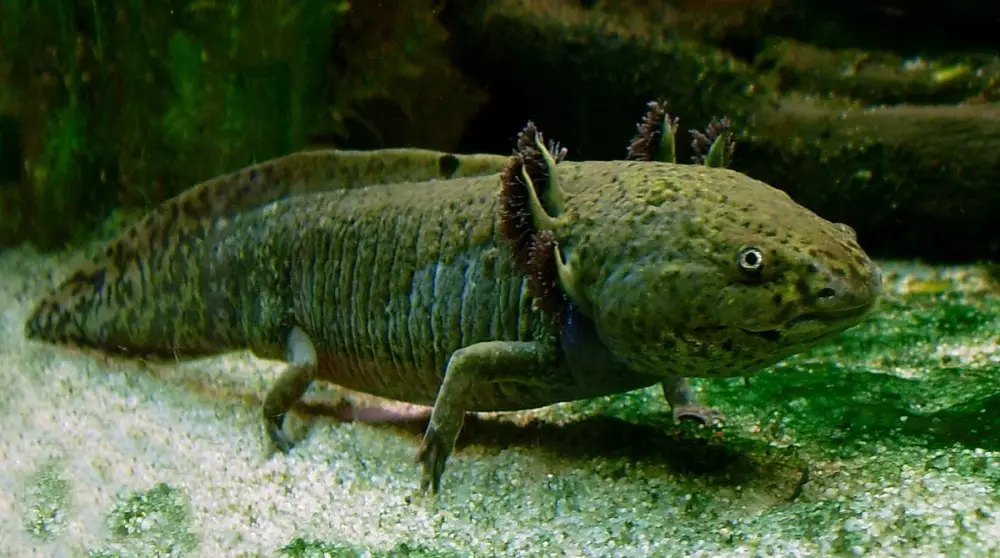
The tiger salamander, also called the eastern tiger salamander, is a large mole salamander from North America and a relative of the axolotl. It is one of the biggest land-dwelling salamanders on the continent and the widest-ranging salamander species in North America, living across much of the United States plus parts of Canada and Mexico.
Its scientific name is Ambystoma tigrinum. It belongs to the mole salamanders, family Ambystomatidae. Several animals once treated as subspecies of the tiger salamander, including the California tiger salamander, the barred tiger salamander and the plateau tiger salamander, are now recognized as separate species after genetic studies split the old, broad grouping apart. The axolotl of Mexico is another relative.
Adults usually measure 15–20 cm (6–8 in) long, and the longest found was 33 cm (13 in). The body is thick and smooth, with a short, broad rounded snout, thick neck, strong legs and a long tail. About 12–13 costal grooves run down each side and help the animal manage moisture. The feet carry specialized pads used for burrowing through loose soil.
The color pattern is where the "tiger" comes from. Blotches or spots in shades from brownish yellow to greenish yellow, sometimes tan or olive, sit against a black or dark brown back. The spots follow no set shape, size or position. The belly is usually yellowish or olive. One less obvious trait: eastern tiger salamanders give off a bright yellow-green fluorescence when lit with blue or ultraviolet light.
Males and females differ. Males are larger, with longer, taller and more flattened tails and longer hind legs, and in the breeding season the male's vent area swells.
Behavior and diet
Diet
Worms, snails, slugs, insects, small crustaceans, frogs and other small animals
Tiger salamanders are secretive and spend most of their lives underground, which makes them hard to find in the wild. Unlike many relatives that borrow other animals' tunnels, they usually dig their own burrows, and some have been found more than 60 cm (24 in) below the surface. Living that deep lets them escape the temperature extremes above ground and keep their skin moist. In dry spells, large numbers have been found piled together under cover or underground. Adults are mostly nocturnal and solitary.
They are opportunistic predators. The usual diet is small insects, snails, slugs, worms, frogs and tiny aquatic crustaceans. When the chance comes, they also take smaller salamanders, lizards, baby snakes and newborn mice. Adults sometimes turn cannibal, usually where prey is scarce and competition is high. Larvae start on small crustaceans and insect larvae, then move on to tadpoles, smaller salamander larvae and even small fish.
For defense, a threatened tiger salamander shows off its tail, and glands in the skin release a thick, white, poisonous fluid to warn predators away. Recorded predators of adults include bobcats, badgers, snakes and owls. Larvae are eaten by aquatic insects, other salamander larvae and snakes.
Adults are almost fully terrestrial and usually return to water only to breed. Like all mole salamanders, they are very loyal to their birthplaces and travel long distances to reach them. Breeding migrations happen in late winter or early spring, often after a warm rain thaws the ground. In a South Carolina study, males began moving in late October or November and females from November through February.
Courtship takes place at night in the water. A male nudges a female away from rivals, then deposits a spermatophore, a packet of sperm, on the pond bottom for her to pick up. Some "sneaker" males mimic females to slip their own spermatophore in without alerting a rival. Females favor males with longer tails. About 24–48 hours after mating, the female attaches her eggs to twigs, grass and leaves on the pond floor, with up to about 100 eggs per mass.
Larvae are fully aquatic, with large external gills and a tail fin starting just behind the head, much like an axolotl. Many transform into land-dwelling adults within about two and a half to five months. Others, especially in warmer climates, keep growing as larvae until adult size; these big larvae are called "waterdogs." Some never transform at all and breed while still in larval form. This is called neoteny, and it is most common where conditions on land are poor. A single tiger salamander has only about a 50% chance of breeding more than once in its life.
Range and habitat
Habitat
Forests, grassy fields and marshy areas with loose soil, near ponds and wetlands for breeding
The tiger salamander is the widest-ranging salamander species in North America. It is most often found on the Atlantic coast from New York to Florida, with smaller populations across the United States, in eastern Mexico and in southern Canada. Populations in the northern and eastern United States appear to be native relict populations. Animals on the West Coast are not necessarily native; many arrived through use as fishing bait, and they have hybridized with local salamanders there.
Habitat on land ranges from woodlands of conifers and broadleaf trees to open grassy fields and marshy ground. The one constant is loose soil for burrowing. They are less dependent on forest than most of their relatives, but they must live close enough to ponds or small wetlands to breed. Breeding sites include cattle ponds, vernal pools and flooded swamps, and larger, deeper, more forested wetlands are more likely to be colonized.
Conservation status
The tiger salamander is listed as Least Concern on the IUCN Red List, based on a 2022 assessment by the IUCN SSC Amphibian Specialist Group. NatureServe ranks it G5, globally secure.
That overall rating hides local declines. In the southeastern United States, populations are falling mainly because of deforestation and the loss of wetlands. Pond disturbance, invasive fish, road construction, vehicle strikes and pollution of breeding waters add to the pressure. Research in the Colorado Rockies suggested acid rain could play a part.
Disease is another concern. Tiger salamanders carry ranaviruses, including one named for the species, Ambystoma tigrinum virus, which can cause heavy die-offs of larvae. They can also carry the chytrid fungus that threatens frogs worldwide while staying unaffected themselves. Moving larvae around as fishing bait appears to be a major way these pathogens spread. Some former subspecies are in worse shape: the California tiger salamander is now federally listed as endangered, mostly because of habitat loss.
Where to see tiger salamander in the U.S.
9 zoos across 7 states
Find the closest one
Rank the 8 zoos holding tiger salamander by how far they are from you. Your location is used in your browser to sort this list and is never sent to us.
1 more zoo holds tiger salamander but has no coordinates on file yet, so it isn't ranked here. It's in the full list below.
Arizona· 1
California· 2
Colorado· 2
Florida· 1
Michigan· 1
Texas· 1
Virginia· 1
AZAThe Association of Zoos and Aquariums. Accredited members have passed an independent inspection of animal care and welfare, safety, conservation and education, repeated every five years. Many smaller facilities never apply, so “not accredited” isn't a verdict on its own. What accreditation means · How we check this
Built from each zoo's own published animal list.
Tiger Salamander: common questions
How big do tiger salamanders get?
Usually 15–20 cm (6–8 in) long. The largest on record measured 33 cm (13 in), making this one of the biggest land salamanders in North America.
Are tiger salamanders poisonous?
Yes, as a defense. When threatened, a tiger salamander raises its tail and releases a thick, white, poisonous fluid from skin glands to warn off predators.
What do tiger salamanders eat?
Mostly worms, snails, slugs, insects and small crustaceans. Given the chance, they also take frogs, smaller salamanders, lizards, baby snakes and newborn mice.
How long do tiger salamanders live?
Around 12–15 years. Aquatic adults have lived up to 25 years in captivity.
Where do tiger salamanders live?
Across much of the United States, plus southern Canada and eastern Mexico, in woods, fields and marshy ground with loose soil and nearby ponds for breeding.
Is a tiger salamander an axolotl?
No. The axolotl is a relative, but it stays in its gilled larval form for life, while most tiger salamanders transform into land-living adults.
Can you keep a tiger salamander as a pet?
Yes. They are popular pets and considered suitable for beginner amphibian keepers because their care is manageable and they are generally docile.
Why do tiger salamanders glow?
Eastern tiger salamanders fluoresce bright yellow-green under blue or ultraviolet light.