
Salamanders in U.S. zoos
Salamanders are tailed amphibians of the order Urodela, with slender, lizard-like bodies, short legs and thin, moist skin. There are about 760 living species, found in the Northern Hemisphere and the American tropics, with the highest diversity in eastern North America. Many can regenerate lost limbs, and a higher share are at risk than frogs.
Most widely held
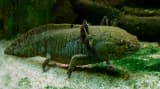 AxolotlAmbystoma mexicanumAt 25 zoos · Critically Endangered
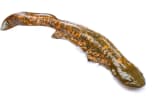 Eastern HellbenderCryptobranchus alleganiensis alleganiensisAt 11 zoos · Vulnerable
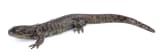 Tiger SalamanderAmbystoma tigrinumAt 9 zoos · Least Concern
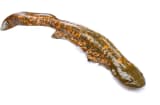 HellbenderCryptobranchus alleganiensisAt 6 zoos · Vulnerable
What makes a salamander
Salamanders are amphibians with a tail at every life stage, a cylindrical body and short legs that stick out to the sides. Their skin is thin and permeable, kept moist by mucus, and it doubles as a breathing surface. That permeable skin usually ties them to water or damp places.
Breathing varies widely between species. Larvae use feathery external gills, many adults use lungs, and the lungless salamanders rely on skin and mouth. The eastern hellbender has working lungs but takes in most of its oxygen through loose folds of skin along its sides.
Giants, gill-keepers and land dwellers
Size ranges from minute salamanders of 27 mm (1.1 in) to the Chinese giant salamander at 1.8 m (6 ft). The hellbender is the largest in North America and belongs to the same giant salamander family. Built flat to hug stream beds, it lives in clear, cool, fast-flowing rocky rivers.
The axolotl never fully grows up: it reaches maturity without metamorphosis, keeping its external gills and aquatic life. It is famous for regeneration, regrowing lost limbs and its tail. Its relative the tiger salamander does metamorphose and is one of the largest land-dwelling salamanders in North America, catching prey with a sticky tongue.
Defense and behavior
Slow and soft-bodied, salamanders rely on chemistry. Skin glands make many species slippery and distasteful or toxic, and brightly colored species, often yellow, orange or red with black, advertise their toxicity. Some salamanders drop the tail when attacked; it wriggles to distract the predator and later regrows.
The eyes of most salamanders are adapted mainly for vision at night. About a third of the world's species live in North America, with the highest concentration in the Appalachian Mountains.
Conservation picture
A higher share of salamander species than of frogs falls into the at-risk categories of the IUCN Red List. Chytridiomycosis has been linked to amphibian declines generally, and a second chytrid fungus discovered in 2013 attacks salamanders specifically.
The axolotl is Critically Endangered, with as few as 50 to 1,000 adults left in the wild, largely because introduced tilapia and carp eat its eggs and young. The hellbender is Vulnerable, with populations down about 77 percent in Missouri since the 1980s because of siltation, dams, pollution and disease.
Common questions
Is a salamander a lizard?
No. Salamanders are amphibians, and their closest relatives are frogs and toads. They look lizard-like only because both kept the ancient four-legged body plan, and their thin skin is permeable to water and works as a breathing surface.
What is the largest salamander?
The Chinese giant salamander is the largest, reaching 1.8 m (6 ft) and up to 65 kg (145 lb), which also makes it the largest amphibian in the world. In North America the largest is the hellbender, at 30 to 74 cm (12 to 29 in).
Can salamanders regrow limbs?
Yes. Salamanders can regenerate lost limbs and other damaged body parts, including tissue of the eye. The axolotl can regrow entire limbs and its tail over a period of months instead of healing with a scar.
Why does the axolotl keep its gills?
The axolotl is neotenic: it reaches adulthood without going through metamorphosis, so it stays fully aquatic and keeps its feathery external gills for life.
Where do most salamanders live?
Salamander diversity is highest in eastern North America, especially the Appalachian Mountains. About one-third of known species live in North America.
Are salamanders endangered?
Many are. A higher proportion of salamander species than frogs are in IUCN at-risk categories; the axolotl and Chinese giant salamander are Critically Endangered, and the hellbender is Vulnerable.
Sources
Last reviewed