- Where to see one
- 22 U.S. zoos in our directory hold reticulated python, confirmed against each zoo's own animal list.
- Native range
- South and Southeast Asia
- Size
- The world's longest snake; wild individuals studied in Sumatra ranged from 1.5 to 6.5 m (4 ft 11 in to 21 ft 4 in) and 1 to 75 kg (2 to 165 lb)
About the reticulated python
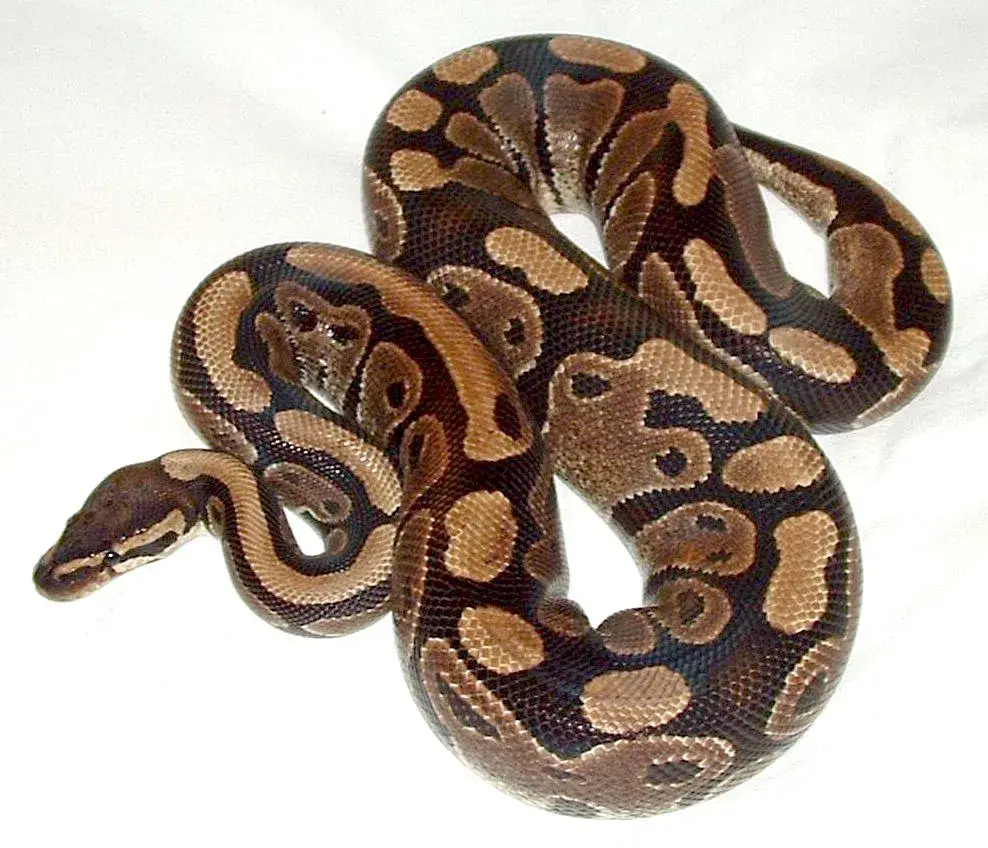
The reticulated python is a python species native to South and Southeast Asia. It holds the title of the world's longest snake, and is the third heaviest after the green anaconda and Burmese python. It is a non-venomous constrictor and a strong swimmer, reported far out at sea, which has allowed it to colonize many small islands within its range. Its color pattern is a complex geometric arrangement of irregular diamond shapes flanked by smaller light-centered markings — in a zoo enclosure it can look almost garish, but amid the leaf litter and shadow of a jungle floor, it lets the snake all but disappear, a form of disruptive coloration that helps it both hide from predators and ambush prey.
Its taxonomy has shifted more than once. First described in 1801 by Johann Gottlob Theaenus Schneider, it was later placed in its own genus, Broghammerus, by Raymond Hoser in 2004, though most taxonomists set that name aside because of how it was published. A 2014 study proposed the genus Malayopython for the reticulated python and its close relative the Timor python, and that name is now the one in general use among reliable sources. Three subspecies have been proposed, including two dwarf forms found on and around the Selayar Archipelago south of Sulawesi — one confined to the island of Tanahjampea, the other found on Selayar Island as well as adjacent Sulawesi itself — though the reticulated python's Sangihe Islands population and some other populations remain formally undescribed.
Size claims for this species are notoriously hard to pin down, because a live snake this large is nearly impossible to fully straighten for measurement, and shed or removed skins stretch well beyond the animal's living length. The specimen once considered the largest accurately measured snake, "Colossus," kept at what is now the Pittsburgh Zoo and Aquarium in the 1950s and '60s, was later found to be considerably shorter than its reported peak length of 8.7 meters (28 ft 7 in): its skeleton measured 6.35 m (20 ft 10 in) after death. One of the largest specimens with a scientifically credible measurement, from East Kalimantan, Indonesia, was recorded under anesthesia at 6.95 m (22 ft 10 in) and 59 kg (130 lb).
Because of the difficulty of measuring such a large, powerful, loose-skinned animal, claims made by zoos and parks have sometimes proven exaggerated — a snake in Indonesia once claimed at 14.85 m (48 ft 9 in) was later shown to be closer to 6.5 to 7 m (21 to 23 ft). Scientists generally accept length measurements only when taken on a dead or anesthetized snake later preserved in a museum collection. Under that standard, a reticulated python named "Medusa," kept in Kansas City, Missouri, is recognized by Guinness World Records as the longest snake ever kept in captivity, measured in 2011 at 7.67 m (25 ft 2 in) and 158.8 kg (350 lb). An albino reticulated python named "Twinkie," housed in Fountain Valley, California, was recognized by Guinness as the largest albino snake in captivity in 2012, at 7 m (23 ft) and about 168 kg (370 lb). Dwarf forms also exist, originating from islands northwest of Australia and selectively bred in captivity into "super dwarf" reticulated pythons that reach only 1.82 to 2.4 m (6 to 7 ft 10 in) as adults. A standing reward once offered by the New York Zoological Society, later the Wildlife Conservation Society, for a live snake of 30 ft (9.14 m) or more — raised over the years to $50,000 — has never been claimed.
Behavior and diet
Diet
Small mammals as juveniles; larger mammals and occasional birds as adults
The reticulated python is an ambush predator, waiting for prey to come within striking range before seizing it in its coils and killing by constriction. Small individuals up to 3 to 4 m (9.8 to 13.1 ft) long feed mainly on small mammals such as rats, other rodents, mouse-eared bats, and treeshrews. Larger snakes switch to bigger prey, including small Indian civets, binturongs, primates, wild boar, and deer species weighing more than 60 kg (130 lb); it can apparently swallow prey up to one-quarter its own length and up to its own body weight. Near people, it will occasionally take stray chickens, cats, and dogs. Among the largest documented meals is a half-starved sun bear of 23 kg (51 lb), eaten by a 6.95 m individual in East Kalimantan, which took about 10 weeks to digest.
The species is oviparous. Females lay between 15 and 80 eggs per clutch, which hatch after an average of 88 days at an optimal incubation temperature of 31 to 32 °C (88 to 90 °F). Hatchlings measure at least 0.61 m (2 ft) at birth.
Range and habitat
Habitat
Rainforest, woodland, and grassland, often near rivers, streams, and lakes
The reticulated python is found across South and Southeast Asia, from the Nicobar Islands, India, Bangladesh, and Myanmar through Thailand, Laos, Cambodia, Vietnam, Malaysia, and Singapore, east through Indonesia's islands — including Sumatra, Borneo, Sulawesi, Java, and many smaller islands — and across much of the Philippines. It lives in rainforests, woodlands, and nearby grasslands, and is closely associated with rivers, streams, and lakes. As a capable long-distance swimmer, it has even been reported far out at sea, a trait that has let it establish itself on many small islands throughout its range. In the early 20th century it was reportedly common even in busy parts of Bangkok, where it would sometimes take domestic animals.
Conservation status
The reticulated python is listed as Least Concern by the IUCN, owing to its wide distribution across South and Southeast Asia. It is nonetheless of major economic importance across its range: it is hunted for its skin, used in traditional medicine, and sold as a pet, making it among the most commercially important reptile species in the world. In the United States, it was added to the federal Injurious Wildlife List in 2015, barring its import and, for a time, its interstate transport, though a 2017 court decision rescinded the interstate transport restriction.
Where to see reticulated python in the U.S.
22 zoos across 16 states
Find the closest one
Rank the 18 zoos holding reticulated python by how far they are from you. Your location is used in your browser to sort this list and is never sent to us.
4 more zoos hold reticulated python but have no coordinates on file yet, so they aren't ranked here. They're in the full list below.
California· 1
Florida· 1
Illinois· 1
Kentucky· 1
Louisiana· 1
Massachusetts· 1
Michigan· 2
Minnesota· 1
Missouri· 1
New York· 2
Ohio· 1
Oklahoma· 1
Pennsylvania· 2
Tennessee· 1
Texas· 4
Virginia· 1
AZAThe Association of Zoos and Aquariums. Accredited members have passed an independent inspection of animal care and welfare, safety, conservation and education, repeated every five years. Many smaller facilities never apply, so “not accredited” isn't a verdict on its own. What accreditation means · How we check this
Built from each zoo's own published animal list.
Reticulated Python: common questions
How big does a reticulated python get?
It is the world's longest snake. A large, scientifically measured wild specimen from East Kalimantan came in at 6.95 m (22 ft 10 in) and 59 kg (130 lb); individuals over 6 m (19 ft 8 in) are rare.
What does a reticulated python eat?
Small mammals such as rats and treeshrews as juveniles, and progressively larger mammals — including civets, primates, wild boar, and deer — as adults, along with the occasional bird.
Is the reticulated python endangered?
No. It is listed as Least Concern by the IUCN because of its wide range across South and Southeast Asia, though it is heavily hunted for its skin and for the pet trade.
Where do reticulated pythons live in the wild?
Across South and Southeast Asia, from India and Bangladesh through Southeast Asia and Indonesia to the Philippines, typically in rainforest, woodland, and grassland near water.
Can reticulated pythons swim?
Yes. They are strong swimmers that have been reported far out at sea, which is how the species has colonized many small islands within its range.
Which U.S. zoos have reticulated pythons?
Feather & Fang's directory lists 8, including the Houston Zoo, Detroit Zoo, and Buffalo Zoo.