- Where to see one
- 18 U.S. zoos in our directory hold umbrella cockatoo, confirmed against each zoo's own animal list.
- Native range
- The North Moluccas of Indonesia: Halmahera, Bacan, Ternate, Tidore, Kasiruta and Mandioli
- Size
- About 46 cm (18 in) long; roughly 400 g (14 oz) for small females up to 800 g (28 oz) for large males
- Lifespan
- Reported at 40 to 60 years in captivity; the wild lifespan is not well known
- Clutch size
- Usually two white eggs, incubated for about 28 to 30 days
- Other name
- White cockatoo
Conservation status
Endangeredassessed 2018
IUCN Red List category EN — step 4 of 7.
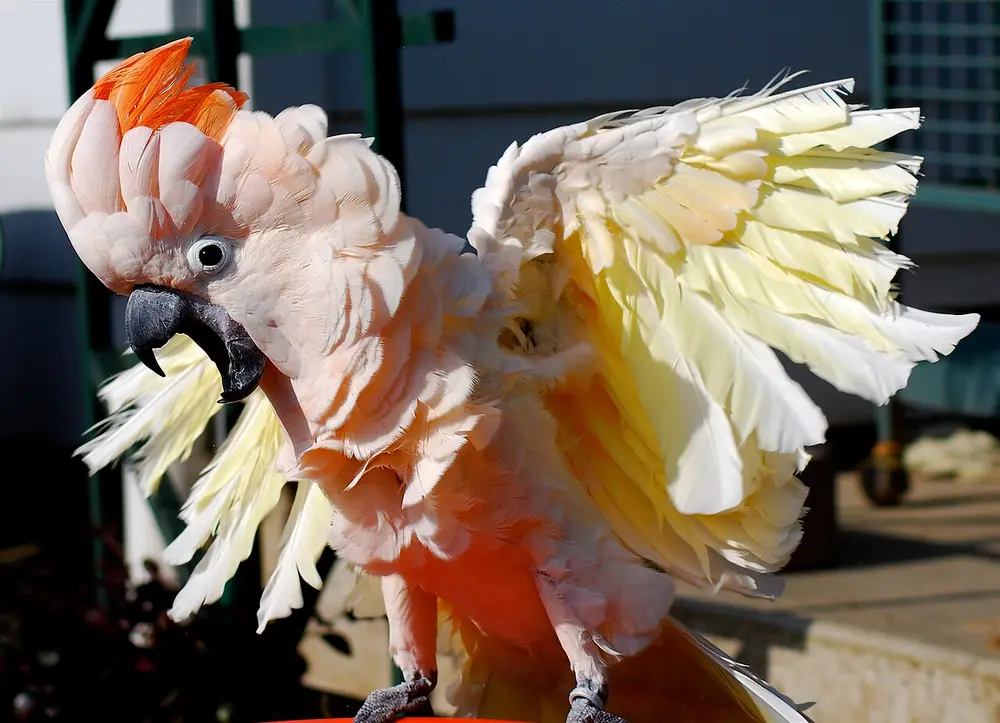
The white cockatoo, also called the umbrella cockatoo, is a medium-sized, all-white cockatoo endemic to lowland tropical rainforest on islands of Indonesia, including Halmahera, Bacan, Ternate and Tidore in North Maluku. When surprised it raises a large, semicircular head crest that resembles an umbrella. Pale yellow on the wings and tail shows when it flies. Around 46 cm (18 in) long, it weighs about 400 g to 800 g, and it lives in primary, logged and secondary forest below 900 m as well as mangroves and plantations. Like other cockatoos it nests in hollows of large trees, and its zygodactyl feet let it grasp objects with one foot while standing on the other.
About the umbrella cockatoo
The umbrella cockatoo, also called the white cockatoo, is a medium-sized, all-white parrot of the cockatoo family. It is found naturally only in lowland rainforest on a handful of islands in the North Moluccas of Indonesia. Its name comes from the broad, semicircular crest it fans open like an umbrella when surprised.
Scientists know the bird as Cacatua alba, a name first published in 1776 by the German zoologist Philipp Ludwig Statius Müller. The species name alba is a feminine form of the Latin word for "white." It closely resembles other white cockatoos, such as the sulphur-crested, yellow-crested and salmon-crested cockatoos, but those birds carry yellow, orange or pink crest feathers. The umbrella cockatoo's crest is white.
Up close, the plumage is not purely white. The inner half of the trailing edge of the large flight feathers is pale yellow, and the yellow shows most clearly on the underside of the wings when the bird flies. Hidden parts of the tail feathers and the bases of the long crest feathers are yellow as well. The beak and legs are dark grey, and a pale blue ring of bare skin surrounds each eye.
Males and females look much alike, but there are clues. Males usually have a broader head and a larger beak. Adult males have dark brown or black irises, while some mature females develop reddish-brown irises. Like other cockatoos, the umbrella cockatoo produces a fine feather powder, similar to talc, that rubs off easily on clothing.
Its feet are zygodactyl, with two toes pointing forward and two pointing back. That arrangement lets the bird hold food or an object in one foot while it balances on the other.
Behavior and diet
Diet
Fruit, seeds, nuts and berries, plus insects and the occasional small lizard
Umbrella cockatoos are diurnal birds that spend most of their time in the forest canopy. They travel alone, in pairs or in small groups, and flocks of up to 15 birds are common. In the afternoon, larger gatherings of up to 50 birds can form. Apart from mated pairs, individuals do not form close bonds, and there is no firm pecking order within a group.
Most birds stay in one area, though some wander nomadically in search of food. They are bright, curious animals that have been seen using tools, such as picking up a branch to scratch their own backs. Pairs communicate with a range of calls and gestures. They have also been observed banging pieces of wood against trees and logs, apparently to signal that a territory is taken.
In the wild the diet is mostly plant food: berries, seeds, nuts, fruit and roots. Reported fruits include papaya, durian, langsat and rambutan. The birds also take large insects such as crickets, small lizards such as skinks, and insect larvae during the nesting season. Because they raid maize fields, farmers sometimes treat them as crop pests.
By eating fruit, umbrella cockatoos help spread seeds through the forest. Their nest holes are probably used by other animals outside the breeding season.
Courtship is a showy affair. The male ruffles his feathers, fans his tail, opens his wings, raises his crest and bounces around. The female usually ignores or avoids him at first. If she accepts him, the two preen each other's heads and scratch around each other's tails, which strengthens the pair bond. Experienced pairs skip most of the display.
Pairs are monogamous and their bonds last for life. Breeding follows the weather, usually starting when plant growth peaks, most often between December and March. A pair leaves its group, finds a cavity high in a large tree, usually 5 to 30 m (16 to 98 ft) above the ground, and lays two white eggs, occasionally three.
Both parents share incubation, which lasts around 28 to 30 days. The larger chick soon dominates the smaller one and takes more of the food, and parents often raise only one. Chicks leave the nest at roughly 84 days, or about three months, and become independent at about 15 to 18 weeks. Estimates of the age at first breeding range from three to four years up to about six years.
Range and habitat
Habitat
Lowland tropical rainforest, logged and secondary forest, mangroves, swamps and plantations, below about 900 m (2,950 ft)
The umbrella cockatoo is an island endemic. It lives naturally on Halmahera, Bacan, Ternate, Tidore, Kasiruta and Mandioli, all in the North Maluku province of Indonesia. Birds recorded on Obi and nearby Bisa are thought to be introduced. A small introduced population also breeds on Taiwan.
Within its range it uses primary forest, logged forest and secondary growth below about 900 m (2,950 ft). It also turns up in mangroves, swamps, coconut plantations and farmland, and it is especially common along the edges of clearings and rivers. Tall secondary vegetation may be its preferred habitat.
Conservation status
The umbrella cockatoo is listed as Endangered on the IUCN Red List, in an assessment by BirdLife International published in 2018. Wild numbers have fallen because of trapping for the cage-bird trade and the loss of forest habitat, and hunting adds further pressure.
Trapping was heavy in the early 1990s. In 1991, Indonesian catch quotas were exceeded by up to 18 times in some places, and at least 6,600 birds were taken from the wild that year. An estimated 17% of the world population was removed each year between 1990 and 1993. The United States was the largest importer of wild-caught birds, with 10,143 recorded between 1990 and 1999.
The species was placed on CITES Appendix II in 1981, which restricts international trade in wild-caught birds. Indonesia stopped issuing any catch quota in 1999, making capture illegal. Even so, illegal trade continues: surveys found more than 200 birds taken from north Halmahera in 2007. About 40% of parrots trapped there were smuggled to the Philippines, and the rest entered the domestic market.
A 1991 to 1992 survey estimated the wild population at between 42,545 and 183,129 birds, possibly an underestimate. More recent observations point to rapid, ongoing declines that are expected to worsen.
Where to see umbrella cockatoo in the U.S.
18 zoos across 15 states
Find the closest one
Rank the 13 zoos holding umbrella cockatoo by how far they are from you. Your location is used in your browser to sort this list and is never sent to us.
5 more zoos hold umbrella cockatoo but have no coordinates on file yet, so they aren't ranked here. They're in the full list below.
Arizona· 1
Delaware· 1
Illinois· 2
Kansas· 1
Massachusetts· 1
Michigan· 1
Missouri· 1
New York· 2
North Carolina· 1
Ohio· 1
Pennsylvania· 1
South Dakota· 1
Tennessee· 1
Texas· 2
Wisconsin· 1
AZAThe Association of Zoos and Aquariums. Accredited members have passed an independent inspection of animal care and welfare, safety, conservation and education, repeated every five years. Many smaller facilities never apply, so “not accredited” isn't a verdict on its own. What accreditation means · How we check this
Built from each zoo's own published animal list.
Umbrella Cockatoo: common questions
Why is it called an umbrella cockatoo?
Because of its crest. When the bird is surprised or excited, it raises a broad, semicircular fan of white feathers that looks like an open umbrella.
How big do umbrella cockatoos get?
About 46 cm (18 in) long. Small females weigh around 400 g (14 oz), and large males can reach about 800 g (28 oz).
How long do umbrella cockatoos live?
Reportedly 40 to 60 years in captivity. Their lifespan in the wild is poorly known and is thought to be shorter.
What do umbrella cockatoos eat?
Mostly fruit, seeds, nuts, berries and roots, including papaya, durian and rambutan. They also eat crickets, insect larvae and small lizards, and they raid maize fields.
Where do umbrella cockatoos live in the wild?
Only on a few islands in the North Moluccas of Indonesia, including Halmahera and Bacan. They live in lowland forest, mangroves, swamps and plantations below about 900 m (2,950 ft).
Are umbrella cockatoos endangered?
Yes. The IUCN lists the species as Endangered, mainly because of trapping for the pet trade and loss of forest habitat.
Can you keep an umbrella cockatoo as a pet?
They are widely kept as pets, but they are demanding. Captive birds need almost constant mental stimulation, and bored birds can pluck out their own feathers until they are bald.
Are male and female umbrella cockatoos different?
Slightly. Males tend to have a broader head and bigger beak, and adult females may have reddish-brown irises while males have dark brown or black eyes.