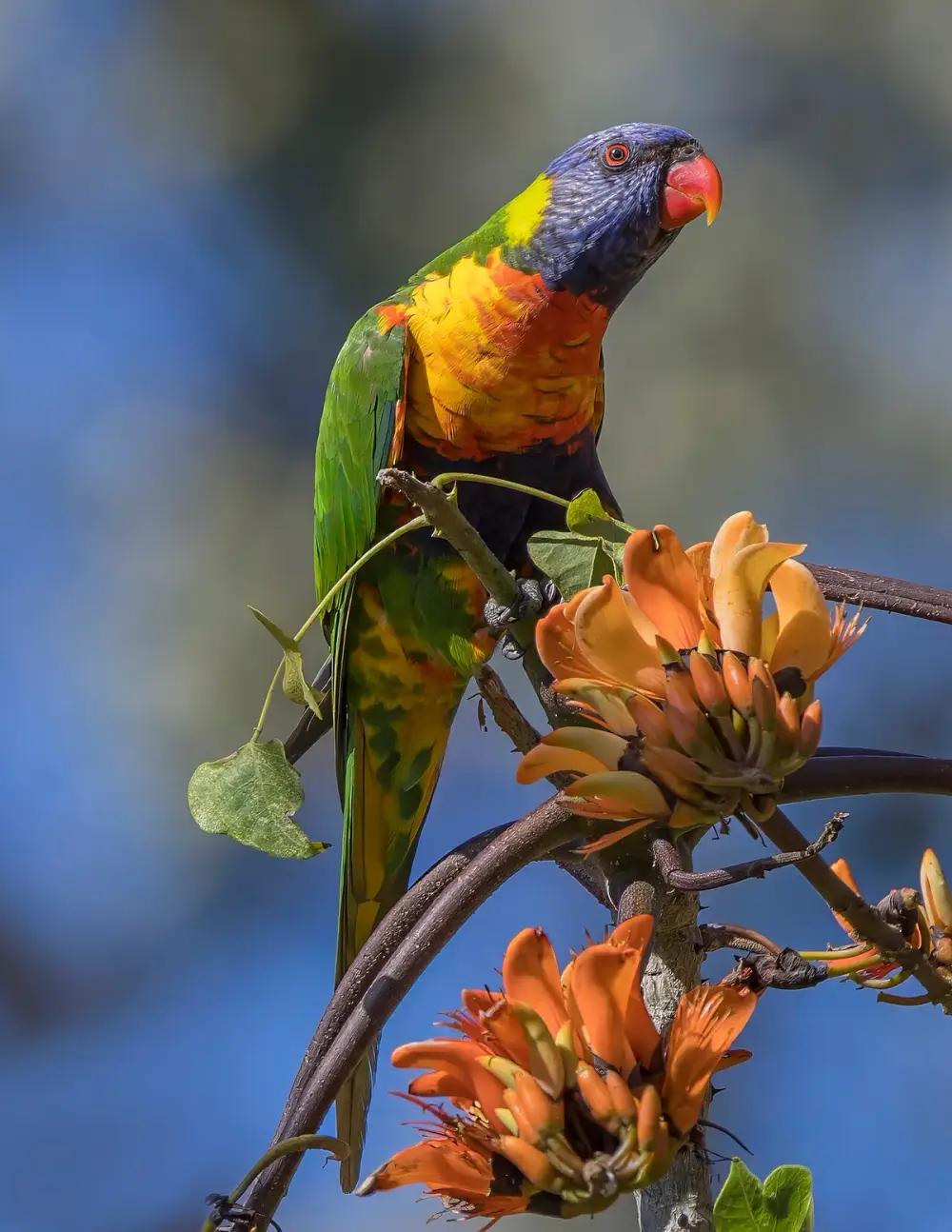
- Where to see one
- 15 U.S. zoos in our directory hold lorikeet, confirmed against each zoo's own animal list.
- Native range
- Australasian region, including southeastern Asia, Polynesia, Papua New Guinea, Timor Leste, and Australia
Conservation status
Not Evaluated
This species has not been assessed for the IUCN Red List, so it sits outside the threat scale entirely.
Varies by species; some face serious threats
About the lorikeet
Lorikeets belong to Loriini, a tribe of small to medium-sized arboreal parrots built around one striking adaptation: a brush-tipped tongue specialized for feeding on nectar and soft fruit, especially berries. Together with the lories, they form a single, monophyletic group within the parrot family Psittaculidae. Researchers once split lories and lorikeets into their own subfamily, separate from other parrots, on the strength of that specialized tongue, but molecular and morphological studies since have shown the group actually sits in the middle of the broader parrot family tree, closely related to the budgerigar and the fig parrots. The name itself has a long paper trail: "lory" comes from the Malay word lūri, first used by the Dutch writer Johan Nieuhof in his 1682 travel account of the East Indies, and later adopted by naturalists such as George Edwards in the 1750s. Which name an individual species gets — "lory" or "lorikeet" — is somewhat subjective, though the convention is that longer, tapering tails earn the "lorikeet" label while short, blunt tails go with "lory."
Taxonomically, the group has been in flux. A comprehensive molecular study published in 2020 reorganized the genus boundaries within Loriini, resurrecting four older genera — Charminetta, Hypocharmosyna, Charmosynopsis, and Glossoptilus — and creating three entirely new ones, while eliminating another when the collared lory turned out to belong inside the genus Vini. The extinct New Caledonian lorikeet, though not sampled in that study, is likewise assumed to belong within Vini, based on its plumage and geography. As currently understood, the tribe Loriini contains 61 species spread across 12 genera. Lorikeets are found throughout the Australasian region — southeastern Asia, Polynesia, Papua New Guinea, Timor Leste, and Australia — and the majority carry very brightly colored plumage, a hallmark of the group. The multi-colored rainbow lorikeet, one of the tribe's best-known members, appeared in the first edition of The Parrots of the World and in John Gould's lithographs of the Birds of Australia. A lory also makes a literary appearance in Lewis Carroll's Alice's Adventures in Wonderland, arguing with Alice about its age in the book's third chapter.
Behavior and diet
Diet
Nectar, pollen, and soft fruits, taken with a specialized brush-tipped tongue
The lorikeet's tongue is the key to its way of life: brush-tipped and covered at the end with tufts of fine papillae, it is built to collect nectar and pollen efficiently, letting lorikeets feed from the flowers of roughly 5,000 different plant species. In the wild, rainbow lorikeets feed mainly on pollen and nectar, and many fruit orchard owners consider them a pest, since they often fly in groups and strip trees of fresh fruit. Rainbow lorikeets are also frequent visitors to backyard bird feeders stocked with lorikeet-friendly food, including store-bought nectar mixes, sunflower seeds, and fruits such as apples, grapes, and pears. Despite their reputation as nectar specialists, rainbow lorikeets have occasionally been observed feeding on meat as well.
Range and habitat
Habitat
Arboreal, tied to flowering and fruiting trees
Lorikeets are distributed across the Australasian region, spanning southeastern Asia, Polynesia, Papua New Guinea, Timor Leste, and Australia. As arboreal birds built around a nectar-and-fruit diet, their movements and range within this broad region track the availability of flowering and fruiting trees. The tribe's 61 species are split across 12 genera, a level of diversity that spans everything from widespread mainland Australian species to island specialists found nowhere else.
Conservation status
Lorikeets have no single conservation status, because the IUCN Red List assesses each of the tribe's 61 species separately. Some, such as the rainbow lorikeet, are listed as Least Concern. Others are in serious trouble.
The ultramarine lorikeet is Endangered and ranks among the 50 rarest birds in the world, and the blue lorikeet is Vulnerable. For both, European rats introduced to their small island homes are a major cause of decline, along with habitat destruction. Conservation efforts have relocated some of these birds to places free of predation and habitat destruction.
Where to see lorikeet in the U.S.
15 zoos across 11 states
Find the closest one
Rank the 14 zoos holding lorikeet by how far they are from you. Your location is used in your browser to sort this list and is never sent to us.
1 more zoo holds lorikeet but has no coordinates on file yet, so it isn't ranked here. It's in the full list below.
California· 2
Colorado· 1
Florida· 3
Indiana· 1
Kentucky· 1
North Carolina· 1
Pennsylvania· 1
South Carolina· 1
Tennessee· 2
Virginia· 1
Washington· 1
AZAThe Association of Zoos and Aquariums. Accredited members have passed an independent inspection of animal care and welfare, safety, conservation and education, repeated every five years. Many smaller facilities never apply, so “not accredited” isn't a verdict on its own. What accreditation means · How we check this
Built from each zoo's own published animal list.
Lorikeet: common questions
Is the lorikeet endangered?
It depends on the species. Some, such as the rainbow lorikeet, are Least Concern, but the ultramarine lorikeet is Endangered and the blue lorikeet is Vulnerable, mainly because of rats introduced to their island habitats.
What does a lorikeet eat?
Mainly nectar and pollen, gathered with a specialized brush-tipped tongue, along with soft fruits; rainbow lorikeets in particular will also visit bird feeders for nectar mixes, seeds, and fruit.
Where do lorikeets live in the wild?
Across the Australasian region, including southeastern Asia, Polynesia, Papua New Guinea, Timor Leste, and Australia.
Why is it called a "lorikeet"?
The name traces back to the Malay word lūri, adopted by 17th- and 18th-century naturalists; species with longer, tapering tails are generally called lorikeets, while short-tailed relatives are called lories.
Which U.S. zoos have lorikeets?
Six U.S. zoos, including the San Diego Zoo, the Indianapolis Zoo, and the Riverbanks Zoo.