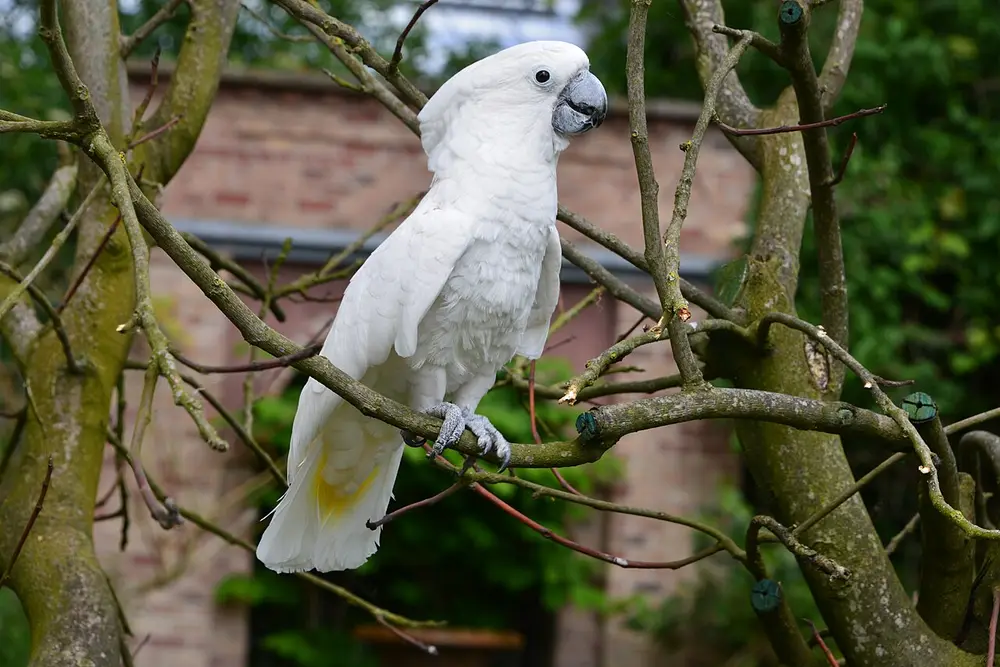
Moluccan Cockatoo
Cacatua moluccensis
Also known as Salmon-crested Cockatoo
- Where to see one
- 13 U.S. zoos in our directory hold moluccan cockatoo, confirmed against each zoo's own animal list.
- Native range
- The Seram archipelago in eastern Indonesia; a small introduced population lives on Oahu, Hawaii
- Size
- 46–52 cm (18–20.5 in) tall; up to 850 g (1.9 lb)
- Lifespan
- Very long-lived; one captive bird reached 92 years
- Wild population
- An estimated 20,000–60,000 mature birds (2024)
- Other name
- Salmon-crested cockatoo
Conservation status
Endangeredassessed 2024
IUCN Red List category EN — step 4 of 7.
The Moluccan cockatoo, also called the salmon-crested cockatoo, is endemic to the Seram archipelago in eastern Indonesia, where it inhabits lowland forests below 1,000 metres. It is among the largest of the white cockatoos, up to 46 to 52 cm tall, with white-pink feathers and a peachy glow. Its diet consists mainly of seeds, nuts, fruit and coconuts, and it may also eat insects from the ground. It breeds once a year, usually between December and March, when vegetation growth peaks and food is plentiful. It has one of the louder calls in the parrot world and is a capable mimic in captivity.
About the Moluccan cockatoo
The Moluccan cockatoo, also called the salmon-crested cockatoo, is a large white cockatoo found only in the Seram archipelago of eastern Indonesia. A parrot of the cockatoo family, Cacatuidae, it is known for a hidden salmon-red crest and one of the loudest calls of any bird. It is listed as Endangered.
Its scientific name is Cacatua moluccensis, and it is one of 11 species in the genus Cacatua. The German naturalist Johann Friedrich Gmelin described it in 1788, with the Maluku Islands as the type locality. No subspecies are recognized. Cockatoos as a family are parrots of Australasia, set apart from the true parrots by their movable crests.
At 46–52 cm (18–20.5 in) tall and up to 850 g (1.9 lb), it is among the largest white cockatoos. Females are slightly smaller than males on average. The plumage is white with a definite peachy-pink glow, and there is a slight yellow tint under the wings and tail.
The crest
The bird's signature is a large crest that normally lies flat along the head. When the cockatoo feels threatened, it raises the crest to reveal bright red-orange plumes hidden underneath, a sudden flash meant to frighten attackers. It also lifts the crest when excited or in other emotional displays. Some describe the color as flamingo-like.
Built like a cockatoo
Like other cockatoos, it has a strong curved bill, short legs, strong claws and a zygodactyl foot, with two toes pointing forward and two back. The large bill is kept sharp by rasping the jaws together, and a muscular tongue holds seeds in place while the bill cracks off the husk. Cockatoos often use the bill as a third limb when climbing. A fine powder spread through the feathers from special down feathers helps keep the plumage in condition.
Behavior and diet
Diet
Seeds, nuts, fruit and coconuts; possibly some insects
Cockatoos are diurnal and highly social, roosting, feeding and traveling in noisy flocks. They are not early risers, typically waiting for the sun to warm their roosts before they start to feed. Calls are loud and harsh and help birds recognize each other, warn of predators, keep flocks together and defend nests; threatened cockatoos also hiss.
The Moluccan cockatoo has one of the louder voices among parrots, with calls measured at up to 129 decibels. In captivity it is a capable mimic.
Cockatoos also favor one foot, much as people favor one hand: in most species 87–100% of birds hold their food in the left foot. To bathe, cockatoos may hang upside down or fly about in the rain, or flutter among wet leaves in the canopy.
What Moluccan cockatoos eat
In the wild, the diet is mainly seeds, nuts and fruit, including coconuts. There is some evidence that the birds also pick insects off the ground. Pet birds given too little protein have tested positive for anemia. Like other cockatoos, they open seeds with a large, powerful bill.
Breeding
Moluccan cockatoos breed once a year, usually between December and March, when plant growth is at its peak and food is plentiful. Cockatoos in general are monogamous, with pair bonds that can last many years, and they nest in tree hollows they cannot dig themselves, lining them with sticks and wood chips. Females of most cockatoo species first breed at three to seven years old, and young birds of some species stay with their parents for up to a year. Some of the larger cockatoos lay only a single egg.
Range and habitat
Habitat
Lowland forest below 1,000 m (3,300 ft)
The Moluccan cockatoo is endemic to the Seram archipelago of eastern Indonesia, part of the cockatoo family's wider range across the Philippines, eastern Indonesia, New Guinea, the Solomon Islands and Australia. It lives in lowland forest below about 1,000 m (3,300 ft). Manusela National Park on Seram is a stronghold for the species.
Outside its native range, a small population has become established on the Hawaiian island of Oahu. Birds have also been seen in the wild in Puerto Rico, but these are probably escaped pets, and no breeding has been recorded there.
Because cockatoos depend on large, mature trees for nest hollows, clearing forest hits them especially hard. Island species with small natural ranges, like this one, are more vulnerable still.
Conservation status
The Moluccan cockatoo is listed as Endangered on the IUCN Red List, most recently assessed by BirdLife International in 2024. An estimated 20,000 to 60,000 mature birds remain, and the population is expected to decline rapidly because of continued trapping and habitat destruction.
Trapping for the pet trade has been a major problem. At its peak, more than 6,000 birds a year were being taken from the wild, and between 1983 and 1990 a recorded 66,654 were exported from Indonesia, not counting birds sold within the country or smuggled out. Smuggled cockatoos are put in crates or bamboo tubes and shipped by boat out of Indonesia, and some illegal trapping still continues on Seram.
Since 1989 the species has been listed on CITES Appendix I, which bans commercial international trade in wild-caught birds. Captive-bred birds can be traded legally only with proper CITES paperwork.
A demanding pet
The Moluccan cockatoo is widely considered one of the most demanding parrots to keep. It is intelligent, large, extremely loud and a determined chewer, so it needs a very large, sturdy cage or aviary. Pet birds can be very affectionate, but those cuddled constantly when young without learning to play or forage on their own often develop problems. Without enough attention, toys and enrichment, large cockatoos may start plucking their feathers or become aggressive.
Where to see moluccan cockatoo in the U.S.
13 zoos across 13 states
Find the closest one
Rank the 11 zoos holding moluccan cockatoo by how far they are from you. Your location is used in your browser to sort this list and is never sent to us.
2 more zoos hold moluccan cockatoo but have no coordinates on file yet, so they aren't ranked here. They're in the full list below.
California· 1
Florida· 1
Hawaii· 1
Kansas· 1
Maryland· 1
Massachusetts· 1
Michigan· 1
Minnesota· 1
North Carolina· 1
Ohio· 1
Pennsylvania· 1
Tennessee· 1
Virginia· 1
AZAThe Association of Zoos and Aquariums. Accredited members have passed an independent inspection of animal care and welfare, safety, conservation and education, repeated every five years. Many smaller facilities never apply, so “not accredited” isn't a verdict on its own. What accreditation means · How we check this
Built from each zoo's own published animal list.
Moluccan Cockatoo: common questions
Why is it called the salmon-crested cockatoo?
Because of its crest. When raised, it reveals bright salmon to red-orange plumes hidden beneath the white outer feathers, and the body plumage also has a peachy-pink glow.
How big is a Moluccan cockatoo?
It stands 46–52 cm (18–20.5 in) tall and weighs up to 850 g (1.9 lb), making it one of the largest white cockatoos.
How loud is a Moluccan cockatoo?
Very loud. Its calls have been measured at up to 129 decibels, among the loudest of any bird.
How long do Moluccan cockatoos live?
A very long time. One captive bird mentioned in a 2011 paper lived to 92, and large cockatoos generally live 30 to 70 years or more.
What do Moluccan cockatoos eat?
Mainly seeds, nuts and fruit, including coconuts, with some evidence that they also eat insects from the ground.
Are Moluccan cockatoos endangered?
Yes. The species is listed as Endangered, mainly because of trapping for the pet trade and loss of forest habitat.
Can you keep a Moluccan cockatoo as a pet?
Only captive-bred birds can be traded internationally, with CITES paperwork, and they are among the most demanding parrots to keep, needing a huge sturdy cage, constant attention and plenty to chew.