
Hornbills and toucans in U.S. zoos
Hornbills and toucans are two unrelated families of big-billed birds. Hornbills (Bucerotidae, about 62 species) live in Africa, Asia and Melanesia; toucans (Ramphastidae, over 40 species) live only in the American tropics. Their resemblance is convergent evolution: each fills the same ecological niche on different continents.
Most widely held
 Southern Ground HornbillBucorvus leadbeateriAt 18 zoos · Vulnerable
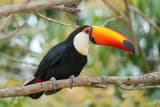 Toco ToucanRamphastos tocoAt 12 zoos · Least Concern
 Von der Decken's HornbillTockus deckeniAt 11 zoos · Least Concern
 Rhinoceros HornbillBuceros rhinocerosAt 10 zoos · Vulnerable
 Keel-billed ToucanRamphastos sulfuratusAt 8 zoos · Near Threatened
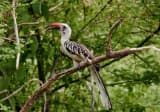 Red-billed HornbillTockus erythrorhynchusAt 7 zoos · Least Concern
 ToucanRamphastidaeAt 7 zoos
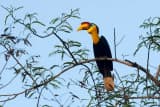 Wrinkled HornbillRhabdotorrhinus corrugatusAt 7 zoos · Endangered
 Curl-crested AracariPteroglossus beauharnaisiiAt 6 zoos · Least Concern
 Silvery-cheeked HornbillBycanistes brevisAt 6 zoos · Least Concern
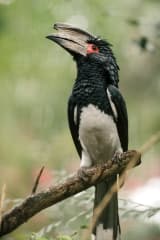 Trumpeter HornbillBycanistes bucinatorAt 6 zoos · Least Concern
 HornbillBucerotidaeAt 4 zoos
Two families, one look
Hornbills and toucans are the classic example of convergent evolution in birds. Hornbills belong to the family Bucerotidae, with about 62 living species across sub-Saharan Africa and from the Indian subcontinent to the Philippines and the Solomon Islands. Toucans, aracaris and toucanets make up the family Ramphastidae, with over 40 species found only in the Neotropics. The two groups are not closely related: toucans sit near the barbets and woodpeckers, hornbills near the hoopoes.
Both families nest in cavities, eat fruit along with small animals, and rely on oversized bills. The toco toucan is the largest toucan, while the green aracari, at 30 to 40 cm (12 to 16 in), is among the smallest members of its family. Among hornbills, the southern ground hornbill is the heaviest, and the red-billed hornbill, about 42 cm (17 in) long, is one of the smaller species.
Telling them apart
The quickest field mark is the casque, a hollow ridge along the top of the upper bill that only hornbills have. In some species it is barely visible; in others, such as the rhinoceros hornbill with its orange-and-red casque shaped like a rhinoceros horn, it is large. Some large casques are braced with bone and open inside, so they can act as resonators for calls. The trumpeter hornbill carries a big grey casque, while the red-billed hornbill has none at all.
Toucan bills lack a casque but are often much more colorful, and in some large species measure more than half the body length. The keel-billed toucan has a mostly green bill with orange sides and a red tip. Hornbills are also the only birds whose first two neck vertebrae are fused, a feature thought to give the heavy bill a steadier base.
Nesting behavior
Both groups nest in tree holes rather than building open nests, and toucans mostly use cavities made by other animals. Hornbills add a twist: in most species the female seals herself inside with a wall of mud, droppings and fruit pulp, leaving a slit just wide enough for the male to pass food in. The wrinkled hornbill follows this pattern, with the male feeding the whole family alone.
Ground hornbills skip the sealing and nest conventionally. The southern ground hornbill is a cooperative breeder, with each breeding pair helped by at least two other birds.
Conservation picture
Because forest hornbills need large old trees with nest cavities, clearing forest removes both nest sites and food. No African hornbill is seriously threatened, but many Asian species are at risk from hunting and habitat loss, most of them on islands. The wrinkled hornbill was moved to Endangered in 2018 because of heavy deforestation, and the rhinoceros hornbill was uplisted to Vulnerable the same year.
The southern ground hornbill is Vulnerable globally on the IUCN Red List, and its slow breeding, about one fledgling every three years in good conditions, makes recovery difficult. Toucans have been hunted for food and kept as pets across their range; the keel-billed toucan is Near Threatened because of habitat loss and trapping for the wildlife trade.
Common questions
Are hornbills and toucans related?
No. Toucans are related to barbets and woodpeckers, while hornbills are allied with the hoopoes and wood-hoopoes. Their similar look is an example of convergent evolution, since both occupy the same ecological niche on different continents.
How can you tell a hornbill from a toucan?
Look for a casque: many hornbills carry a hollow, horn-like ridge on top of the bill, which toucans never have. Range helps too, since hornbills are native to Africa, Asia and Melanesia and toucans only to the Neotropics, from southern Mexico to northern Argentina.
What is the largest hornbill?
The southern ground hornbill appears to be the largest and most massive hornbill, averaging 3.77 kg (8.3 lb) and weighing up to 6.3 kg (14 lb), with a wingspan of about 180 cm (5 ft 11 in).
What is the largest toucan?
The toco toucan is the largest toucan, at about 680 g (1.5 lb) and up to 63 cm (25 in) long. It is also the only toucan that lives outside forest, in savanna with forest patches and open woodland.
Why is a toucan's bill so light?
The bill is built of bone struts with foam-like keratin between them, so it weighs far less than it looks. Researchers have found it also works as an efficient system for shedding body heat.
Why do hornbills seal themselves into their nests?
In most hornbills the female walls up the nest cavity with mud, droppings and fruit pulp, leaving a narrow slit through which the male passes food. The behavior apparently protects the nest site from rival hornbills; ground hornbills do not do it.
Are hornbills endangered?
Some are. No African hornbill is seriously threatened, but many Asian species are at risk from hunting and habitat loss because they depend on primary forest, and three species are rated Critically Endangered.
Sources
Last reviewed