- Where to see one
- 9 U.S. zoos in our directory hold rainbow lorikeet, confirmed against each zoo's own animal list.
- Native range
- Eastern and southeastern Australia, from northern Queensland to South Australia
- Size
- 25–30 cm (9.8–11.8 in) long including the tail; 75–157 g (2.6–5.5 oz)
- Clutch size
- One to three eggs
- Incubation
- About 25 days, by the female alone
- Introduced populations
- Perth, Tasmania, Auckland (New Zealand) and Hong Kong
Conservation status
Least Concernassessed 2016
IUCN Red List category LC — step 1 of 7.
The rainbow lorikeet is a medium-sized parrot, 25 to 30 cm long, found along the east coast of Australia from northern Queensland through New South Wales and Victoria to South Australia. Its plumage is bright, with a deep blue head, green wings and back, and an orange-yellow chest. It inhabits forest, shrubland and wetlands, and feeds mainly on fruit, pollen and nectar, using a tongue with a brush-like tip suited to gathering pollen and nectar from flowers. Males and females look identical. Pairs are mostly monogamous and may stay together for life, nesting in tree hollows or palm trunks.
About the rainbow lorikeet
The rainbow lorikeet is a medium-sized, brightly colored parrot native to eastern Australia, where it lives along the coast from northern Queensland to South Australia. It is one of the lorikeets, with a brush-tipped tongue adapted for gathering nectar and pollen, and it is the most commonly observed bird in Australia.
Its scientific name is Trichoglossus moluccanus. The species name means "of the Moluccas," a mistake that goes back to 1788, when the German naturalist Johann Friedrich Gmelin described it believing the specimens came from those islands. The type locality was later corrected to Botany Bay in Australia. For years the name "rainbow lorikeet" covered a much larger group of birds, including island forms in the Lesser Sundas and Melanesia. Six forms once treated as its subspecies are now considered separate species, including the coconut lorikeet and the red-collared lorikeet, which were split off in 2019. Today two subspecies of the rainbow lorikeet are recognized.
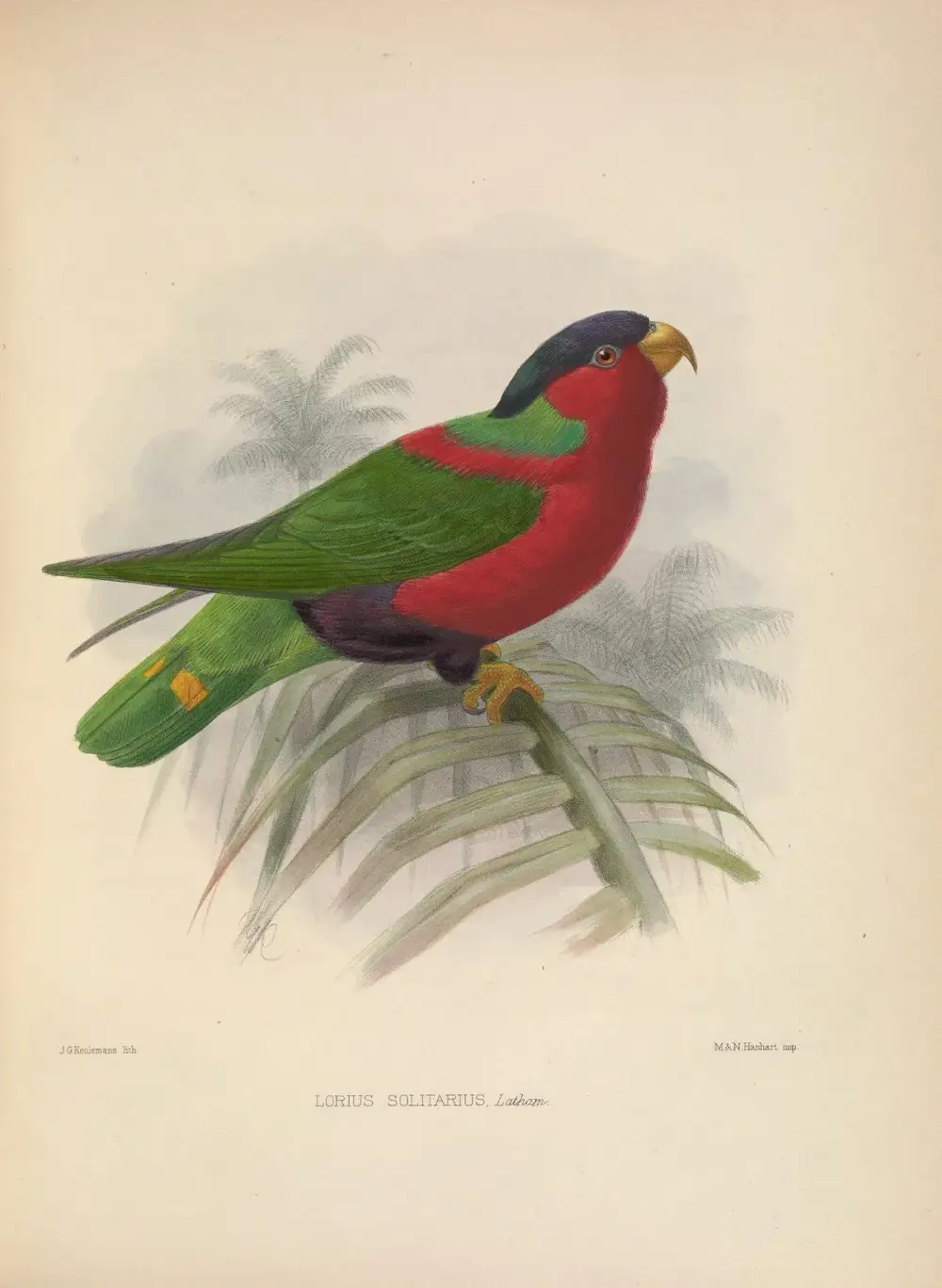
This is a medium-sized parrot, 25–30 cm (9.8–11.8 in) long including the tail, weighing 75–157 g (2.6–5.5 oz). Its colors live up to the name. The head is deep blue, bordered by a greenish-yellow collar on the nape. The wings, back and tail are green, the chest is orange-yellow, and the belly is deep blue, with green thighs and rump. In flight, a yellow wing bar stands out against red feathers under the wing.
Males and females look the same. There are no obvious visual differences, so a veterinarian has to determine sex surgically or by DNA testing a feather. Young birds have a black beak that gradually brightens to the adult's orange.
The rainbow lorikeet looks a lot like the coconut lorikeet (T. haematodus), once considered the same species. The rainbow lorikeet has a blue belly and a more orange breast with little or no blue-black barring.
Behavior and diet
Diet
Nectar, pollen and fruit, plus some seeds and crops
Rainbow lorikeets eat mainly nectar, pollen and fruit. The tongue is the key adaptation: its tip carries a brush-like structure of tiny projections, called papillae, that sweeps up pollen and nectar from flowers. In Australia, eucalyptus nectar is especially important. Other nectar sources include Pittosporum, Grevillea, the African tulip tree and the sago palm. They also eat figs and other wild fruits, papaya and mangoes that fruit bats have already opened, and farm crops such as apples, maize and sorghum.
That appetite brings them into conflict with people. Many fruit growers consider rainbow lorikeets a pest, since flocks can strip trees of ripe fruit. In towns, the birds are noisy and their droppings foul outdoor areas and cars.
Many are also remarkably tame. At campsites and in suburban gardens, wild lorikeets are often used to people and will take food from the hand, and they are regular visitors at backyard feeders offering nectar mix, sunflower seeds and fruit such as apples, grapes and pears. Feeding them bread, or bread soaked in honey, is a common mistake. It lacks the nutrients they need and can cause health and feather problems in young birds. Packaged lorikeet mixes from veterinarians and pet stores are a better option.
Pairs are mostly monogamous and stay together for long periods, perhaps for life. In southern Australia, breeding usually runs from late winter to early summer, August to January. Elsewhere in Australia, breeding has been recorded in every month except March, depending on local food supply and climate. Nests go in tree hollows, often in tall eucalypts, in palm trunks or under overhanging rock. Pairs sometimes nest in the same tree as other lorikeet pairs or other bird species, and one population in the Admiralty Islands nests in holes in the ground on predator-free islets. The female lays one to three eggs and incubates them alone for about 25 days.
Range and habitat
Habitat
Rainforest, coastal bush, woodland, shrubland, wetlands, parks and gardens
The rainbow lorikeet is native to the east coast of Australia, from northern Queensland south through New South Wales, then west through Victoria and into South Australia. It lives in rainforest, coastal bush and woodland, as well as shrubland, wetlands and some human-made habitats such as parks and gardens.
People have also carried it far beyond that range. Introduced populations exist in Perth in Western Australia, in Tasmania, in Auckland in New Zealand, and in Hong Kong. Birds were accidentally released near the University of Western Australia in the 1960s, and in the southwest of Western Australia the species is now classed as a pest. There it competes with native birds for food and for scarce nesting hollows, harming species such as the purple-crowned lorikeet, Carnaby's black cockatoo and the Australian ringneck.
In New Zealand, a resident of Auckland's North Shore illegally released captive-bred birds in the 1990s, and by 1999 a wild population of 150–200 birds had formed. The Department of Conservation began removing them in 2000 out of concern that they would outcompete native honeyeaters, and they are now managed as a pest of national interest to stop them from establishing in the wild.
Conservation status
The rainbow lorikeet is listed as Least Concern on the IUCN Red List, based on a 2016 BirdLife International assessment. It is widespread and often common. In the annual BirdLife Australia backyard bird count, it is the most commonly observed bird in the country.
The broader picture is less rosy for some related island forms once counted as subspecies. The Biak lorikeet, which may deserve to be its own species, is threatened by habitat loss and capture for the parrot trade.
A seasonal illness also affects the species. Each year in southeast Queensland and northeast New South Wales, thousands of rainbow lorikeets become paralyzed and unable to fly or eat. Known as lorikeet paralysis syndrome, it occurs only from October to June, peaking from December to February, a pattern that points to poisoning from the fruit of an unidentified plant.
Where to see rainbow lorikeet in the U.S.
9 zoos across 8 states
Find the closest one
Rank the 9 zoos holding rainbow lorikeet by how far they are from you. Your location is used in your browser to sort this list and is never sent to us.
Alabama· 1
Florida· 2
Illinois· 1
Indiana· 1
Kansas· 1
New York· 1
Pennsylvania· 1
South Dakota· 1
AZAThe Association of Zoos and Aquariums. Accredited members have passed an independent inspection of animal care and welfare, safety, conservation and education, repeated every five years. Many smaller facilities never apply, so “not accredited” isn't a verdict on its own. What accreditation means · How we check this
Built from each zoo's own published animal list.
Rainbow Lorikeet: common questions
What do rainbow lorikeets eat?
Mainly nectar, pollen and fruit. Their brush-tipped tongue is adapted for collecting nectar and pollen, and eucalyptus nectar is a key food in Australia.
How big is a rainbow lorikeet?
About 25–30 cm (9.8–11.8 in) long including the tail, and 75–157 g (2.6–5.5 oz) in weight.
Where do rainbow lorikeets live?
Along the east coast of Australia, from northern Queensland to South Australia, in rainforest, coastal bush, woodland and gardens. Introduced populations live in Perth, Tasmania, Auckland and Hong Kong.
Can you tell male and female rainbow lorikeets apart?
No, not by looks. The sexes are identical, so sex is confirmed by a veterinary procedure or a DNA test on a feather.
Is it safe to feed wild rainbow lorikeets?
Only with the right food. Bread, or bread coated with honey, lacks the nutrients they need and can cause health and feather problems in young birds, and packaged lorikeet mixes from veterinarians or pet stores are made for their diet.
Are rainbow lorikeets endangered?
No. They are rated Least Concern and are the most commonly observed bird in Australia.
Do rainbow lorikeets mate for life?
Often. They are mostly monogamous and stay paired for long periods, if not for life.
Why are rainbow lorikeets considered pests?
They strip fruit trees in orchards and, where introduced, compete with native birds for food and nest hollows. In Western Australia and New Zealand they are managed as pests.