- Where to see one
- 9 U.S. zoos in our directory hold yellow-naped amazon, confirmed against each zoo's own animal list.
- Native range
- Pacific coast of southern Mexico and Central America to northern Costa Rica, plus the Mosquito Coast and Honduras's Bay Islands
- Size
- No figures published for this species; Amazon parrots as a genus measure 23–45 cm (9–17.75 in), and the closely related yellow-crowned amazon averages about 35 cm (14 in) and 402–561 g (14–20 oz)
- Lifespan
- No figure for this species; Amazon parrots as a genus can live 30 to 50 years in captivity
- Distinctive mark
- A yellow band across the lower nape
- Population trend
- More than 92% lost over the last three generations
Conservation status
Critically Endangeredassessed 2021
IUCN Red List category CR — step 5 of 7.
The yellow-naped amazon is a widespread amazon parrot of the Pacific coast of southern Mexico and Central America, recognised by its green forehead and crown and a yellow band across the lower nape. It lives in dry forest and mangrove, nests in natural tree cavities, and feeds on nuts, berries, seeds and fruit. Pairs are monogamous and defend small territories around the nest by duetting. The species mimics sounds readily, including human speech in captivity. Its decline is attributed mainly to deforestation and illegal removal of young for the parrot trade.
About the yellow-naped amazon
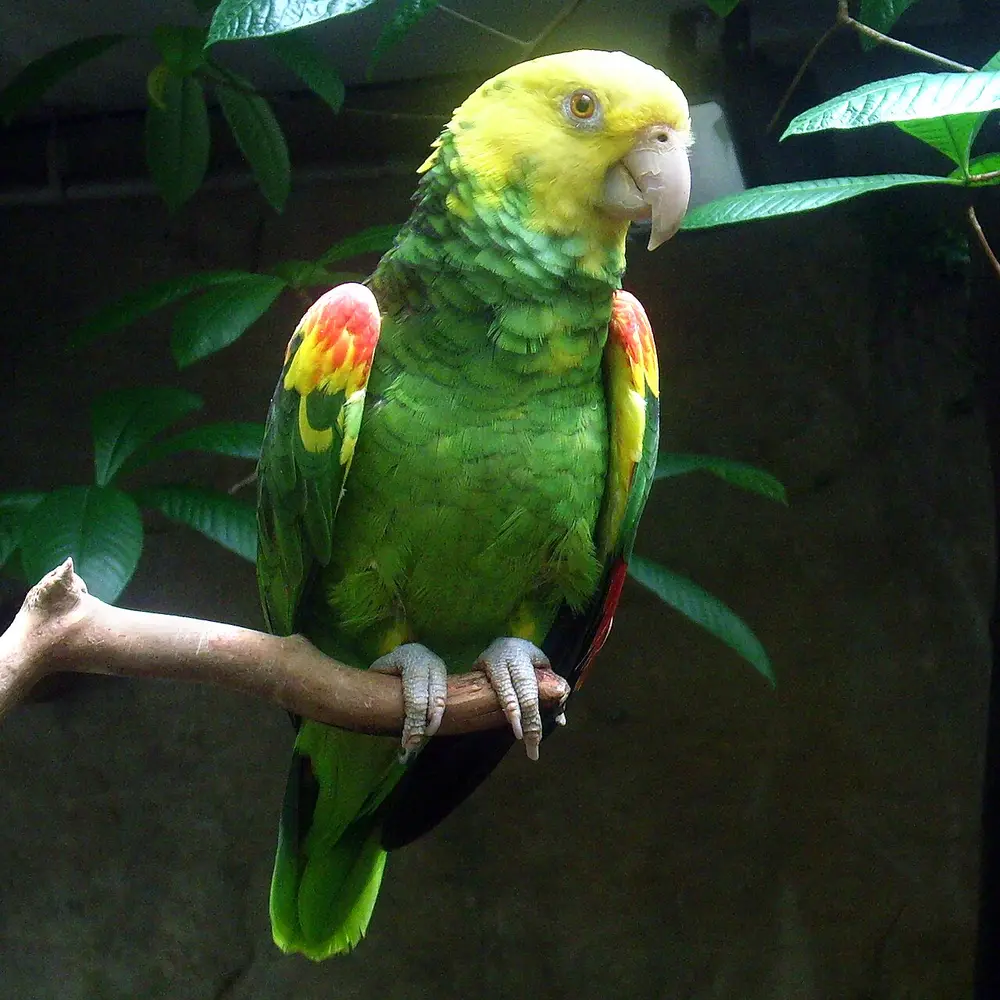
The yellow-naped amazon is a mostly green amazon parrot of the Pacific side of southern Mexico and Central America, named for the yellow band on the back of its neck. It belongs to the yellow-crowned amazon complex and is sometimes treated as a subspecies of that bird. It is prized as a talker and is now Critically Endangered.
Its scientific name is Amazona auropalliata, and it belongs to Amazona, a genus of about 30 medium-sized, short-tailed parrots found from Mexico and the Caribbean to South America. Taxonomists still argue over the yellow-crowned group. Some list a single species, Amazona ochrocephala, while others split it into as many as three, including the yellow-naped and the yellow-headed amazon. The split rests mostly on how far the yellow extends in the plumage and on the color of the bill and legs, and genetic studies of mitochondrial DNA do not back it up.
In the field the bird is easy to describe. The forehead and crown are green, and a yellow band crosses the lower nape and hindneck. The eyes are orange, the beak dark gray and paler toward the base of the upper mandible, and the feet dark gray as well. Like other amazons it has a heavy bill with a distinct notch in the upper mandible, and short, rounded wings and tail. A rare blue mutation exists in which the whole body is turquoise.
Three subspecies are recognized. The nominate form lives from southern Mexico to northwestern Costa Rica, A. a. parvipes lives on the Mosquito Coast of eastern Honduras and northeastern Nicaragua, and A. a. caribaea is found on Honduras's Bay Islands.
Behavior and diet
Diet
Nuts, seeds, berries and fruit
The yellow-naped amazon has the best-studied voice of any wild parrot. Like all parrots it learns its calls, and in the wild that learning produces dialects. The set of calls a population uses changes sharply at geographic boundaries, much as human languages and accents do. These dialects stay stable for long periods, and they matter to the birds: parrots respond less to calls from outside their own dialect.
Mated pairs are monogamous during the breeding season and defend a small territory around the nest by singing duets. These duets are remarkably complex, with precisely timed sequences of calls arranged by rules that change the order and structure of notes in predictable but flexible ways. Neighboring pairs counter-duet, rapidly trading duets back and forth in a way that resembles the counter-singing of male songbirds. Now and then the exchange gets heated enough that the birds fight at the territory boundary, though this is rare.
Diet
Like many parrots, yellow-naped amazons eat nuts, berries, seeds and fruit. Amazon parrots in general also take buds, nectar and flowers, crack nut shells easily with their beaks and hold food in one foot. Studies of the closely related yellow-crowned amazon add more detail: those birds gather in treetops in feeding parties of about ten, are fond of maize and cultivated fruit, which can make them pests in orchards and farms, and are important both as seed predators and as seed dispersers.
Nesting
Yellow-naped amazons nest in natural tree cavities. They do not dig their own holes, but they chew at the entrance to shape it. Many kinds of trees are used, with dead coyol palms among the favorites. Clutch details have not been published for the yellow-naped amazon itself. In the closely related yellow-crowned amazon, the female lays 2 to 4 plain white eggs and incubates them for 24 to 27 days while the male stays near the entrance and feeds her, and chicks fledge at around 56 days.
Breeding success is low. Most nests fail, and poaching is the main reason. Boa constrictors are known to raid nests of the related yellow-crowned amazon, taking fledglings and nesting females.
Range and habitat
Habitat
Tropical dry forest and mangroves
The yellow-naped amazon lives along the Pacific coast from southern Mexico south to northern Costa Rica, with separate populations on the Caribbean-side Mosquito Coast and the Bay Islands of Honduras. It inhabits tropical dry forest and mangroves.
Censuses show declines across most of the range. Numbers are reduced in Costa Rica and Nicaragua, and populations in Honduras, Mexico and Guatemala are vanishingly small. Costa Rica's population, despite a significant drop recorded over an 11-year survey period, is still considered the species' stronghold. The Mesoamerican Parrot Census Network, supported by the World Parrot Trust, has enlisted volunteers to track the bird across its range.
Conservation status
The yellow-naped amazon is classed as Critically Endangered on the IUCN Red List, assessed in 2021 after a dramatic decline across its whole range. The species has lost more than 92% of its population over the last three generations. It is also listed on Appendix I of CITES.
Two threats drive the decline: deforestation, and the illegal taking of young birds for the pet trade. The same talent that makes the species so studied in the wild, its ability to learn and mimic sounds, is probably why it is so popular in aviculture. The United States and the European Union have banned the capture of wild parrots for the pet trade to protect wild populations, but some illegal trade still moves between Mexico and the United States.
Where to see yellow-naped amazon in the U.S.
9 zoos across 7 states
Find the closest one
Rank the 9 zoos holding yellow-naped amazon by how far they are from you. Your location is used in your browser to sort this list and is never sent to us.
California· 3
Florida· 1
Kansas· 1
Minnesota· 1
South Dakota· 1
Tennessee· 1
Texas· 1
AZAThe Association of Zoos and Aquariums. Accredited members have passed an independent inspection of animal care and welfare, safety, conservation and education, repeated every five years. Many smaller facilities never apply, so “not accredited” isn't a verdict on its own. What accreditation means · How we check this
Built from each zoo's own published animal list.
Yellow-naped Amazon: common questions
Can yellow-naped amazons talk?
Yes. They readily mimic sounds, including human speech in captivity, which is a big part of their popularity. Like all parrots, though, individual birds vary a lot in how well they mimic.
Are yellow-naped amazons endangered?
Yes. The species is Critically Endangered, having lost more than 92% of its population over three generations to deforestation and poaching for the pet trade.
What do yellow-naped amazons eat?
Nuts, seeds, berries and fruit. Amazon parrots also eat buds, flowers and nectar.
How long do yellow-naped amazons live?
Decades, though no species-specific figure is published. Amazon parrots as a genus can live 30 to 50 years in captivity, and one yellow-crowned amazon, a close relative, was reported to live 56 years.
Where do yellow-naped amazons live?
On the Pacific slope from southern Mexico to northern Costa Rica, plus the Mosquito Coast of Honduras and Nicaragua and Honduras's Bay Islands. They live in tropical dry forest and mangroves.
Is the yellow-naped amazon the same as the yellow-headed amazon?
Not quite. Both belong to the yellow-crowned amazon complex, which some authorities treat as one species and others split into three, separated mainly by where the yellow appears on the head and by bill and leg color.
Do yellow-naped amazons bite?
They can. They are known for protective behavior around the nest that often leads to bites, especially in males during the breeding season. Fanning the tail and pinning the eyes are warning signs.
Can you keep a yellow-naped amazon as a pet?
They are kept as pets, but they demand a lot. They tend to bond with one person, need to chew, and require socialization and toys, and wild capture for the trade is a main driver of the species' collapse.