- Where to see one
- 6 U.S. zoos in our directory hold yellow-headed amazon, confirmed against each zoo's own animal list.
- Other names
- Yellow-headed parrot, double yellow-headed amazon
- Native range
- Mexico, Belize, and small parts of Guatemala and Honduras
- Size
- 38–43 cm (15–17 in) long
- Lifespan
- Amazon parrots can live 30 to 50 years in captivity
- Adult plumage
- Reached at 2 to 4 years
Conservation status
Endangeredassessed 2020
IUCN Red List category EN — step 4 of 7.
Endangered (EN); CITES Appendix I
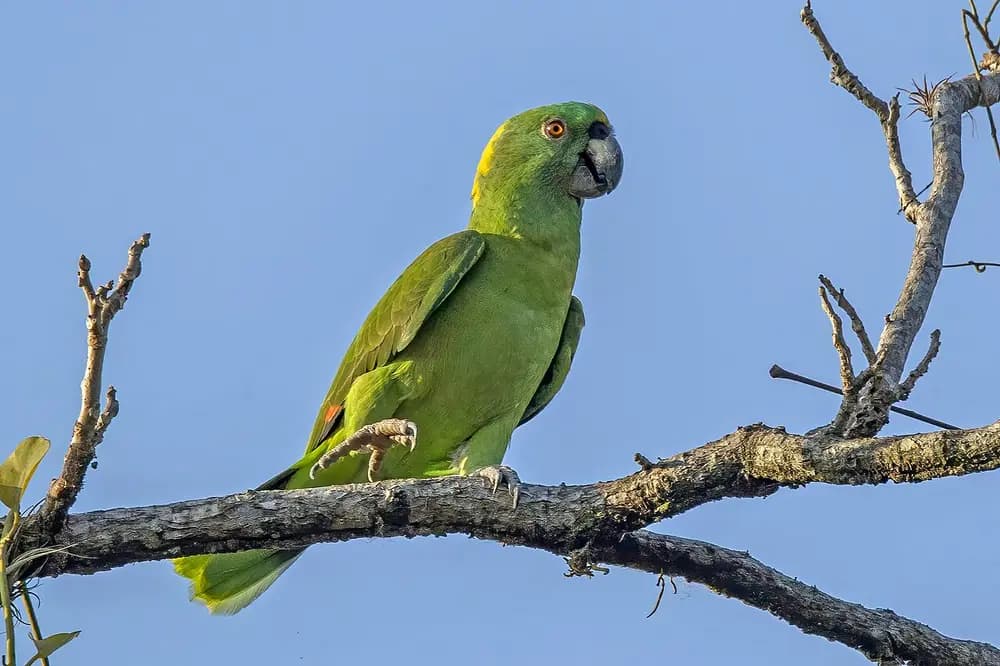
The yellow-headed amazon is a stocky, short-tailed green parrot with a yellow head, 38-43 centimetres long, native to Mexico and northern Central America. It lives in riparian forest and areas with scattered trees, as well as evergreen forest in Belize and mangroves in Guatemala, and is seen singly, in pairs, in small groups and occasionally in big flocks. Wild birds give low-pitched, sometimes human-sounding screams, yet often fly silently, unlike many other parrots. Capture for the pet trade and habitat destruction have sharply reduced its numbers, and the species is described as endangered.
About the yellow-headed amazon
The yellow-headed amazon is an endangered green parrot of Mexico and northern Central America with a bright yellow head. It belongs to Amazona, a genus of about 30 medium-sized, short-tailed parrots of the Americas, and is closely related to the yellow-naped and yellow-crowned amazons. It lives in riverside forest, mangroves and open country with scattered trees.
It is a solidly built bird, 38–43 cm (15–17 in) long, with rounded wings and a square tail, the typical amazon shape. The body is bright green with dark scalloping on the neck, yellow thighs and red at the bend of the wing. The flight feathers are blackish to bluish violet with a red patch on the outer secondaries, the base of the tail hides another red patch, and the outer tail feathers are tipped yellow.
The bill is horn-colored gray, and the ring of bare skin around the eye is whitish in Mexican birds and grayish elsewhere. The name "double yellow-headed" comes from the head pattern: this bird has both the yellow crown of the yellow-crowned amazon and the yellow nape of the yellow-naped amazon.
How much yellow a bird carries depends on where it comes from. Adults of the Tres Marías Islands form (tresmariae) are yellow over the head and upper chest. The widespread Mexican form (oratrix) has a fully yellow head. Belizean birds (belizensis) have yellow only on the crown, and birds from the Sula Valley in Honduras (hondurensis) have yellow on the crown and nape. Young birds show less yellow and take 2 to 4 years to reach adult plumage.
The species' classification is tangled. Amazona oratrix is part of the yellow-crowned amazon complex, which has been called "a taxonomic headache." Some authorities treat the whole complex as one species, others split it into three, and DNA studies have not supported the traditional three-way split.
Behavior and diet
Diet
Amazon parrots eat mainly seeds, nuts, fruit, berries, buds, nectar and flowers
Yellow-headed amazons are seen singly, in pairs, in small groups and now and then in large flocks. Wild birds give low-pitched screams that can sound almost human, with calls described as a rolled "kyaa-aa-aaah" and "krra-aah-aa-ow" and a deep, rolling "ahrrrr." Unlike many parrots, they often fly in silence. Hungry young birds make a clucking sound.
They nest high in the canopy of tall trees, mostly in Astronium graveolens and Enterolobium cyclocarpum. Its own breeding season isn't described in detail, but amazon parrots in general breed seasonally in late winter and spring, a generally dry period, and amazons in Mexico peak from March to April.
What yellow-headed amazons eat
The wild diet of this species isn't recorded separately, but amazon parrots as a group feed mainly on seeds, nuts, fruits, berries, buds, nectar and flowers, with some leaves. Their heavy bills crack nutshells easily, and they hold food in one foot. Mainland amazons forage and feed their young twice a day, usually about an hour after sunrise and about an hour and a half before sunset, and spend the time between preening themselves and their mates.
Talking ability
The yellow-headed amazon is one of the best-talking parrots, which has made it a prized pet for centuries. Its ability to mimic speech is generally beaten only by the African grey parrot and matched by close relatives such as the yellow-naped amazon. Captive birds seem to love singing and learning songs, and have a naturally powerful, operatic voice.
That popularity comes with a temperament. Along with the yellow-naped and blue-fronted amazons, it belongs to the "Hot Three," known for hormonal aggression, especially in males during the breeding season. Birds often bond strongly to a single person.
Range and habitat
Habitat
Riverside forest, mangroves, evergreen and pine forest, and areas with scattered trees
The historic range covered both coasts of Mexico, from the Tres Marías Islands and Jalisco to Oaxaca on the Pacific side and from Nuevo León to northern Chiapas and southwestern Tabasco on the Gulf side. Separate populations lived across most of Belize and in a small area of northeastern Guatemala and northwestern Honduras.
It lives in riparian forest along rivers, in areas with scattered trees, in evergreen forest in Belize and in mangroves in Guatemala. The Belizean pine forests are one notable ecoregion where it occurs.
Escaped and released birds have founded populations far from home. More than 50 live in Stuttgart, Germany. Smaller groups live in coastal San Diego neighborhoods including Coronado, Ocean Beach, Point Loma and La Jolla, and in Santa Ana, Loma Linda and Pasadena in Southern California. Apparently breeding birds have also been reported in Puerto Rico.
Yellow-headed amazon vs yellow-naped and yellow-crowned amazons
The three members of the yellow-crowned complex look alike and can hybridize in captivity. The amount and placement of yellow is the main difference.
| Feature | Yellow-headed amazon | Yellow-naped amazon | Yellow-crowned amazon |
|---|---|---|---|
| Scientific name | Amazona oratrix | Amazona auropalliata | Amazona ochrocephala |
| Yellow on the head | Whole head in Mexican birds; crown only in Belize; crown and nape in Honduras | Nape | Crown |
| Range | Mexico, Belize, Guatemala, Honduras | Lives close to yellow-headed birds in Oaxaca without apparent interbreeding; shares northern Honduras with the yellow-crowned | Includes northern Honduras |
Conservation status
The yellow-headed amazon is listed as Endangered on the IUCN Red List, assessed in 2020, and is on CITES Appendix I, which regulates international trade, including in captive-bred birds, through permits.
Capture for the pet trade and habitat destruction have caused a steep decline. Numbers fell by 90 percent, to about 7,000 birds, between the mid-1970s and 1994, then by another 68 percent from 1994 to 2004. An estimated 40 to 60 percent of poached birds die before they are sold. The status of the Tres Marías form, sometimes treated as a separate species, is unclear, but its tiny range is a concern.
Traders have also bleached or dyed the feathers of more common parrots, such as the white-fronted amazon, to sell them as yellow-headed amazons, a practice that is often fatal to the birds.
Where to see yellow-headed amazon in the U.S.
6 zoos across 6 states
Find the closest one
Rank the 5 zoos holding yellow-headed amazon by how far they are from you. Your location is used in your browser to sort this list and is never sent to us.
1 more zoo holds yellow-headed amazon but has no coordinates on file yet, so it isn't ranked here. It's in the full list below.
Alabama· 1
California· 1
Kansas· 1
South Dakota· 1
Texas· 1
Wisconsin· 1
AZAThe Association of Zoos and Aquariums. Accredited members have passed an independent inspection of animal care and welfare, safety, conservation and education, repeated every five years. Many smaller facilities never apply, so “not accredited” isn't a verdict on its own. What accreditation means · How we check this
Built from each zoo's own published animal list.
Yellow-headed Amazon: common questions
Can you keep a yellow-headed amazon as a pet?
Only captive-bred birds may be owned. They are popular pets because they talk so well, but males can be aggressive in the breeding season and birds often bond to one person.
Can yellow-headed amazons talk?
Yes. They are among the best-talking parrots, generally surpassed only by the African grey parrot, and they also learn songs.
How big is a yellow-headed amazon?
About 38–43 cm (15–17 in) long, a stocky green parrot with a short square tail.
How long do yellow-headed amazons live?
Decades, probably: no figure is given for this species alone, but amazon parrots as a group can live 30 to 50 years in captivity, and one yellow-crowned amazon reached 56.
Where do yellow-headed amazons live?
In Mexico, Belize and small parts of Guatemala and Honduras, in riverside forest, mangroves and open woodland. Introduced birds also live in Southern California, Germany and Puerto Rico.
Why are yellow-headed amazons endangered?
Mainly because of poaching for the pet trade, along with habitat loss. Wild numbers fell by about 90 percent between the mid-1970s and 1994 and kept falling afterward.
What is a double yellow-headed amazon?
It is another name for the yellow-headed amazon, referring to its yellow crown and yellow nape together.