- Where to see one
- 22 U.S. zoos in our directory hold kangaroo, confirmed against each zoo's own animal list.
- Native range
- Australia and New Guinea
- Size
- A large male can stand 2 m (6 ft 7 in) tall and weigh 90 kg (200 lb)
- Lifespan
- About 7–10 years in the wild for eastern greys; over 20 years recorded in captivity
- Top speed
- Up to 70 km/h (43 mph) over short distances
- Group name
- A mob, court or troupe
Conservation status
Least Concernassessed 2016
IUCN Red List category LC — step 1 of 7.
Least Concern (LC) for all four kangaroo species
Kangaroos are marsupials of the subfamily Macropodinae, a name meaning large foot, and are native to Australia and New Guinea. In everyday use the word covers the largest members of the family, including the red, antilopine, eastern grey and western grey kangaroos. They have powerful hind legs, large feet built for leaping, a long muscular tail for balance and a small head. Females carry their young, called joeys, in a pouch where postnatal development is completed. Kangaroos graze, and abrasive grass wears their molars down so that they move forward in the mouth before falling out, replaced by new teeth growing in at the back.
About the kangaroo
A kangaroo is a large hopping marsupial in the family Macropodidae, native to Australia and New Guinea. The name covers the four biggest members of that family: the red, eastern grey, western grey and antilopine kangaroos. Smaller relatives in the same family are called wallaroos and wallabies, and female kangaroos carry their young in a pouch.
"Kangaroo" is a size label rather than a single branch of the family tree. The four species sit in two genera, Macropus (the greys) and Osphranter (the red and the antilopine), and the same family holds roughly 50 smaller macropods. The red kangaroo is the largest surviving marsupial anywhere in the world, while the western grey kangaroo is smaller, with a large male weighing about 54 kg (119 lb).
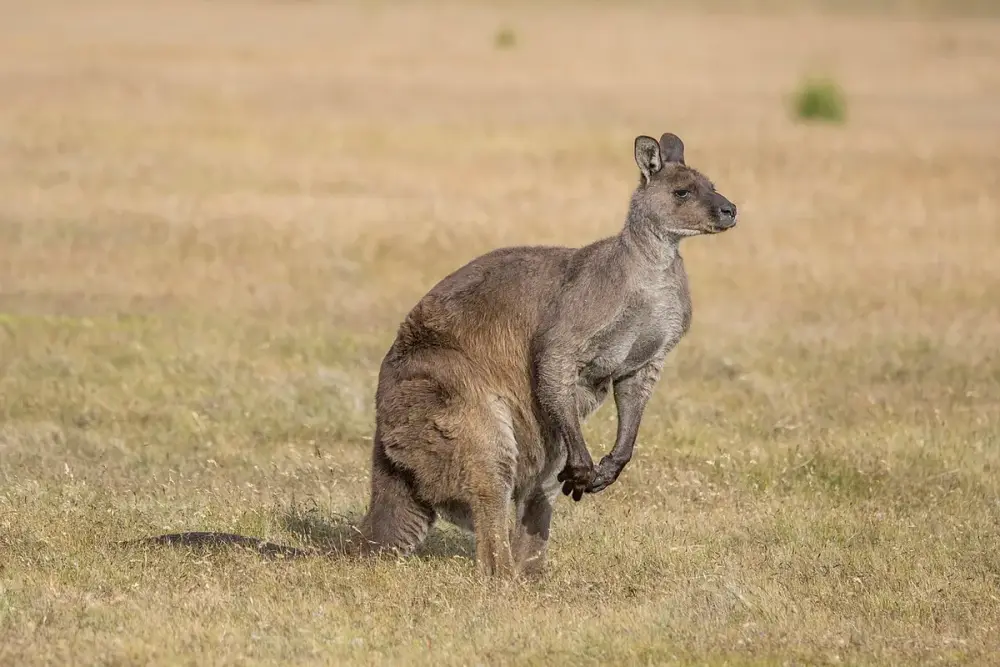
The body plan is built around the back half. Kangaroos have large, powerful hind legs, long feet made for leaping, a long muscular tail and a small head. Males are much bigger than females: in eastern greys, females weigh up to about 40 kg (88 lb) and males more than twice that, up to 90 kg (198 lb). Eastern greys have an almost white face, an even fur color and a black tail tip, while western greys have a darker face and a white patch on the upper thigh.
The teeth are unusual for a mammal. Lower incisors sit apart on an unfused jaw, giving a wide bite that crops grass close to the ground. Because grass is gritty with silica, the molars wear down, move forward in the mouth and drop out, to be replaced by new teeth growing in at the back. Among other mammals this kind of tooth replacement is known only in elephants and manatees.
Behavior and diet
Diet
Grasses, shrubs and, in smaller species, underground fungi
Kangaroos are the only large mammals that use two-legged hopping as their main way of getting around. A red kangaroo cruises comfortably at about 20–25 km/h (12–16 mph), can sprint at up to 70 km/h (43 mph) over short distances, and can hold 40 km/h (25 mph) for nearly 2 km (1.2 mi). Elastic tendons in the hind legs store about 70% of the potential energy and supply most of the spring for each hop, so moving faster costs surprisingly little extra effort.
At slow speeds the animal walks on five points. It plants its forelimbs and tail, swings the hind feet forward, then repeats. Research has found that the tail pushes with as much force as the front and hind legs combined, acting as a third leg rather than a simple prop. The highest recorded jump for a red kangaroo is about 3.0 m (10 ft).
All kangaroos are strict herbivores. The eastern grey is mainly a grass grazer, while the red kangaroo eats a good share of shrubs too. Kangaroos have a single-chambered stomach, unlike the four-compartment stomach of cattle, though they sometimes bring food back up to chew as cud. Unlike cattle, they release almost no methane; the hydrogen from fermentation is turned into acetate and used for energy instead.
Many kangaroos are nocturnal and crepuscular, resting in shade through hot days and feeding in the cool of evening, night and early morning. They live in mobs that usually number 10 or more. Newcomers greet with nose touching and sniffing, and mothers groom their young. Males also hold long, ritualised "boxing" matches that may help set dominance ranks: they stand tall, lock forearms and wrestle, and balance on the tail to kick at each other's belly.
Breeding is remarkable. After a gestation of only 31–36 days, a blind, hairless joey about the size of a lima bean climbs through its mother's fur into the pouch and latches onto a teat. It usually stays in the pouch for about nine months and keeps nursing until around 18 months. A mother can pause the development of a second embryo until the pouch is free, a process called embryonic diapause, and can make two kinds of milk at once for a newborn and an older joey.
Range and habitat
Habitat
Grassland, open woodland, forested mountains and arid rangeland
Kangaroos are native to Australia and New Guinea, and each species has its own region. The red kangaroo lives in the arid and semi-arid center, with its densest populations in the rangelands of western New South Wales. The eastern grey covers the fertile east from Cape York Peninsula to Victoria, plus Tasmania, where it can reach about 100 animals per km² (about 260 per sq mi) in open woodland.
The western grey kangaroo lives across southern Western Australia, coastal South Australia and the Murray–Darling basin. The antilopine kangaroo is the far-northern counterpart of the greys, living on grassy plains and in woodland. Eastern greys use habitats from open woodland and grassland to forested mountains, usually in higher-rainfall areas.
Large kangaroos have coped with farming better than smaller macropods. Clearing land for pasture and adding stock watering points created more grazing, and the Australian government estimated 42.8 million kangaroos in the commercial harvest areas in 2019, down from 53.2 million in 2013.
Kangaroo vs wallaby
Kangaroos and wallabies belong to the same family and often the same genera. The difference is mainly size: "kangaroo" is kept for the four largest species, "wallaroo" for mid-sized ones, and "wallaby" for most of the smaller macropods, such as Bennett's wallaby. Tree-kangaroos like Matschie's tree-kangaroo are a separate, tree-climbing branch of the same family.
| Feature | Kangaroo | Wallaby |
|---|---|---|
| Species covered | Red, eastern grey, western grey, antilopine | Most smaller macropods |
| Typical size | Large male up to 2 m (6 ft 7 in) tall, 90 kg (200 lb) | Head and body 45–105 cm (18–41 in) |
| Tail length | Long, used as a third leg | 33–75 cm (13–30 in) |
| Family | Macropodidae | Macropodidae |
| Abundance | Relatively plentiful | Many smaller species are rare or endangered |
Conservation status
All four kangaroo species, red, eastern grey, western grey and antilopine, are rated Least Concern on the IUCN Red List in assessments from 2016. Kangaroos are relatively plentiful despite a common belief to the contrary, while many of the smaller macropods are rare and endangered.
That abundance brings conflict. Kangaroos are shot for meat and hides and to protect grazing land, and some Australians view them as pests that need regular culling. There is concern that current management may harm kangaroo welfare, biodiversity and Aboriginal culture. Kangaroos are also involved in nine out of ten animal-vehicle collisions in Australia.
Natural predators are few. Today the threat comes from dingoes and from introduced foxes, feral cats and domestic and feral dogs. In southern Queensland, about half of young eastern grey joeys do not survive to independence.
Where to see kangaroo in the U.S.
22 zoos across 14 states
Find the closest one
Rank the 11 zoos holding kangaroo by how far they are from you. Your location is used in your browser to sort this list and is never sent to us.
11 more zoos hold kangaroo but have no coordinates on file yet, so they aren't ranked here. They're in the full list below.
Arizona· 1
California· 1
Florida· 5
Indiana· 1
Kansas· 1
Kentucky· 1
Louisiana· 1
Michigan· 2
Minnesota· 2
New Jersey· 1
North Carolina· 2
Ohio· 1
South Carolina· 1
Washington· 2
AZAThe Association of Zoos and Aquariums. Accredited members have passed an independent inspection of animal care and welfare, safety, conservation and education, repeated every five years. Many smaller facilities never apply, so “not accredited” isn't a verdict on its own. What accreditation means · How we check this
Built from each zoo's own published animal list.
Kangaroo: common questions
Are kangaroos dangerous?
Rarely. Kangaroos are shy by nature and normally pose no threat to people, though a small number of attacks have been recorded, including two documented fatalities in Australia.
How big do kangaroos get?
A large male kangaroo can stand about 2 m (6 ft 7 in) tall and weigh 90 kg (200 lb). Females are much smaller; eastern grey females usually weigh up to about 40 kg (88 lb).
How fast can a kangaroo go?
Up to 70 km/h (43 mph) in short bursts. A red kangaroo can hold about 40 km/h (25 mph) for nearly 2 km (1.2 mi).
What do kangaroos eat?
Plants only. Eastern greys mostly graze on grasses, red kangaroos also eat shrubs, and smaller kangaroo species eat underground fungi.
How long do kangaroos live?
Eastern grey kangaroos live about 7–10 years in the wild, and captive animals have lived more than 20 years.
How big is a baby kangaroo?
About the size of a lima bean. It is born blind and hairless after 31–36 days and crawls into the pouch, where it usually stays for around nine months.
Where do kangaroos live?
In Australia and New Guinea. Red kangaroos live in the dry interior, eastern greys in the fertile east and Tasmania, western greys in the south, and antilopine kangaroos in the far north.
What is a group of kangaroos called?
A mob, a court or a troupe. Groups usually hold 10 or more animals.