- Where to see one
- 8 U.S. zoos in our directory hold western grey kangaroo, confirmed against each zoo's own animal list.
- Native range
- Southern Australia, from just south of Shark Bay through Western Australia and South Australia, into western Victoria, and the Murray–Darling basin in New South Wales and Queensland
- Size
- 28–54 kg (62–120 lb), body length 0.84–1.1 m (2 ft 9 in–3 ft 7 in), tail 0.80–1.0 m (2 ft 7 in–3 ft 3 in), standing height about 1.3 m (4 ft 3 in)
Conservation status
Least Concernassessed 2016
IUCN Red List category LC — step 1 of 7.
Least Concern (LC), population increasing
About the western grey kangaroo
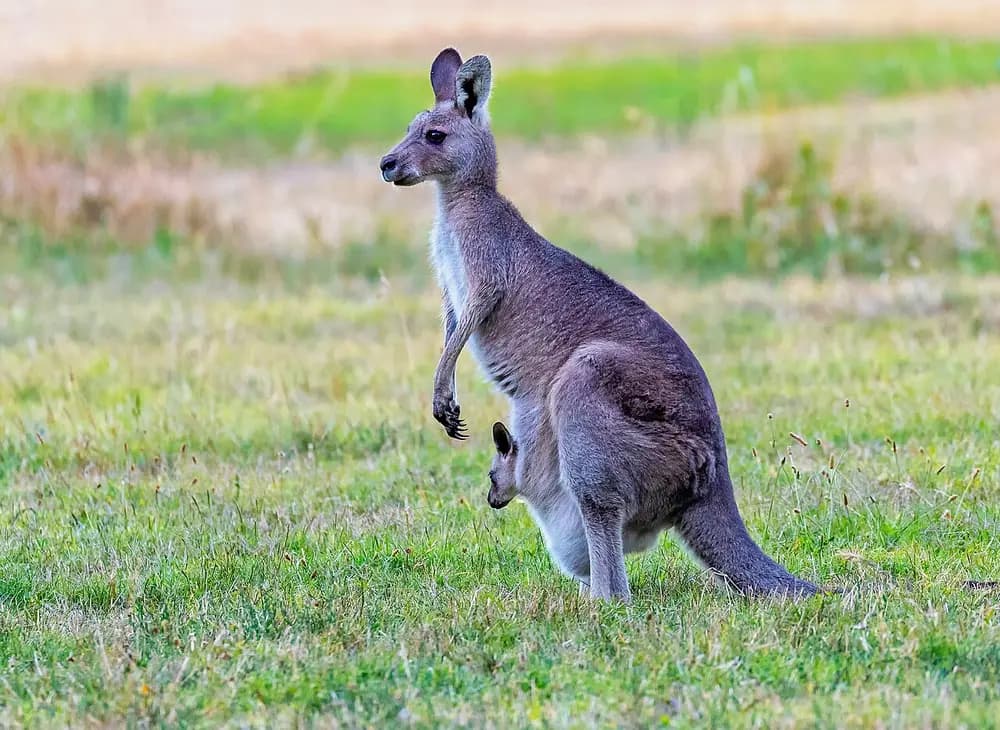
The western grey kangaroo is one of the largest macropods in Australia, a big-bodied grazer found across almost the entire southern part of the continent — from just south of Shark Bay through coastal Western Australia and South Australia, into western Victoria, and throughout the Murray–Darling basin in New South Wales and Queensland. It goes by several other names, including western grey giant kangaroo, black-faced kangaroo, mallee kangaroo, and sooty kangaroo, and on Kangaroo Island it's often called the Kangaroo Island grey kangaroo.
The species weighs 28–54 kg (62–120 lb) and reaches a body length of 0.84–1.1 m (2 ft 9 in to 3 ft 7 in), with a tail adding another 0.80–1.0 m (2 ft 7 in to 3 ft 3 in). Standing, it reaches roughly 1.3 m (4 ft 3 in) tall. The species shows strong sexual dimorphism, with males growing up to twice the size of females. Its fur is thick and coarse, ranging from pale grey to brown, with a paler throat, chest, and belly. It's easy to confuse with its close relative, the eastern grey kangaroo, but the western grey has darker grey-brown fur, darker coloring around the head, and sometimes a blackish patch near the elbow.
The two species overlap extensively in the Murray–Darling basin but rarely interbreed in the wild, even though hybrids have been produced in captivity — and only when the mating pair is a female eastern grey and a male western grey, an example of what's known as unidirectional hybridization. Taxonomically, the western grey kangaroo was a source of confusion for nearly two centuries: it was first noted by Matthew Flinders in 1802 on Kangaroo Island, misidentified for decades, briefly and incorrectly linked to Tasmania in 1888, and not formally sorted out until the 1990s. Two subspecies are recognized today: Macropus fuliginosus fuliginosus, endemic to Kangaroo Island, and Macropus fuliginosus melanops, whose form changes gradually from west to east across the mainland.
Behavior and diet
Diet
Grasses and forbs, also leafy shrubs and low trees
The western grey kangaroo feeds at night, mainly on grasses and forbs, though it also browses leafy shrubs and low trees. Its diet was more varied during the Late Pleistocene, with a greater share of C4 plants than present-day populations eat. Mature males carry a distinctive, curry-like odor strong enough to have earned the species the nickname "stinker." As a nocturnal animal, it also adjusts its core body temperature with the seasons — in summer, its lowest daily body temperature (reached mid-morning) runs about 2.2°C (4°F) cooler than on cool spring days, a strategy thought to help it conserve energy when food is scarce.
Western grey kangaroos live in groups of up to 15. During the breeding season, males compete for access to females through "boxing" contests, locking arms and trying to push each other over; typically only the dominant male in the group actually mates. Gestation lasts just 30–31 days, after which the underdeveloped joey climbs into the pouch and attaches to a teat for another 130–150 days. Females reach sexual maturity at 17 months, males at around 20 months.
Range and habitat
The western grey kangaroo occupies almost the entire southern part of Australia: south of Shark Bay through coastal Western Australia and South Australia, into western Victoria, and across the whole Murray–Darling basin in New South Wales and Queensland. It is not found in the north of the continent or in the far southeast. Its range overlaps with that of the eastern grey kangaroo throughout the Murray–Darling basin, where both species are common, though the boundary of the eastern grey's range stops at the New South Wales–South Australia border. The Kangaroo Island subspecies is restricted to that island off South Australia, while the mainland subspecies grades gradually in form from west to east.
Conservation status
The western grey kangaroo is rated Least Concern on the IUCN Red List, in a 2016 assessment, and its population trend is increasing. Within commercial harvest areas alone, the population was estimated at around 3,800,000 individuals in 2020.
Even so, the species has a complicated relationship with agriculture. Because its feeding habits can damage crops and it's seen as competing with livestock for water and pasture, it's considered a pest in some areas, and licensed culling is permitted annually to limit that damage. Commercial hunting for meat and skin is also allowed under regulation in New South Wales, mainland South Australia, and Western Australia, though it's prohibited in Tasmania, the Northern Territory, and on Kangaroo Island. About 40% of harvested meat goes toward human consumption, and the skins are valued as a durable leather used in handbags, briefcases, and belts. Despite the hunting, the species remains protected and managed by state faunal authorities, and its numbers continue to grow.
Where to see western grey kangaroo in the U.S.
8 zoos across 6 states
Find the closest one
Rank the 8 zoos holding western grey kangaroo by how far they are from you. Your location is used in your browser to sort this list and is never sent to us.
California· 2
Kansas· 1
Massachusetts· 2
Michigan· 1
New Mexico· 1
Wisconsin· 1
AZAThe Association of Zoos and Aquariums. Accredited members have passed an independent inspection of animal care and welfare, safety, conservation and education, repeated every five years. Many smaller facilities never apply, so “not accredited” isn't a verdict on its own. What accreditation means · How we check this
Built from each zoo's own published animal list.
Western Grey Kangaroo: common questions
Is the western grey kangaroo endangered?
No. It's classified as Least Concern by the IUCN, and its population is increasing, with an estimated 3.8 million individuals in commercial harvest areas as of 2020.
How big does a western grey kangaroo get?
Adults weigh 28–54 kg (62–120 lb) and reach a body length of 0.84–1.1 m (2 ft 9 in to 3 ft 7 in), plus a tail of similar length, standing about 1.3 m (4 ft 3 in) tall.
What does a western grey kangaroo eat?
It feeds at night mainly on grasses and forbs, along with leafy shrubs and low trees.
Where do western grey kangaroos live in the wild?
Across the southern part of Australia — from just south of Shark Bay through Western Australia and South Australia, into western Victoria, and throughout the Murray–Darling basin in New South Wales and Queensland.
Which U.S. zoos have western grey kangaroos?
Six U.S. zoos, including the Los Angeles Zoo, Franklin Park Zoo, and the ABQ BioPark Zoo.