Tammar Wallaby
Notamacropus eugenii
Also known as Dama Tammar Wallaby, Tamar Wallaby
- Where to see one
- 7 U.S. zoos in our directory hold tammar wallaby, confirmed against each zoo's own animal list.
- Native range
- South and Western Australia, plus introduced populations in New Zealand
- Size
- Males up to 9.1 kg (20 lb), 59–68 cm (23–27 in) long; females up to 6.9 kg (15 lb), 52–63 cm (20–25 in) long; both sexes stand about 45 cm (18 in) tall
- Lifespan
- Females to age 14; males to age 11
About the tammar wallaby
The tammar wallaby, also known as the dama wallaby or darma wallaby, is a small macropod native to South and Western Australia. Its geographic range has shrunk considerably since European colonization, but it remains common within its reduced range and is listed as Least Concern by the IUCN. It has also been introduced to New Zealand and reintroduced to parts of Australia where it once disappeared entirely. The species was first described in 1817 by French naturalist Anselme Gaëtan Desmarest, who named it after a specimen collected on an island in the Nuyts Archipelago off South Australia, now known as St. Peter Island. Its common name comes from the tamma shrub (Allocasuarina campestris) that once sheltered it in Western Australia.
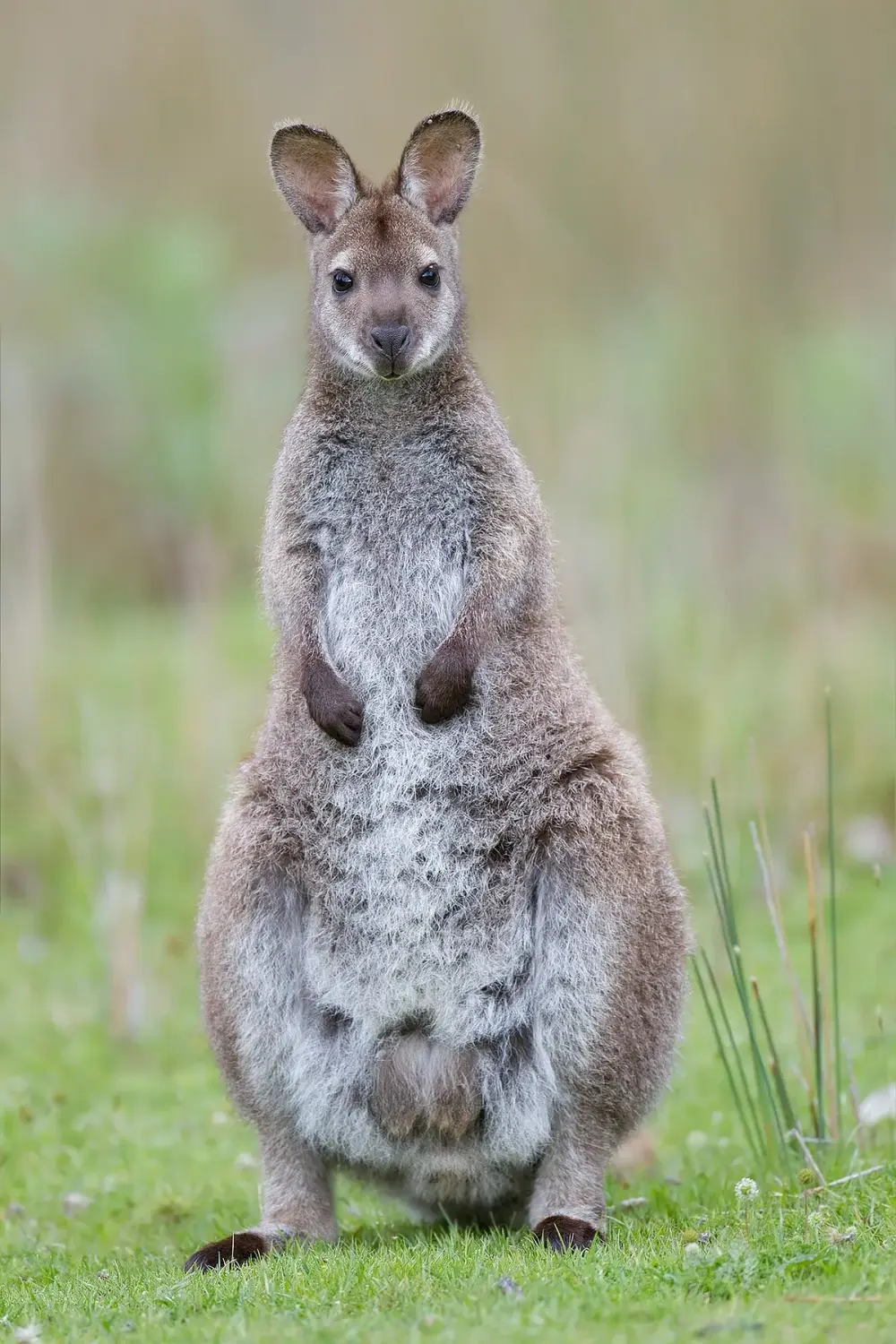
One of the smallest wallabies in its genus, the tammar wallaby has a proportionally small head with large ears and a thick-based, elongated tail. Its coat is dark greyish above with a paler underside and rufous sides and limbs. It shows strong sexual dimorphism: males reach 9.1 kg (20 lb) and 59 to 68 cm (23–27 in) long, while females reach only 6.9 kg (15 lb) and 52 to 63 cm (20–25 in), though both sexes stand about 45 cm (18 in) tall. Fossil remains from the Late Pleistocene have been found in the Naracoorte Caves, and genetic studies suggest mainland and island populations split from each other 7,000 to 15,000 years ago, while the South Australian and Western Australian populations diverged around 50,000 years ago. Skull variation distinguishes tammar wallabies from Western Australia, Kangaroo Island, and mainland South Australia as separate population groups, and a later genetic study proposed formally splitting the species into two subspecies, one for South Australian tammars and one for Western Australian tammars.
Like all macropods, the tammar wallaby moves by hopping, typically leaping 0.8 to 2.4 m (2.6–7.9 ft) with 3.5 landings per second. Energy from each landing is stored as strain in stretched leg tendons and recovered through elastic recoil on the next leap, letting the animal increase speed without a proportional rise in energy cost — an advantage that particularly helps mothers carrying young in the pouch. The species also has unusually capable senses: its eyes give it 324° of peripheral vision and 50° of binocular vision, along with blue- and green-sensitive cone photoreceptors that allow color vision in the blue-green range, though not in the red-yellow range. Its mobile outer ears can track sound sources independently of head movement, boosting eardrum sound pressure by 25 to 30 dB at 5 kHz when pointed directly at a source.
Behavior and diet
Diet
Grazing and browsing herbivore — grasses and shrubs including heart-leaved poison, small-flowered wallaby grass, and marri
Tammar wallabies are nocturnal, sheltering in scrub for shade during the day and moving into open grassland to feed by night. Home ranges expand and contract with the seasons — about 16 ha (40 acres) in winter, growing to roughly 42 ha (100 acres) in dry summers as animals search farther for food — and ranges overlap freely among neighbors. As herbivores, they both graze and browse, though browsing is less efficient since they often drop leaves while chewing large ones, handling bigger leaves with their fingers. Documented food plants include heart-leaved poison, small-flowered wallaby grass, and marri, and some island populations survive with no fresh water at all, subsisting on seawater.
The species is highly gregarious, and larger groups spend more time feeding, grooming, and interacting while spending less time on vigilance, a trade-off that also shows in resting posture — animals in bigger groups are more likely to lie on their sides rather than stay alert with heads raised. Documented predators include dingoes, feral cats, red foxes, and wedge-tailed eagles, and the extinct thylacine may once have hunted them too. Tammar wallabies appear to respond more strongly to seeing a predator than hearing one, though their sense of smell also helps detect threats, and a wallaby that spots danger warns others by thumping its foot.
Breeding is seasonal and polygynandrous, with most births occurring between late January and early February. In the weeks before births begin, males start checking females' reproductive status by scent, and once a female gives birth she quickly enters estrus again, allowing mating almost immediately. Males compete through mate-guarding and form dominance hierarchies during the estrous period. The species uses embryonic diapause: a fertilized blastocyst remains dormant for nearly a year while a joey occupies the pouch, only resuming development once the older joey has left or been removed, with development typically beginning around the summer solstice in late December. Milk composition changes through three lactation phases, shifting from carbohydrate-rich milk that fuels rapid organ growth in phase 2A, through phase 2B while the joey still cannot leave the pouch, to phase 3, when the joey can leave the pouch, eat plants, and receives milk richer in protein and lipids to fuel continued growth. Joeys stop needing the pouch by around 250 days and are fully weaned at 300 to 350 days. Females can mature at nine months and live to age fourteen; males mature around two years and live to about eleven.
Range and habitat
Habitat
Grassland at night, shrubland by day
The tammar wallaby is native to South and Western Australia, and has been introduced to New Zealand's Kawau Island — brought there by Sir George Grey in 1870 — as well as reintroduced to parts of the Rotorua area and to some Australian regions where it had previously disappeared. Its range has contracted sharply since European colonization: in the early 20th century, populations in the Western Australian southwest were considered numerous but were already declining in agricultural areas to the north as land was cleared for wheat and sheep farming. Populations in the Eyre Peninsula and around Adelaide were wiped out by organized hunting during the 19th and 20th centuries, and the Flinders Island and St Peter Island populations were eliminated in similar fashion. Today the species remains particularly numerous on Kangaroo Island and on four Western Australian islands, moving between shrubland cover by day and grassland foraging areas by night.
Conservation status
The tammar wallaby is listed as Least Concern by the IUCN as of 2016, with a total population of up to 50,000 mature individuals. Despite that overall status, fragmentation of its range has produced high levels of inbreeding and physical deformities in some populations. Historical hunting and land clearing for agriculture eliminated the species from large parts of its former mainland range, including areas around Adelaide and the Eyre Peninsula, and from several offshore islands. The species has also faced a specific disease threat: in late 1998 and early 1999, tammar sudden death syndrome, caused by an orbivirus in the family Reoviridae, killed 120 to 230 tammar wallabies at research facilities and zoos in New South Wales and Queensland, with most animals dying less than 12 hours after symptoms appeared and showing haemorrhaging of the muscles and internal organs on necropsy. The disease has not been recorded south of Sydney, and its rapid progression makes treatment difficult.
Where to see tammar wallaby in the U.S.
7 zoos across 5 states
Find the closest one
Rank the 7 zoos holding tammar wallaby by how far they are from you. Your location is used in your browser to sort this list and is never sent to us.
California· 2
Iowa· 1
Kansas· 1
New York· 1
Pennsylvania· 2
AZAThe Association of Zoos and Aquariums. Accredited members have passed an independent inspection of animal care and welfare, safety, conservation and education, repeated every five years. Many smaller facilities never apply, so “not accredited” isn't a verdict on its own. What accreditation means · How we check this
Built from each zoo's own published animal list.
Tammar Wallaby: common questions
Is the tammar wallaby endangered?
No, it is listed as Least Concern, though some fragmented populations show high inbreeding and physical deformities.
How big does a tammar wallaby get?
Males reach up to 9.1 kg (20 lb) and 59–68 cm (23–27 in) long; females reach up to 6.9 kg (15 lb) and 52–63 cm (20–25 in), with both sexes standing about 45 cm (18 in) tall.
What does a tammar wallaby eat?
Grasses and shrubs, including documented species such as heart-leaved poison, small-flowered wallaby grass, and marri; some island populations drink seawater instead of fresh water.
How long do tammar wallabies live?
Females can live to about 14 years and males to about 11.
Where do tammar wallabies live in the wild?
In South and Western Australia, plus introduced populations on New Zealand's Kawau Island, sheltering in shrubland by day and feeding in grassland at night.
Which U.S. zoos have tammar wallabies?
Five zoos in the Feather & Fang directory list this species, including the Los Angeles Zoo, the Buffalo Zoo, and the Philadelphia Zoo.