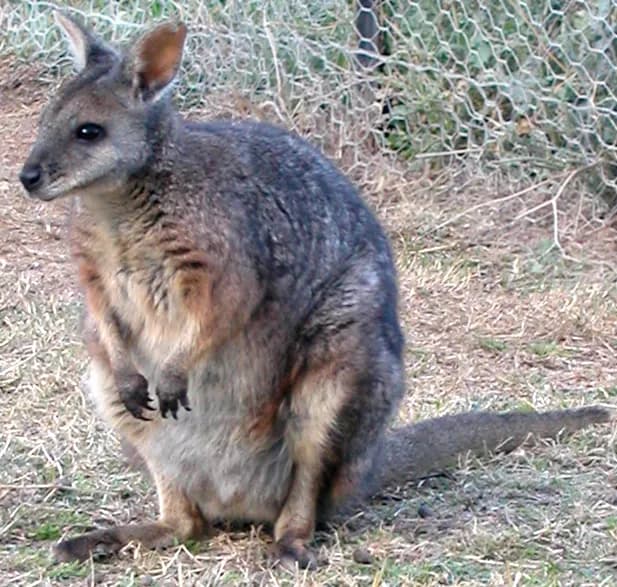
Bennett's Wallaby
Notamacropus rufogriseus
Also known as Albino Bennetts Wallaby, Red-necked Wallaby
- Where to see one
- 40 U.S. zoos in our directory hold bennett's wallaby, confirmed against each zoo's own animal list.
- Native range
- Eastern Australia, including Tasmania
- Size
- 13.8–18.6 kg (30–41 lb); head-body length about 90 cm (35 in)
- Lifespan
- Up to nine years
Conservation status
Least Concernassessed 2016
IUCN Red List category LC — step 1 of 7.
Least Concern (LC), assessed 2016 for the red-necked wallaby as a species
About Bennett's wallaby
Bennett's wallaby is the common name used for the Tasmanian subspecies of the red-necked wallaby, a medium-sized macropod marsupial common across the more temperate, fertile parts of eastern Australia, including Tasmania. It's identified by a black nose and paws, a white stripe on the upper lip, and a grizzled medium-grey coat washed with reddish color across the shoulders. Adults weigh 13.8 to 18.6 kg (30 to 41 lb) and reach a head-body length of about 90 cm (35 in), with males generally larger than females. It closely resembles the black-striped wallaby, differing mainly in its larger size, softer fur, and the absence of a black stripe down the back. Red-necked wallabies can live up to nine years.
Two or three subspecies are recognized. The mainland form, Notamacropus rufogriseus banksianus — the red-necked wallaby proper — breeds year-round. The Tasmanian form, N. r. rufogriseus, known as Bennett's wallaby, is smaller, as island subspecies often are, with longer, darker, shaggier fur, and breeds in late summer, mostly between February and April; captive Tasmanian females that become pregnant outside that window can delay birth by up to eight months to keep to their normal schedule. Bennett's wallabies have adapted well to living near people and can be found grazing lawns on the fringes of Hobart and other Tasmanian towns.
Behavior and diet
Diet
Grasses, roots, tree leaves, and weeds
Red-necked wallabies, Bennett's wallaby included, are mainly solitary animals, though they'll gather where food, water, or shelter is abundant, forming a social hierarchy similar to other wallaby species when they do. They're mainly nocturnal, spending most of the day resting. Diet consists of grasses, roots, tree leaves, and weeds.
Courtship follows a set pattern: the female licks the male's neck, the male rubs his cheek against hers, the pair briefly spar standing upright the way two males would, and then they mate. A courting pair stays together for about a day before separating. Female estrus lasts 33 days. A female bears a single offspring at a time; the joey stays in the pouch for roughly 280 days, after which mother and young remain together for only about a month more — although females may stay within their mother's home range for life, while males disperse at around two years old. The species also practices alloparental care, in which one adult adopts another's offspring, a behavior also documented in wolves, elephants, and humans, among others.
Research has shown that red-necked wallabies, like other social mammals, manage conflict through reconciliation — after a fight, former opponents will reunite and engage in affiliative contact.
Range and habitat
Habitat
Coastal scrub and sclerophyll forest
The native range of the red-necked wallaby runs through coastal scrub and sclerophyll forest across coastal and highland eastern Australia, from Bundaberg, Queensland, south to the South Australian border, plus Tasmania and several Bass Strait islands (it's unclear which Tasmanian island populations are native versus introduced). Numbers have grown in Tasmania and coastal Queensland over the past several decades as hunting pressure eased and forest clearing created a patchwork of pasture for night grazing alongside bushland cover for daytime shelter. The species is, for reasons not fully understood, less common in Victoria.
Red-necked wallabies have also been introduced well beyond Australia. A notable population was established in New Zealand's Canterbury Region after animals from Tasmania were released near Waimate starting in 1870 and again in 1874; the population in the Hunters Hills has since grown large enough across roughly 350,000 hectares that it's classified as a pest species requiring containment. Smaller introduced or escaped colonies exist in England (Peak District, Derbyshire, and Ashdown Forest), on the island of Inchconnachan in Scotland's Loch Lomond (founded in 1975 from Whipsnade Zoo stock), across the Isle of Man (descended from 1960s–70s wildlife-park escapees, with a 2023 survey estimating an average of 568 wallabies in one survey area), on Lambay Island off Ireland (introduced by the Baring family after being donated by Dublin Zoo in the 1980s), in the Forest of Rambouillet in France (from a 1970s zoo escape), and in Mecklenburg-Vorpommern, Germany (also from zoo escapees).
Conservation status
Bennett's wallaby is the Tasmanian subspecies of the red-necked wallaby, and the red-necked wallaby as a species is listed as Least Concern on the IUCN Red List, based on a 2016 assessment. No separate IUCN category is cited for the subspecies.
The species has a history of local expansion in parts of its native range, Tasmania and coastal Queensland in particular, following reduced hunting pressure and habitat changes from partial forest clearing. It also has a series of long-established introduced populations outside Australia, in New Zealand, the United Kingdom, Ireland, France, and Germany.
In several of those introduced ranges, including New Zealand's Hunters Hills and the Isle of Man, the species has been classified as an invasive pest because of its impact on agriculture or native ecology, even as some, such as the Isle of Man's, have become an unofficial local tourism draw.
Where to see bennett's wallaby in the U.S.
40 zoos across 24 states
Find the closest one
Rank the 32 zoos holding bennett's wallaby by how far they are from you. Your location is used in your browser to sort this list and is never sent to us.
8 more zoos hold bennett's wallaby but have no coordinates on file yet, so they aren't ranked here. They're in the full list below.
California· 3
Delaware· 1
District of Columbia· 1
Idaho· 1
Illinois· 2
Indiana· 1
Iowa· 1
Kansas· 1
Kentucky· 2
Maine· 1
Maryland· 2
Massachusetts· 3
Michigan· 3
Minnesota· 2
New Jersey· 2
New Mexico· 1
New York· 3
North Carolina· 1
Oregon· 1
Pennsylvania· 1
Rhode Island· 1
South Carolina· 1
Texas· 4
Virginia· 1
AZAThe Association of Zoos and Aquariums. Accredited members have passed an independent inspection of animal care and welfare, safety, conservation and education, repeated every five years. Many smaller facilities never apply, so “not accredited” isn't a verdict on its own. What accreditation means · How we check this
Built from each zoo's own published animal list.
Bennett's Wallaby: common questions
Is Bennett's wallaby endangered?
No. The red-necked wallaby, the species Bennett's wallaby belongs to, is listed as Least Concern on the IUCN Red List (2016 assessment). It has expanded in parts of its native range and become established, sometimes as a pest, in several countries outside Australia.
How big does a Bennett's wallaby get?
It weighs 13.8 to 18.6 kg (30 to 41 lb) with a head-body length of about 90 cm (35 in); males run larger than females.
What does a Bennett's wallaby eat?
Grasses, roots, tree leaves, and weeds.
How long do Bennett's wallabies live?
Up to nine years.
Where do Bennett's wallabies live in the wild?
In coastal scrub and sclerophyll forest across coastal and highland eastern Australia and Tasmania, with additional introduced populations in New Zealand, the United Kingdom, Ireland, France, and Germany.
Which U.S. zoos have Bennett's wallabies?
Ten U.S. zoos list them, including the Santa Barbara Zoo, the Minnesota Zoo, and Roger Williams Park Zoo.