- Where to see one
- 21 U.S. zoos in our directory hold cape porcupine, confirmed against each zoo's own animal list.
- Native range
- central and southern Africa, north to southern Kenya, Uganda, and Congo
- Size
- 25–32 in (63–81 cm) long from head to base of tail, plus a 4.3–7.9 in (11–20 cm) tail; typically 22–53 lb (10–24 kg), exceptionally up to 66 lb (30 kg)
- Lifespan
- up to 10 years in the wild, up to 20 years in captivity
About the Cape porcupine
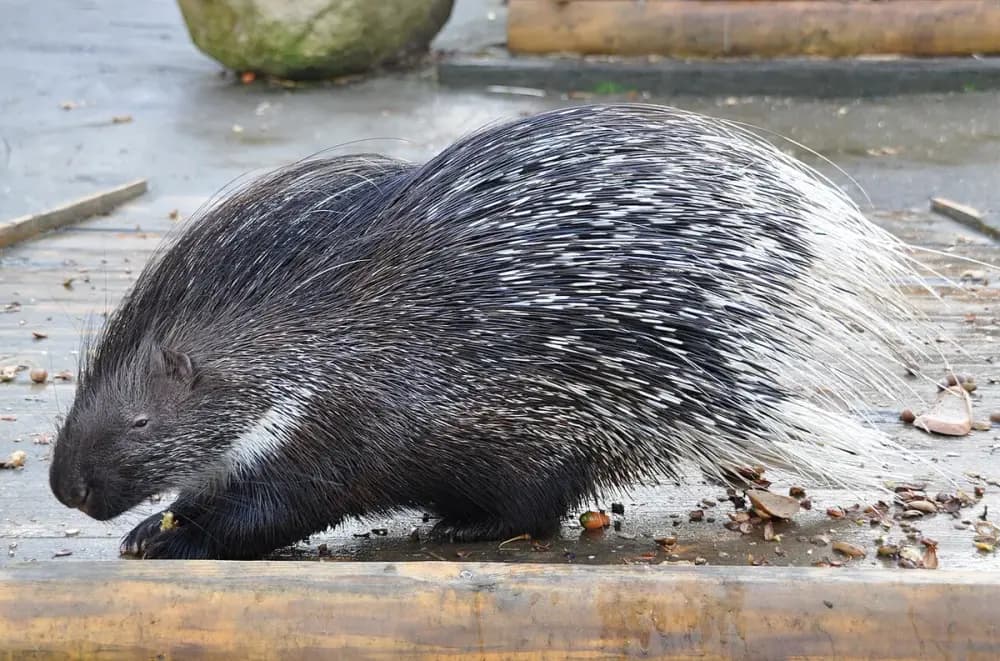
The Cape porcupine, also called the Cape crested porcupine or South African porcupine, is a species of Old World porcupine native to central and southern Africa. It's one of the largest rodents on the continent and one of the largest porcupine species anywhere — among living rodents, only the capybara and the Eurasian and North American beavers tend to outweigh it. It closely resembles its relative the crested porcupine but is slightly larger, and the two can be told apart by a band of short white spines running along the Cape porcupine's rump.
Adults measure 25 to 32 inches (63–81 cm) from head to the base of the tail, with the tail itself adding another 4.3 to 7.9 inches (11–20 cm). Weights typically run 22 to 53 pounds (10–24 kg), with exceptionally large individuals reaching 66 pounds (30 kg); males and females are close in size, though regional averages vary; in Zimbabwe, for instance, males averaged 37 pounds (16.9 kg) and females 41 pounds (18.4 kg), while in South Africa's Orange River valley both sexes averaged closer to 27–29 pounds (12.3–13 kg). The animal is heavily built, with a stocky body, short limbs, and a stubby tail. Long spines up to 20 inches (50 cm) long cover its back and flanks, mixed with thicker, sharply pointed defense quills up to 12 inches (30 cm) long; the quills carry alternating bands of black and white and grow in clusters of five to eight from evenly spaced grooves in the skin. A crest of long, bristly hair runs from the top of the head to the shoulders, and the hollow spines on the tail rattle when shaken to warn off predators. The eyes and ears are relatively small, and the animal has five clawed toes on each foot, though the first toes on the front feet are vestigial.
There are no currently recognized subspecies of the Cape porcupine, and its range covers most of southern and central Africa, reaching as far north as southern Kenya, Uganda, and Congo. It tolerates a wide span of elevations, from sea level up to about 6,600 feet (2,000 m), though it is only marginally present in dense forest and the driest deserts and does not occur in swampland.
Behavior and diet
Diet
fruits, roots, tubers, bulbs, and bark; occasionally carrion and bones
Cape porcupines are nocturnal and, unusually for rodents, monogamous — mated pairs typically live and raise young together, sharing and jointly defending a territory that can include up to six separate burrows, even though the pair usually forages alone. Both sexes scent-mark their territory, though males do so more often and appear to take a larger role in defending it. Home range size depends on habitat and food availability but can span anywhere from about 170 to 500 acres (67–203 hectares).
The diet is mostly plant material — fruits, roots, tubers, bulbs, and bark — digested with the help of a long small intestine and large caecum suited to breaking down tough fibrous food; porcupines have also been known to gnaw on carrion and bones. Farmers often consider them pests because they raid crops and strip bark from trees, though that same bark-stripping behavior may help keep some savanna ecosystems from becoming overly dense with trees. When threatened, a Cape porcupine will first freeze; if cornered, it turns aggressive and charges backward to drive its quills into an attacker, and otherwise it will retreat into a burrow and present only its quills to anything trying to dig it out.
Mating happens year-round, though most births fall in the rainy season between August and March, and females typically produce only one litter a year unless an earlier one is lost. Females go into a roughly nine-day estrus, and after mating a copulatory plug forms and is expelled about two days later. Gestation runs around 94 days and usually produces one to three young, with more than half of litters being single pups. Newborns weigh 11 to 16 ounces (300–440 g) and are born with their incisors already erupted, though their quills — soft at birth — harden within hours. Young are weaned around 100 days old and reach full adult size and sexual maturity by the end of their first year.
Range and habitat
Habitat
a wide range of environments from sea level to 6,600 ft (2,000 m), avoiding dense forest, the driest deserts, and swampland
The Cape porcupine ranges across the whole of southern and central Africa, extending to the northern edge of its range in southern Kenya, Uganda, and Congo. Within that range it occupies a broad span of habitats and elevations, from sea level up to roughly 6,600 feet (2,000 m). It is only marginally present in dense forest and in the driest desert habitats, and it is not found in swampland at all. No subspecies are currently recognized across this large range.
Conservation status
The Cape porcupine's IUCN status is Least Concern. The text of its profile does not describe specific population threats, though it notes that farmers commonly regard the species as a pest because it feeds on crops and strips bark from trees — a conflict that shapes how the animal is treated in parts of its agricultural range, even without rising to a formal conservation concern. Relative to most other rodents, it is notably long-lived, surviving up to 10 years in the wild and as long as 20 years in captivity.
Where to see cape porcupine in the U.S.
21 zoos across 16 states
Find the closest one
Rank the 21 zoos holding cape porcupine by how far they are from you. Your location is used in your browser to sort this list and is never sent to us.
California· 1
Colorado· 1
Florida· 3
Idaho· 1
Indiana· 1
Kansas· 1
Louisiana· 1
Maryland· 1
Michigan· 1
Minnesota· 1
Mississippi· 1
New York· 2
Ohio· 1
Tennessee· 2
Virginia· 1
Wisconsin· 2
AZAThe Association of Zoos and Aquariums. Accredited members have passed an independent inspection of animal care and welfare, safety, conservation and education, repeated every five years. Many smaller facilities never apply, so “not accredited” isn't a verdict on its own. What accreditation means · How we check this
Built from each zoo's own published animal list.
Cape Porcupine: common questions
Is the Cape porcupine endangered?
No. It is listed as Least Concern, though it is sometimes killed as a crop pest in parts of its African range.
How big does a Cape porcupine get?
It measures 25–32 inches (63–81 cm) from head to the base of the tail, with weights typically between 22 and 53 pounds (10–24 kg) and exceptional individuals up to 66 pounds (30 kg).
What does a Cape porcupine eat?
Mostly plant material — fruits, roots, tubers, bulbs, and bark — and occasionally carrion or bones.
How long do Cape porcupines live?
Up to about 10 years in the wild, and as long as 20 years in captivity.
Where do Cape porcupines live in the wild?
Across central and southern Africa, as far north as southern Kenya, Uganda, and Congo, in habitats ranging from sea level to about 6,600 feet (2,000 m).
Which U.S. zoos have Cape porcupines?
Twelve zoos in our directory, including Los Angeles Zoo, Cheyenne Mountain Zoo, and Nashville Zoo at Grassmere.