- Where to see one
- 27 U.S. zoos in our directory hold african crested porcupine, confirmed against each zoo's own animal list.
- Native range
- Italy, North Africa, West Africa, Central Africa, and East Africa
- Size
- Head-and-body length 60–83 cm (24–33 in); weight 13–27 kg (29–60 lb)
- Lifespan
- Up to 28 years
About the african crested porcupine
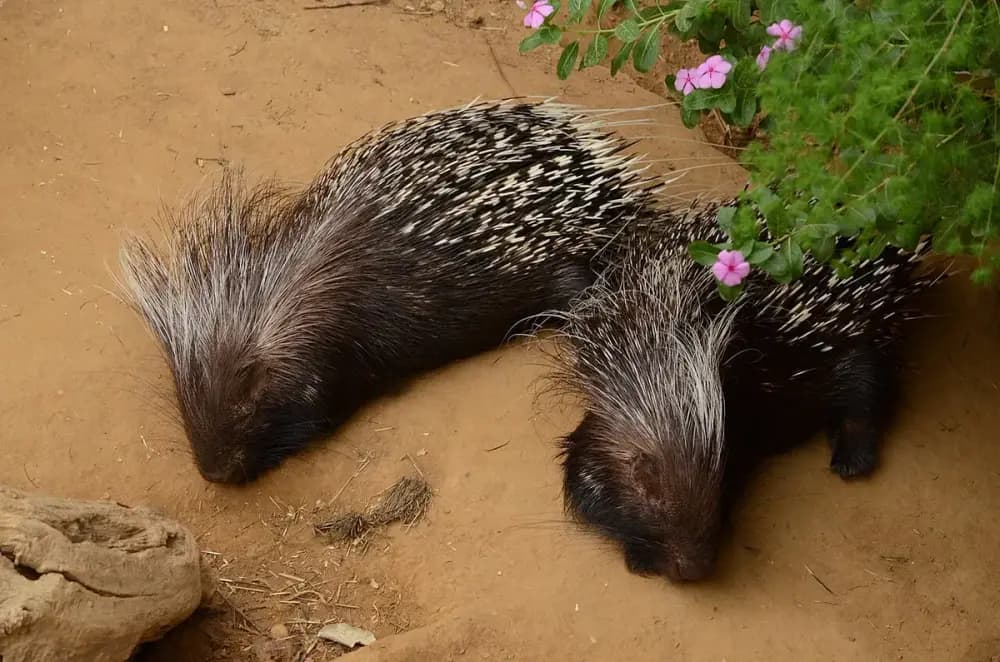
The African crested porcupine, also just called the crested porcupine, is one of the largest porcupine species alive, rivaled only by the Cape porcupine, and one of the largest rodents in the world, period. It's the only porcupine species found in Europe, with a natural population on mainland Italy and the island of Sicily, alongside a much larger range across North and sub-Saharan Africa. Adults run 60 to 83 cm (24–33 in) long, not counting the tail, and weigh 13 to 27 kg (29–60 lb).
The name comes from the crest of quills running along the head, nape, and back, which the animal can raise at will. Most of the body is covered in coarse dark brown or black bristles, but the sides and rear carry sturdier defensive quills up to 35 cm (14 in) long, banded in alternating light and dark and only loosely attached. The short tail ends in a cluster of hollow, thin-walled "rattle quills" that, when vibrated, produce a hiss much like a rattlesnake's, a warning sound built entirely from modified spines rather than a voice. The front feet carry four clawed digits and a reduced thumb; the back feet have five. Ears and eyes are both small, offset by long whiskers on the head, and the skull is distinctive — an enlarged infraorbital opening that lets chewing muscles attach unusually far forward, a hollowed lower jaw, and an enlarged nasal cavity, all of which point to a skull built around processing tough plant food.
Behavior and diet
Diet
Roots, bulbs, and leaves, with occasional insects, small vertebrates, and carrion
The crested porcupine is nocturnal, largely terrestrial, and rarely climbs, though it can swim when it needs to. It's also monogamous, which is unusual among rodents, and pairs raise young together over an extended period — small family groups typically include the adult pair plus offspring of different ages living together.
Diet is mostly plant-based: roots, bulbs, and leaves make up the bulk of it, with occasional insects, small vertebrates, and carrion rounding things out. The animal will also gnaw on bones directly, both to sharpen its ever-growing incisors and to take in extra calcium, and it's known to actively collect bones at night, sometimes gathering them by the thousand and storing them in an underground chamber or cave — a genuinely odd behavior for a herbivorous rodent. High-crowned teeth grind plant material down before it reaches the stomach, and whatever fiber the stomach can't break down gets passed to an enlarged appendix and the front of the large intestine, where gut microbes finish the job — a digestive setup built for a diet that's tough and fibrous rather than rich.
Defense relies almost entirely on the quills. When disturbed, the porcupine raises and fans them to look larger; if that doesn't work, it stamps its feet, rattles the tail quills, and charges backward into the threat, aiming the shorter, thicker rear quills at whatever's bothering it. These attacks aren't just bluff — they've been recorded killing lions, leopards, hyenas, and even people, a remarkable list of casualties for an herbivore with no bite or claw to speak of.
Most reproductive data comes from captive animals. Females typically produce one litter a year, usually one or two young, born in an underground chamber lined with grass after roughly 66 days of gestation. Newborns weigh around 1,000 g (35 oz) — about 5% of the mother's body weight — and leave the den after just a week, by which point their spines have already begun to harden. Porcupines reach adult weight, and typically sexual maturity, somewhere between one and two years old, and breeding can happen at any time of year. Lifespan runs up to 28 years, the second-longest of any rodent, behind only the naked mole-rat, which can live past 37.
Range and habitat
Habitat
Terrestrial, found from sea level up to 2,550 m (8,370 ft)
The crested porcupine's range spans Italy — including mainland Italy and Sicily — and a large stretch of North Africa and sub-Saharan Africa, including Morocco, Algeria, Tunisia, Ghana, Libya, and the Egyptian coast in the north, and a long list of countries further south: Benin, Burkina Faso, Burundi, Cameroon, Central African Republic, Chad, Côte d'Ivoire, the Democratic Republic of the Congo, Eritrea, Ethiopia, Gambia, Djibouti, Guinea, Guinea-Bissau, Kenya, Liberia, Mali, Nigeria, Rwanda, Senegal, Sierra Leone, Somalia, Sudan, South Sudan, Tanzania, Togo, and Uganda. It has been recorded from sea level up to 2,550 m (8,370 ft) in Morocco's Anti-Atlas mountains, and it is now locally extinct in Egypt.
Conservation status
The African crested porcupine is listed as Least Concern, meaning it is not currently considered at risk across its range. No specific population trends, named threats, or protection programs are described for the species beyond its regional extinction in Egypt — its broad geographic range and adaptability across habitat types appear to be enough to keep it off the more concerning parts of the IUCN scale for now.
Where to see african crested porcupine in the U.S.
27 zoos across 19 states
Find the closest one
Rank the 12 zoos holding african crested porcupine by how far they are from you. Your location is used in your browser to sort this list and is never sent to us.
15 more zoos hold african crested porcupine but have no coordinates on file yet, so they aren't ranked here. They're in the full list below.
Alabama· 1
California· 1
Colorado· 1
Florida· 3
Georgia· 1
Illinois· 2
Kentucky· 2
Louisiana· 1
Maryland· 1
Massachusetts· 1
Mississippi· 1
New Jersey· 1
New York· 1
North Carolina· 2
Ohio· 1
Oregon· 1
Tennessee· 2
Texas· 3
Wisconsin· 1
AZAThe Association of Zoos and Aquariums. Accredited members have passed an independent inspection of animal care and welfare, safety, conservation and education, repeated every five years. Many smaller facilities never apply, so “not accredited” isn't a verdict on its own. What accreditation means · How we check this
Built from each zoo's own published animal list.
African Crested Porcupine: common questions
Is the African crested porcupine endangered?
No. It's listed as Least Concern, with no major threats to its overall population described in the available record.
How big does an African crested porcupine get?
It reaches 60 to 83 cm (24–33 in) in head-and-body length and weighs 13 to 27 kg (29–60 lb), making it one of the largest rodents in the world.
What does an African crested porcupine eat?
Mostly roots, bulbs, and leaves, with occasional insects, small vertebrates, and carrion — and it will gnaw on bones for calcium and to keep its incisors sharp.
How long do African crested porcupines live?
Up to 28 years, the second-longest lifespan of any rodent after the naked mole-rat.
Where do African crested porcupines live in the wild?
Across Italy, North Africa, West Africa, Central Africa, and East Africa, from sea level up to over 2,500 m (8,200 ft) in elevation.
Which U.S. zoos have African crested porcupines?
Five zoos in our directory list one, including the Alabama Gulf Coast Zoo, the Staten Island Zoo, and Tregembo Animal Park.