Radiated Tortoise
Astrochelys radiata
Also known as Geochelone Radiate, Madagascar Radiated Tortoise
- Where to see one
- 27 U.S. zoos in our directory hold radiated tortoise, confirmed against each zoo's own animal list.
- Native range
- Southern Madagascar; introduced to Réunion and Mauritius
- Size
- Carapace length 26–38 cm (10–15 in); weight 2.5–8.8 kg (5.5–19.4 lb)
- Lifespan
- Recorded lifespans of up to 188 years
Conservation status
IUCN Red List category CR — step 5 of 7.
About the radiated tortoise
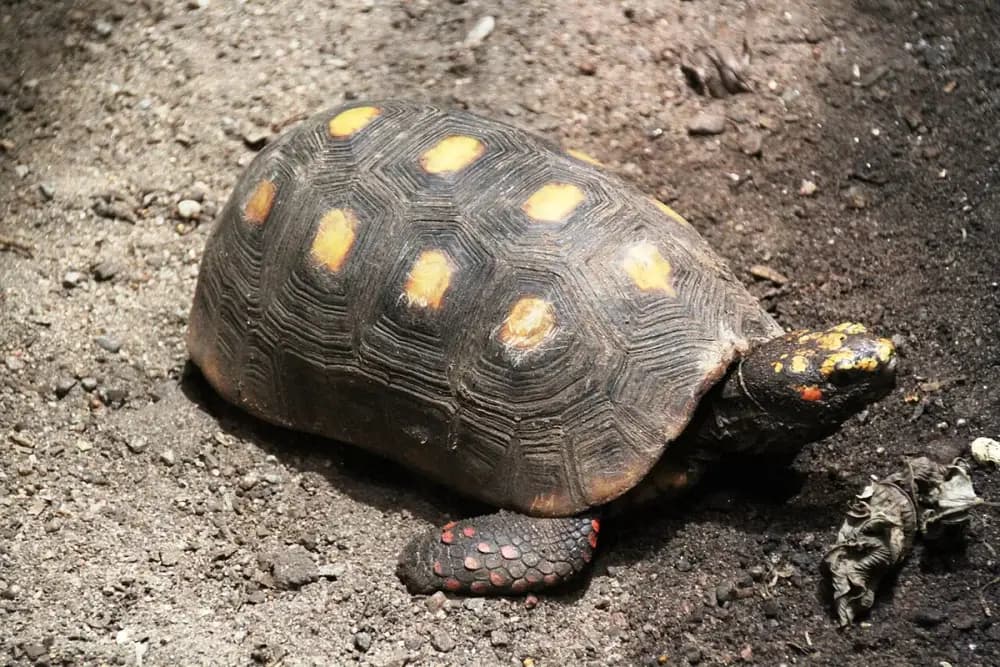
The radiated tortoise is a species in the family Testudinidae, native to and most abundant in southern Madagascar, though it can be found elsewhere on the island and has also been introduced to Réunion and Mauritius. It has the classic tortoise body plan — a high-domed carapace, a blunt head, and elephantine feet — with legs, feet, and head that are yellow except for a black patch of varying size on top of the head.
What sets the species apart visually is its shell: the carapace is marked with yellow lines radiating out from the center of each dark plate, giving the tortoise its name and a "star" pattern more finely detailed than that of similarly patterned species such as India's Geochelone elegans. The radiated tortoise is also larger than that species, and its scutes stay smooth rather than rising into the bumpy, pyramidal shape sometimes seen in other star-patterned tortoises. Sexual dimorphism is slight, though males usually have longer tails with more noticeable notches beneath them, and males tend to reach the largest sizes overall.
The species is exceptionally long-lived. The oldest radiated tortoise ever recorded with certainty, named Tu'i Malila, died at an estimated age of 188 — among the longest confirmed lifespans of any tortoise.
Behavior and diet
Diet
Herbivorous — grazing makes up 80–90% of the diet, plus fruits and succulents
Radiated tortoises are herbivores, and grazing accounts for 80 to 90% of their diet, supplemented by fruits and succulent plants; a favorite food in the wild is Opuntia cactus. They tend to graze repeatedly in the same areas, keeping the vegetation closely trimmed, and appear to prefer new growth over mature growth because of its higher protein and lower fiber content.
Males first mate once they reach a length of about 12 in (31 cm); females need to be a few inches longer. Courtship begins with the male bobbing his head and smelling the female's hind legs and cloaca, and in some cases he may lift her shell with the front edge of his own to keep her from moving away. He then mounts her from the rear, striking his plastron against her carapace while hissing and grunting — a rough process that has, in recorded cases, cracked a female's shell badly enough to pierce the vaginal and anal cavities.
Females lay three to twelve eggs in a hole they excavate 6 to 8 in (15–20 cm) deep, then leave. Incubation is long, typically five to eight months, and hatchlings emerge at 1.2 to 1.6 in (3.2–4 cm), colored white to off-white rather than the yellow of adults. The high-domed adult carapace develops soon after hatching.
Range and habitat
Habitat
Dry brush, thorn forest, and woodland
Radiated tortoises occur naturally only in the extreme southern and southwestern part of Madagascar, and they have also been introduced to the nearby islands of Réunion and Mauritius. Within their native range, they favor dry regions of brush, thorn forest, and woodland.
The species' restriction to a single corner of one island makes it especially vulnerable to habitat pressure. No reliable estimate of the wild population exists, but numbers are known to be declining, and multiple authorities see a real risk of the species collapsing toward extinction in the wild if current trends continue.
Conservation status
The radiated tortoise is Critically Endangered (CR), driven mainly by habitat loss, poaching for food, and overexploitation in the pet trade. It is listed on CITES Appendix I, which makes commercial trade in wild-caught animals illegal except under exceptional licensed circumstances — though Madagascar's economic conditions mean these protections are often poorly enforced.
Captive breeding has shown real promise as a conservation tool, including a program once run at the New York Zoological Society's Wildlife Survival Center; when that center closed in 2005, the work continued at the Behler Chelonian Center, the Turtle Conservancy's breeding facility in Southern California. The North American studbook lists 332 specimens participating in captive-breeding programs such as the Species Survival Plan. Smuggling remains a serious threat: seizures have included 21 tortoises intercepted in Thailand in 2013, 139 seized at a Mumbai airport in 2016, and — most dramatically — more than 10,000 tortoises discovered in a single home in Toliara, Madagascar, in 2018, hundreds of which later died from dehydration or infection despite rescue efforts.
Where to see radiated tortoise in the U.S.
27 zoos across 16 states
Find the closest one
Rank the 27 zoos holding radiated tortoise by how far they are from you. Your location is used in your browser to sort this list and is never sent to us.
Arizona· 1
California· 6
Delaware· 1
Florida· 4
Georgia· 1
Illinois· 1
Indiana· 2
Louisiana· 1
New York· 1
Ohio· 1
Oklahoma· 1
Rhode Island· 1
Tennessee· 1
Texas· 3
Virginia· 1
West Virginia· 1
AZAThe Association of Zoos and Aquariums. Accredited members have passed an independent inspection of animal care and welfare, safety, conservation and education, repeated every five years. Many smaller facilities never apply, so “not accredited” isn't a verdict on its own. What accreditation means · How we check this
Built from each zoo's own published animal list.
Radiated Tortoise: common questions
Is the radiated tortoise endangered?
Yes — it's classified as Critically Endangered, mainly because of habitat destruction and poaching, both for food and for the pet trade.
How big does a radiated tortoise get?
Adults typically have a carapace length of 26 to 38 cm (10 to 15 in) and weigh 2.5 to 8.8 kg (5.5 to 19.4 lb), with males tending to be the largest individuals.
What does a radiated tortoise eat?
It's a herbivore: grazing makes up 80 to 90% of its diet, rounded out by fruits and succulent plants such as Opuntia cactus.
How long do radiated tortoises live?
They're among the longest-lived tortoises; the oldest confirmed individual, Tu'i Malila, died at an estimated 188 years old.
Where do radiated tortoises live in the wild?
They're native to the extreme southern and southwestern part of Madagascar, in dry brush, thorn forest, and woodland, and have also been introduced to Réunion and Mauritius.
Which U.S. zoos have radiated tortoises?
Fifteen zoos in our directory list them, including the Los Angeles Zoo, Zoo Atlanta, and the Houston Zoo.