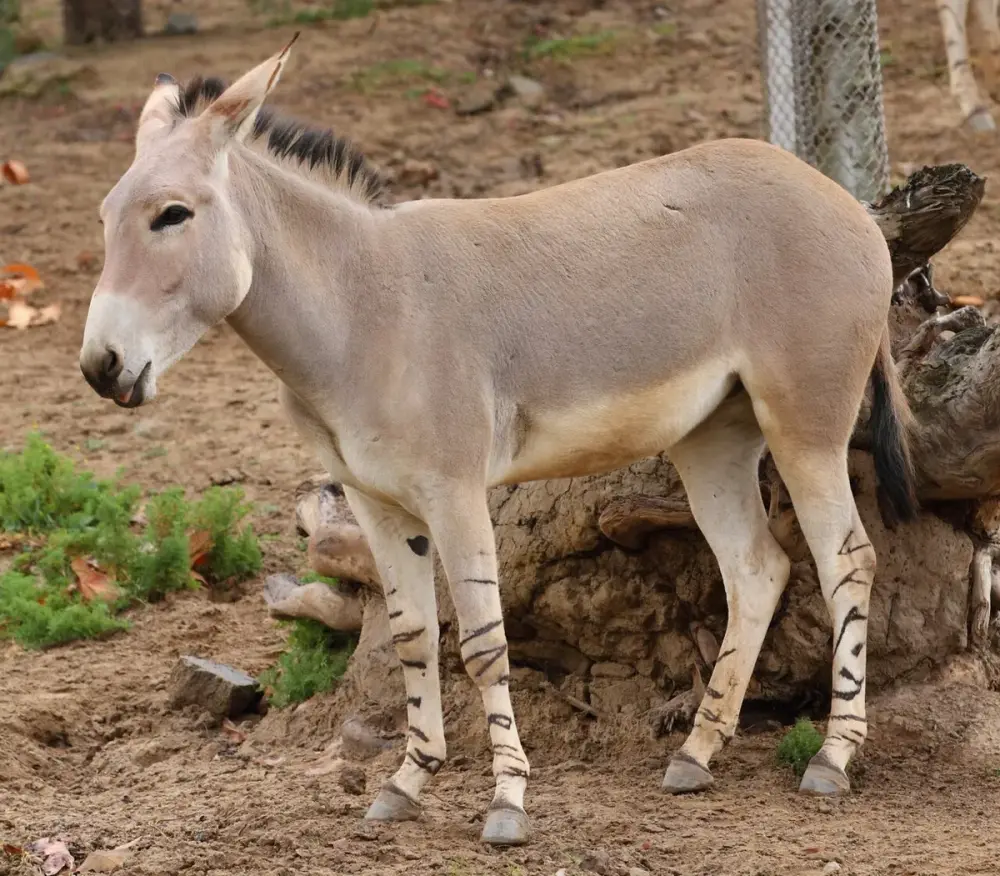
- Where to see one
- 35 U.S. zoos in our directory hold miniature donkey, confirmed against each zoo's own animal list.
- Native range
- Domesticated from the African wild ass; ancestry traces to Nubia and Somalia
- Size
- Donkeys as a species range from under 90 cm (35 in) to about 150 cm (59 in) at the withers, depending on breed
- Lifespan
- 12–15 years for working donkeys in poor conditions; 30–50 years in more prosperous conditions
Conservation status
Not Evaluated
This species has not been assessed for the IUCN Red List, so it sits outside the threat scale entirely.
Not Evaluated (NE); domestic animals are not assessed on the IUCN Red List
About the miniature donkey
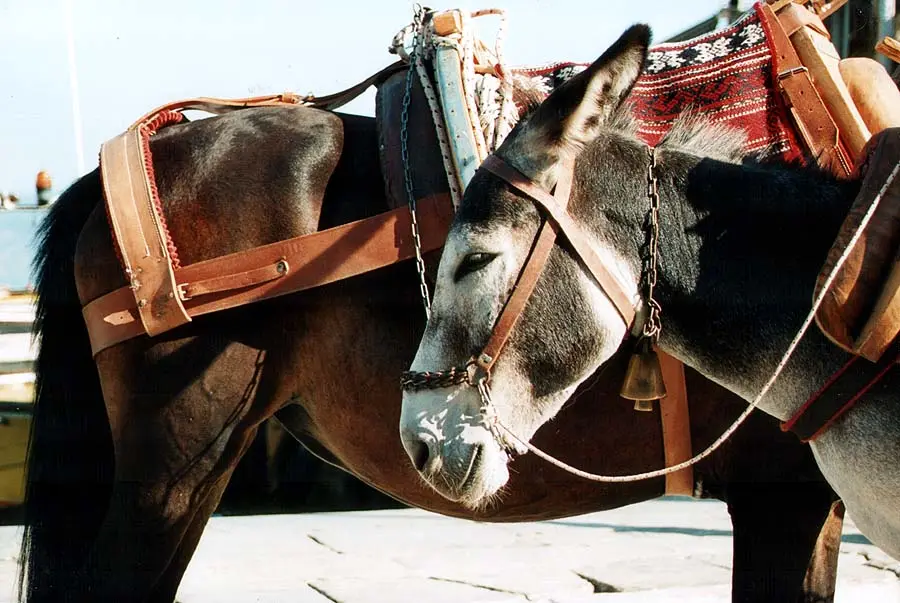
The miniature donkey belongs to the domesticated donkey, a species derived from the African wild ass and classified either as its own species, Equus asinus, or as a subspecies, Equus africanus asinus. Donkeys were domesticated in Africa roughly 5,000 to 7,000 years ago and have served ever since mainly as working animals — pack animals, draft animals, and, in developed countries today, companions, breeding stock, and livestock guardians. Worldwide there are more than 40 million donkeys, the great majority in less-developed countries where they remain essential pack and draft animals.
Donkeys as a species vary considerably in size depending on breed and environment, with heights at the withers ranging from less than 90 centimeters (35 inches) up to roughly 150 centimeters (59 inches) — a range wide enough to include everything from the smallest breeds to substantial draft-type animals. Most donkeys carry dorsal and shoulder stripes that form a distinctive cross pattern across the back, a primitive marking shared widely across the species. An adult male is called a jack, an adult female a jenny (or jennet), and a young donkey of either sex a foal.
Genetically, donkeys trace back to the Nubian and Somalian subspecies of the African wild ass, first domesticated by pastoral peoples in Nubia, where they replaced the ox as the primary pack animal. Genetic evidence points to a second, separate domestication event by Cushitic-speaking peoples in the Horn of Africa and along the Red Sea Hills. From Africa, donkeys spread to Southwest Asia and then, by the second millennium BC, into Europe, arriving in the Americas with Spanish ships in 1495 and reaching what is now the United States by the late 16th century.
Behavior and diet
Unlike wild and feral horses, wild donkeys in dry regions are solitary rather than herd-forming, with each adult establishing its own home range; breeding across a large area may be dominated by a single jack. Their loud bray, lasting around twenty seconds and audible over three kilometers, likely helps keep scattered individuals in contact across open desert. Large ears may help pick up distant sounds and cool the donkey's blood in hot conditions. Donkeys defend themselves by biting, striking with the front hooves, or kicking with the hind legs.
Donkeys have a reputation for stubbornness, but this is attributed to a stronger sense of self-preservation and prey instinct than horses show, rather than to poor temperament — it's simply harder to force or frighten a donkey into something it perceives as dangerous. Once a donkey trusts a handler, it tends to be a willing, companionable, and dependable working partner, and the species is described as intelligent, cautious, friendly, and playful, though formal study of donkey cognition remains limited.
On reproduction, a jenny is pregnant for about 12 months (ranging 11 to 14 months) and usually has a single foal; twins occur in only about 1.7 percent of pregnancies, and both survive in roughly 14 percent of those cases. Jennies come back into heat within 9 or 10 days of giving birth, but fertility stays low at that point, so breeders typically wait one or two further cycles before rebreeding — meaning a jenny has fewer than one foal per year, and breeders often plan for three foals across four years rather than one annually.
Range and habitat
Habitat
Historically arid, marginal desert lands
Donkeys are adapted to marginal desert lands and arid environments, a legacy of their African wild ass ancestry. Wild populations occupied dry country across Africa before domestication carried the species to Southwest Asia, then Europe, and eventually the Americas. In the United States, feral donkey populations — often called burros — became established in the western states after many pack animals were abandoned or escaped at the end of the 19th-century placer mining boom, particularly west of the Rocky Mountains.
The species' global population has shifted substantially over time: after growing steadily through most of history, the world donkey population began shrinking, falling from about 43.7 million in 1995 to 41 million by 2006, with the decline especially sharp in developed countries — Europe's donkey population fell from 3 million in 1944 to just over 1 million by 1994.
Conservation status
The miniature donkey is Not Evaluated (NE) on the IUCN Red List, because domestic animals aren't assessed there. Donkey numbers worldwide are still large but have been reported as declining in recent decades. China held the largest national donkey population as of 2006 (11 million), but by 2017 that number had reportedly dropped to about 3 million amid rising demand for donkey-hide products, a trend that has since pushed sourcing pressure onto African donkey populations as well. Concerns over this trade have led a number of African countries — including Uganda, Tanzania, Botswana, Niger, Burkina Faso, Mali, and Senegal — to ban the export of donkey products to China, and one welfare organization has warned the global donkey population could fall by half within five years if demand keeps rising.
In developed countries, donkey welfare has become enough of a concern that dedicated sanctuaries for retired and rescued donkeys have been established, including one of the largest, near Sidmouth, England, which also runs donkey welfare projects in Egypt, Ethiopia, India, Kenya, and Mexico.
Where to see miniature donkey in the U.S.
35 zoos across 23 states
Find the closest one
Rank the 27 zoos holding miniature donkey by how far they are from you. Your location is used in your browser to sort this list and is never sent to us.
8 more zoos hold miniature donkey but have no coordinates on file yet, so they aren't ranked here. They're in the full list below.
Alaska· 1
Arizona· 1
California· 2
Colorado· 1
Delaware· 1
District of Columbia· 1
Florida· 1
Illinois· 2
Indiana· 2
Iowa· 1
Kansas· 1
Louisiana· 2
Maryland· 1
Michigan· 1
Montana· 1
New York· 4
Oklahoma· 1
Rhode Island· 1
Tennessee· 3
Texas· 1
Washington· 1
West Virginia· 2
Wisconsin· 3
AZAThe Association of Zoos and Aquariums. Accredited members have passed an independent inspection of animal care and welfare, safety, conservation and education, repeated every five years. Many smaller facilities never apply, so “not accredited” isn't a verdict on its own. What accreditation means · How we check this
Built from each zoo's own published animal list.
Miniature Donkey: common questions
Is the miniature donkey endangered?
No. Donkeys are domestic animals, which are not assessed on the IUCN Red List, and they remain numerous worldwide, though global donkey numbers have been falling in recent decades as demand for donkey hide has grown.
How big does a miniature donkey get?
Donkeys generally range from under 90 cm (35 in) to about 150 cm (59 in) at the withers depending on breed, with miniature breeds falling at the small end of that range.
How long do donkeys live?
Working donkeys in poorer conditions have a life expectancy of 12 to 15 years; in more prosperous conditions, donkeys can live 30 to 50 years.
Where do donkeys come from?
Donkeys were domesticated in Africa from the wild ass roughly 5,000 to 7,000 years ago, with ancestry tracing to Nubia and to Cushitic-speaking peoples of the Horn of Africa and Red Sea Hills.
Which U.S. zoos have miniature donkeys?
Six U.S. zoos list this species, including the Maryland Zoo in Baltimore, Detroit Zoo, and Nashville Zoo at Grassmere.