- Where to see one
- 27 U.S. zoos in our directory hold donkey, confirmed against each zoo's own animal list.
- Native range
- Domesticated in northeast Africa from the African wild ass; now kept worldwide
- Size
- About 90 cm (35 in) to 150 cm (59 in) tall at the withers, depending on breed
- Lifespan
- 12–15 years for working donkeys in the poorest countries; 30–50 years where they are well kept
- Gestation
- About 12 months (range 11–14 months), usually one foal
- Names
- Male is a jack, female a jenny or jennet, young a foal
Conservation status
Not Evaluated
This species has not been assessed for the IUCN Red List, so it sits outside the threat scale entirely.
Not Evaluated (NE); domestic animals are not assessed on the IUCN Red List
The donkey, or ass, is a domesticated equine descended from the African wild ass. It was domesticated in Africa some 5,000 to 7,000 years ago and has been used mainly as a working animal ever since, chiefly to pull loads or carry packs. Donkeys are adapted to marginal desert lands, where wild ones are solitary and do not form harems; in dry native climates they spend more than half of each day foraging, often on poor scrub. A jack is an adult male and a jenny an adult female. Jacks are often mated with mares to produce mules, while a stallion and jenny produce the rarer hinny. Their loud bray can last twenty seconds and be heard from over three kilometres away.
About the donkey
The donkey, or ass, is a domesticated member of the horse family, Equidae, descended from the African wild ass. It was domesticated in Africa some 5,000 to 7,000 years ago and is kept worldwide today, mostly as a pack and draught animal in poorer countries.
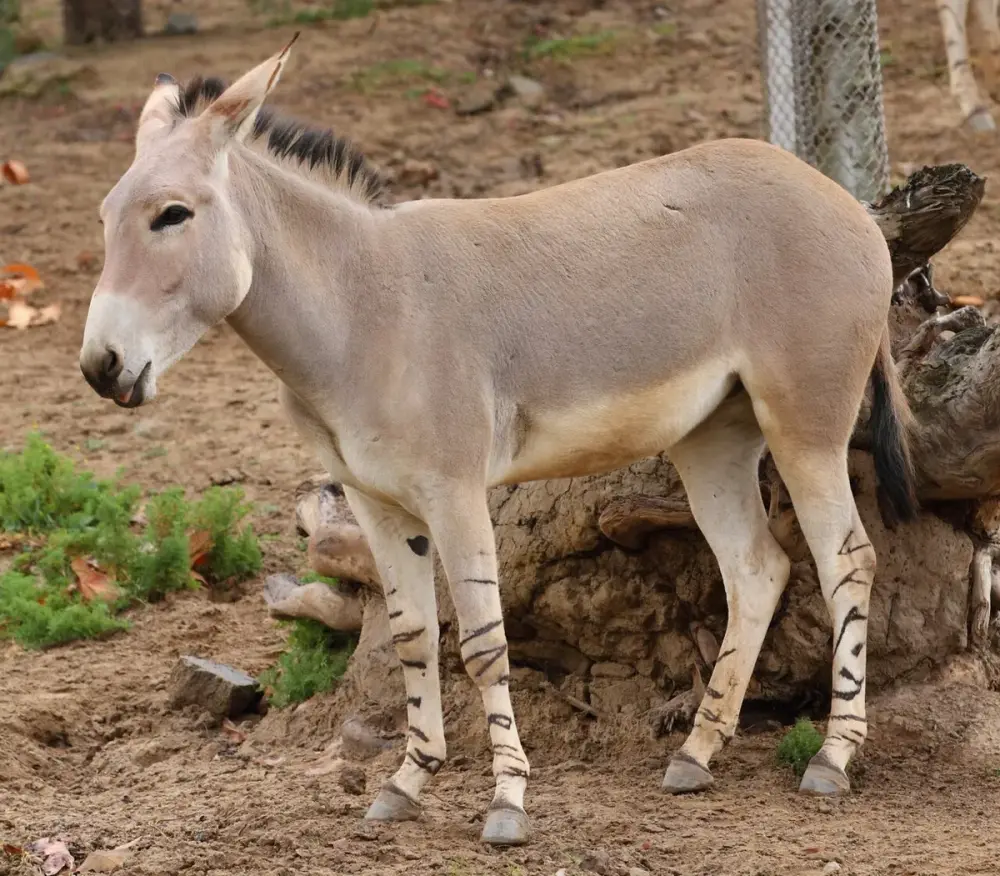
Its scientific name is Equus asinus when treated as its own species, or Equus africanus asinus when counted as a subspecies of the wild ass. A 2003 ruling by the International Commission on Zoological Nomenclature settled that, if the two are lumped, the wild animal's name takes priority. Its direct ancestors are two subspecies of African wild ass: the Nubian and the Somali, the latter better known as the Somali wild ass.
Size varies enormously with breed and living conditions. Height at the withers runs from less than 90 cm (35 in) in the smallest animals, such as the miniature donkey, to about 150 cm (59 in) in large breeds. Big breeds like the Baudet du Poitou, the Asino di Martina Franca and the Mammoth Jack are raised mainly to sire mules.
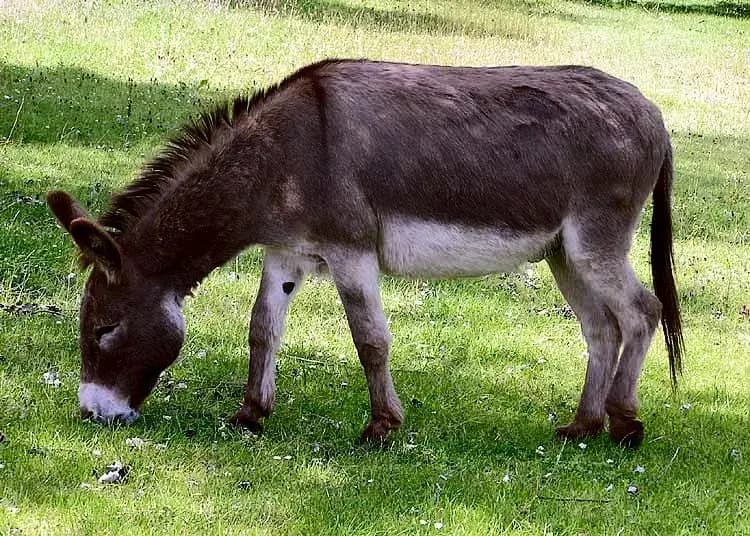
The most recognizable features are the long ears and the coat markings. The large ears may help pick up distant sounds across open desert, and they may also help cool the animal's blood. Most donkeys carry a dark stripe down the spine and another across the shoulders, primitive markings that together form a cross on the back. Their hooves are more elastic than a horse's and do not wear down as quickly, so they need regular trimming.
Behavior and diet
Diet
Grasses, scrub, straw, hay and other fibrous forage
Donkeys have a reputation for stubbornness, but this has been put down to a much stronger sense of self-preservation than horses have. A donkey is much harder to force or frighten into something it judges dangerous. Once a handler has earned its trust, it becomes a willing, dependable partner. Formal studies are limited, but donkeys appear intelligent, cautious, friendly, playful and eager to learn.
In dry country, wild-living donkeys behave differently from wild horses. They are solitary rather than living in harems, and each adult holds its own home range, with one jack sometimes dominating breeding over a wide area. The bray, often written as "hee haw," typically lasts about 20 seconds and can be heard more than 3 km (about 2 mi) away. It probably helps scattered animals keep in touch across open desert. A threatened donkey bites, strikes with its front hooves, or kicks with its hind legs.
That defensive streak is put to work on farms. In the United States, Canada and Australia, donkeys guard sheep and other small livestock, braying loudly and kicking at predators with their front hooves. In 2019 donkeys made up 14.2% of livestock guardian animals in the United States. They are also thought to calm nervous horses when pastured together.
The donkey's digestion is built for poor food. In arid native climates, donkeys spend more than half of each day foraging, often on low-quality scrub. Fibrous roughage is broken down by fermentation in the hindgut, and a donkey digests it more efficiently than a horse does. It needs about 1.5% of its body weight in dry matter per day, against 2–2.5% for a horse of similar size, and is less prone to colic.
Most of its energy comes from structural carbohydrates such as grass, hay and straw. A donkey can meet its needs on six to seven hours of grazing a day on average dryland pasture. Rich temperate pasture is often too much of a good thing: overfeeding leads to obesity, laminitis (founder), hyperlipaemia and gastric ulcers.
A jenny is pregnant for about 12 months, with a range of 11 to 14, and usually has a single foal. Twins occur in about 1.7% of pregnancies. Because of the long pregnancy and low fertility just after foaling, breeders often plan for three foals in four years rather than one every year.
Range and habitat
Habitat
Adapted to marginal desert and dry lands; raised on farms and pasture everywhere
Donkeys were probably first domesticated by pastoral people in Nubia, with genetic evidence pointing to a separate domestication by Cushitic-speaking peoples in the Horn of Africa and along the Red Sea Hills. Remains of domestic donkeys from the fourth millennium BC have been found at Ma'adi in Lower Egypt. From there they spread to Southwest Asia, then to Europe, and Greek and Roman trade carried them around the Mediterranean.
The first donkeys reached the Americas on Columbus's second voyage, landing on Hispaniola in 1495. They crossed the Rio Grande into what is now the United States with Juan de Oñate in 1598. In the 19th-century Gold Rush, the burro became the prospector's pack animal of choice in the West, and escaped or abandoned animals founded the feral herds that still live west of the Rocky Mountains.
As a species, the donkey is adapted to marginal desert land, but today it is raised wherever people farm. There were almost 54 million donkeys worldwide in 2024, with Ethiopia (10.8 million), Sudan (7.76 million) and Pakistan (5.9 million) holding the most. About 96% of the world's donkeys live in developing countries, working as pack and draught animals. In wealthier countries they are kept as pets, livestock guards, mule sires and riding animals for children.
Feral donkeys are a mixed story. The North American burro and the Asinara donkey of Sardinia have protected status. In places that evolved without any equids, such as Hawaii, they cause problems, and in Australia, where there may be 5 million feral donkeys, they are treated as an invasive pest that damages waterholes and causes erosion.
Donkey vs mule vs hinny
Donkeys, mules and hinnies are easy to mix up because all three are long-eared working equines. Mules and hinnies are hybrids between donkeys and horses, and like other interspecies hybrids they are usually sterile.
| Animal | Parents | Fertile? | Notes |
|---|---|---|---|
| Donkey | Donkey father and donkey mother | Yes | A domestic species descended from the African wild ass |
| Mule | Male donkey (jack) and female horse (mare) | Usually not | The more common hybrid, valued as a working and riding animal |
| Hinny | Male horse (stallion) and female donkey (jenny) | Usually not | Less common; mules are generally thought easier to handle and stronger |
| Zonkey | Usually a male zebra and female donkey | Usually not | Also called zebroid, zebrass or zedonk |
Donkeys can also cross with a zebra. The reverse cross, a male donkey with a female zebra, is called a zebra hinny or zebrinny and is rarer still.
Conservation status
As a domestic animal, the donkey is not assessed on the IUCN Red List, so it carries no wild conservation category. Its numbers and welfare are still a real concern. The world population fell from 43.7 million in 1995 to about 41 million in 2006, with the steepest drops in developed countries; Europe went from 3 million donkeys in 1944 to just over 1 million in 1994.
Demand for ejiao, a gelatin made by boiling donkey hides for traditional Chinese medicine, has added pressure. China's donkey population was reported to have fallen to 3 million by 2017, and suppliers turned to Africa. Several African countries, including Uganda, Tanzania, Botswana, Niger, Burkina Faso, Mali and Senegal, responded by banning China from buying their donkey products. In 2019 The Donkey Sanctuary warned that the global population could be halved within about five years if demand kept rising.
Breed diversity, by contrast, is better documented than ever. The FAO's DAD-IS database listed 189 breeds of ass in June 2011, up from 77 in 1995, largely because more breeds were formally identified and recognized.
Where to see donkey in the U.S.
27 zoos across 17 states
Find the closest one
Rank the 17 zoos holding donkey by how far they are from you. Your location is used in your browser to sort this list and is never sent to us.
10 more zoos hold donkey but have no coordinates on file yet, so they aren't ranked here. They're in the full list below.
Alabama· 1
Arizona· 2
California· 3
Florida· 3
Georgia· 2
Illinois· 2
Iowa· 1
Kentucky· 1
Maryland· 1
Mississippi· 1
Missouri· 1
New Jersey· 1
North Carolina· 2
North Dakota· 1
Tennessee· 1
Virginia· 2
Wisconsin· 2
AZAThe Association of Zoos and Aquariums. Accredited members have passed an independent inspection of animal care and welfare, safety, conservation and education, repeated every five years. Many smaller facilities never apply, so “not accredited” isn't a verdict on its own. What accreditation means · How we check this
Built from each zoo's own published animal list.
Donkey: common questions
Is a donkey a horse?
No. The donkey is a separate domestic equine in the same family and genus as the horse, Equus, but it descends from the African wild ass rather than from wild horses.
How big do donkeys get?
Between less than 90 cm (35 in) and about 150 cm (59 in) tall at the withers, depending on breed and living conditions.
How long do donkeys live?
Working donkeys in the poorest countries live about 12 to 15 years. In more prosperous countries, donkeys can live 30 to 50 years.
What do donkeys eat?
Fibrous plants: grass, scrub, hay and straw. They need about 1.5% of their body weight in dry food a day, less than a horse, and rich pasture can make them obese.
Are donkeys dangerous?
They can be. A threatened donkey bites, strikes with its front hooves and kicks with its hind legs, which is why donkeys are used to guard sheep from predators.
Why do donkeys bray?
A bray typically lasts about 20 seconds and carries more than 3 km (2 mi), which may help donkeys stay in contact across open desert.
What is the difference between a donkey and a mule?
A mule is a hybrid of a male donkey and a female horse. Mules are usually sterile, while donkeys breed normally.
Can you keep a donkey as a pet?
Yes. In developed countries donkeys are commonly kept as pets and companions, but they need trimmed hooves, salt and minerals, clean water and careful feeding to avoid obesity.