Przewalski's Horse
Equus przewalskii
Also known as Asian Wild Horse, Przewalkski'S Horse Foal, Przewalskis Wild Horse
- Where to see one
- 9 U.S. zoos in our directory hold przewalski's horse, confirmed against each zoo's own animal list.
- Native range
- steppes of Central Asia, especially Mongolia
- Size
- about 12–14 hands (48–56 in, 122–142 cm) tall, around 300 kg (660 lb)
Conservation status
Endangeredassessed 2015
IUCN Red List category EN — step 4 of 7.
Endangered (EN), assessed in 2015
About the Przewalski's horse
Przewalski's horse, also called the takhi, Mongolian wild horse, or Dzungarian horse, is a rare wild horse native to the steppes of Central Asia and named for the Russian geographer and explorer Nikolay Przhevalsky. It once vanished entirely from the wild but has been reintroduced since the 1990s to sites in its native Mongolia, including Hustai National Park, Takhin Tal Nature Reserve, and Khomiin Tal, along with other locations in Central Asia and Eastern Europe.
Genetically, Przewalski's horse is distinct from the domestic horse in ways that show neither descended from the other: it carries 33 chromosome pairs to the domestic horse's 32, and the two lineages split from a common ancestor somewhere between 160,000 and 38,000 years ago, long before horses were ever domesticated. For decades it was considered the only truly wild horse left, unlike feral populations such as the American mustang or Australian brumby, which descend from once-domesticated animals. That picture got more complicated when horses from the 5,000-year-old Botai culture of Central Asia turned out to be more closely related to Przewalski's horse than to the domestic horse — raising the open question of whether modern Przewalski's horses are themselves feral descendants of Botai domestic stock, or whether both populations simply share the same wild ancestor. Its taxonomic status remains debated: some researchers classify it as its own species, Equus przewalskii, others as a subspecies of the wild horse, Equus ferus przewalskii.
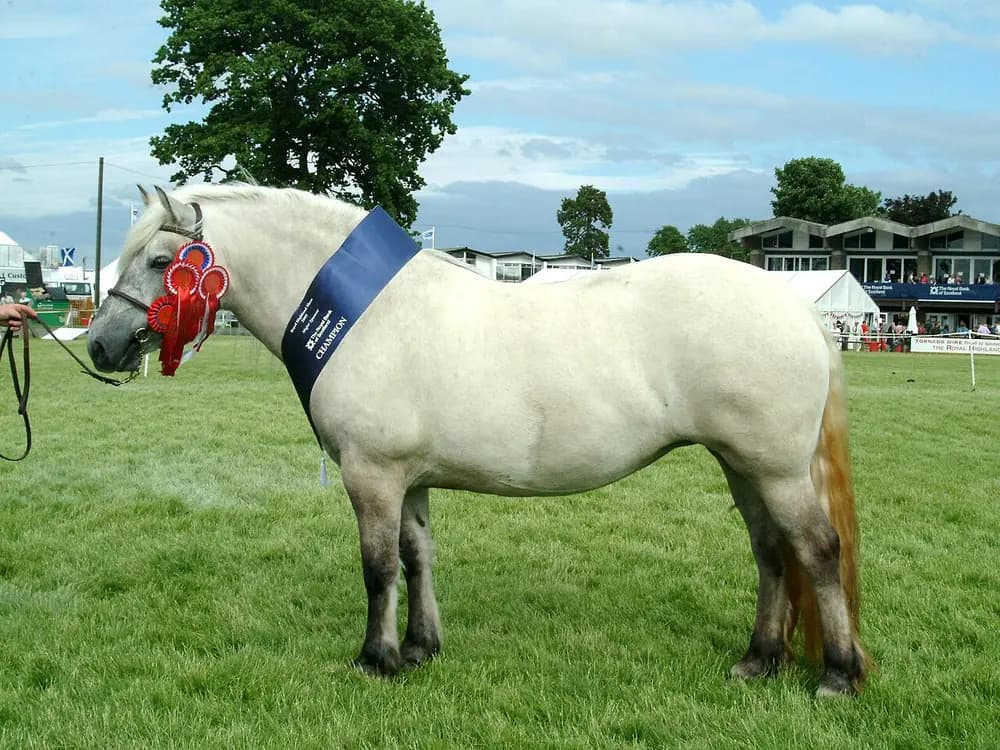
Physically, Przewalski's horse is stockier, smaller, and shorter-legged than a domestic horse, standing about 12 to 14 hands (48–56 in, 122–142 cm) at the shoulder and weighing around 300 kg (660 lb), with a body length near 2.1 m (6 ft 11 in). Its dun coat carries pangaré shading — dark brown around the mane fading to pale brown on the flanks and yellowish-white on the belly and muzzle — along with faint striping on the legs, both considered primitive markings. The mane stands erect rather than falling to one side, and the tail, about 90 cm (35 in) long, has a longer dock and shorter hair than a domestic horse's. Its hooves are longer in front with notably thicker sole horn, an adaptation suited to rough terrain.
Behavior and diet
Diet
grasses and forbs, shifting seasonally
Przewalski's horses live in family groups of one stallion, one to three mares, and their offspring, who stay with the group until they're independent at two or three years old. Young females move on to join other harems, while bachelor stallions — along with older stallions that have lost their harem — form bachelor groups of their own; several family groups can also come together into a larger moving herd. Within a family, stallions herd, drive, and defend every member, while mares often take the lead in day-to-day decisions; stallions and mares tend to stick with preferred partners for years. Communication is constant and detailed, built from vocalizations, scent marking, and a wide range of visual and tactile signals — every kick, groom, or tilt of an ear carries information to the rest of the group.
Diet is entirely plant-based and shifts with the seasons. In spring, the horses favor species like Elymus repens and Festuca valesiaca; in early summer they turn to Dactylis glomerata and clover; by late summer they gravitate back toward Elymus repens and Vicia cracca. Winter fare includes willows, wild pear, apple, pine, rose, and alder, and the horses will dig through snow and ice for grasses growing beneath. Their winter metabolism drops to roughly half its springtime rate, a programmed seasonal adjustment rather than simply a response to less food being available.
Mating happens in late spring or early summer; stallions don't typically start seeking mates until age five. Females can give birth starting at age three, after a gestation of 11 to 12 months, and foals stand within about an hour of birth. Foal mortality is notable at 25 percent, and the large majority of those deaths — about 83 percent — are attributed to infanticide by a rival leading stallion. Foals begin grazing within a few weeks but aren't weaned for another 8 to 13 months, and they reach sexual maturity at two years old.
Range and habitat
Habitat
desert and steppe, including saline districts near natural wells
Przewalski's horse is native to the steppes of Central Asia. Historically, it was described as living in the "wildest parts of the desert," with a preference for especially saline districts, and it was most often observed near natural wells during spring and summer, moving between them across valleys rather than over higher mountain terrain. Home ranges vary enormously by site: as small as 1.2 to 24 km² (0.46–9.3 sq mi) in Hustai National Park, but 150 to 825 km² (58–319 sq mi) in the Great Gobi B Strictly Protected Area, with the ranges of different harems overlapping only slightly. Modern reintroduction has returned the species to several of these historic Mongolian sites plus other locations in Central Asia and Eastern Europe, decades after it disappeared entirely from the wild. Few natural predators remain in this range; the Himalayan wolf is among the small number that still take Przewalski's horses.
Conservation status
Przewalski's horse is listed as Endangered on the IUCN Red List, in a 2015 assessment that covers it under the name Equus ferus. It was once classed as extinct in the wild. After reintroduced horses began breeding, the IUCN moved it to Critically Endangered in 2008 and then to Endangered after a 2011 reassessment.
The species had disappeared from the wild by the late 20th century, surviving only in captive herds that traced back to animals captured around 1900 by Carl Hagenbeck. Reintroduction to Mongolia began in the 1990s, restoring free-ranging herds to protected areas including Hustai National Park, Takhin Tal Nature Reserve, and Khomiin Tal.
The population still carries the mark of that near-extinction. Geneticists have found much lower heterozygosity in Przewalski's horses than in domestic horses, with long stretches of the genome showing little diversity, a consequence of the severe bottleneck the captive population passed through. Exchanges of horses between captive herds since the late 1970s have helped the species keep more genetic diversity than that bottleneck made likely.
Where to see przewalski's horse in the U.S.
9 zoos across 8 states
Find the closest one
Rank the 9 zoos holding przewalski's horse by how far they are from you. Your location is used in your browser to sort this list and is never sent to us.
California· 2
Colorado· 1
District of Columbia· 1
Kansas· 1
Minnesota· 1
New York· 1
Ohio· 1
Utah· 1
AZAThe Association of Zoos and Aquariums. Accredited members have passed an independent inspection of animal care and welfare, safety, conservation and education, repeated every five years. Many smaller facilities never apply, so “not accredited” isn't a verdict on its own. What accreditation means · How we check this
Built from each zoo's own published animal list.
Przewalski's Horse: common questions
Is the Przewalski's horse endangered?
Yes. It is listed as Endangered on the IUCN Red List (2015 assessment). It was extinct in the wild before reintroduction efforts began in Mongolia in the 1990s.
How big does a Przewalski's horse get?
It stands about 12 to 14 hands (48–56 in, 122–142 cm) tall and weighs around 300 kg (660 lb) — smaller and stockier than a domestic horse.
What does a Przewalski's horse eat?
Grasses and forbs, with the specific plants eaten shifting by season, from spring grasses to summer clover to winter browse like willow and pine.
Where do Przewalski's horses live in the wild?
On the steppes and deserts of Central Asia, with reintroduced populations today in Mongolia's Hustai National Park, Takhin Tal Nature Reserve, and other protected sites.
Which U.S. zoos have Przewalski's horses?
7 U.S. zoos keep them, including the San Diego Zoo Safari Park, Denver Zoo, and the Bronx Zoo.
Can Przewalski's horses breed with domestic horses?
Yes. Despite having a different number of chromosome pairs, they can interbreed with domestic horses and produce fertile offspring.