- Where to see one
- 23 U.S. zoos in our directory hold miniature horse, confirmed against each zoo's own animal list.
- Origin
- Europe, with records from the late 18th century; recognized breeds in Argentina, the Netherlands, South Africa and the United States
- Size
- Usually not much over 100 cm (40 in) tall; the American Miniature Horse Association registers none over 86 cm (34 in)
- Lifespan
- Usually 25–35 years
- Gestation
- About 340 days for horses, usually one foal
- Breeds
- Falabella, Dutch Miniature, South African Miniature Horse, American Miniature Horse
Conservation status
Not Evaluated
This species has not been assessed for the IUCN Red List, so it sits outside the threat scale entirely.
Not Evaluated (NE); domestic horses are not assessed on the IUCN Red List
A miniature horse is a type of horse defined by its small size. It is usually bred to show the features of a full-sized horse in miniature, standing little over 100 cm (40 in) tall or even less, although genetically it is much closer to pony breeds such as the Shetland. Records of these horses in Europe go back to the late eighteenth century, and recognized breeds include the Falabella of Argentina, the Dutch Miniature and the American Miniature Horse. They are commonly kept as companion animals and are suited to driving and horse shows, being too small for any but the smallest riders. The usual lifespan is 25 to 35 years, often longer than is typical for full-sized horses.
About the miniature horse
A miniature horse is a very small domestic horse, usually little over 100 cm (40 in) tall, bred to look like a full-sized horse in miniature. Despite its horse-like proportions it is genetically much closer to pony breeds such as the Shetland. Miniature horses are kept in many countries, commonly as companion animals.
Miniature horses belong to the domestic horse, Equus ferus caballus, a one-toed hoofed mammal in the family Equidae. Horses are odd-toed ungulates of the order Perissodactyla, whose only other surviving families are the tapirs and the rhinoceroses, such as the Malayan tapir and the white rhinoceros.
Selective breeding has shrunk the body while keeping a horse's build. Many American miniatures look like a small Arab horse, while others have the stocky build of a small draft horse. Coat colors, eye colors, patterns and markings vary widely, and all are accepted for registration in the American breed. Some colors that are rare in full-sized American horses turn up, such as bay silver dapple, a light bay with a white mane and tail and black legs.
How they are measured
Most horses are measured at the highest point of the withers, where the neck meets the back. American miniatures are instead measured to the root of the last hair of the mane. The American Shetland Pony Club registers miniatures in two sections, up to 86 cm (34 in) and up to 97 cm (38 in), while the American Miniature Horse Association accepts nothing over 86 cm (34 in). The smallest horse on record, Thumbelina, was a miniature horse with dwarfism that stood just 43 cm (17 in) and weighed 26 kg (57 lb).
Health
Miniature horses are generally hardy, but their health risks differ from those of full-sized horses. They rarely suffer from laryngeal hemiplegia, osteochondrosis or navicular disease, which are common in bigger horses. They are far more likely to develop hyperlipaemia, which can lead to fatty liver disease, or eclampsia. Crowded and misaligned teeth are more common than in larger horses, including "parrot mouth" and "sow mouth," and poor chewing can contribute to colic caused by enteroliths, faecoliths or sand.
Behavior and diet
Diet
Grass and other forage, eaten steadily through the day
Miniature horses behave like other horses. Horses are prey animals with a strong fight-or-flight response: when startled they usually flee, though they stand and fight if escape is impossible or their young are threatened. They are also curious and will often pause to work out what frightened them.
Horses are herd animals with a clear ranking, usually led by a dominant mare. They form strong bonds with other horses and with other animals, including people. They communicate by nickering and whinnying, mutual grooming and body language. Kept alone or without enough exercise or stimulation, horses can develop repetitive habits such as wood chewing, wall kicking and weaving.
Senses and sleep
A horse's eye is one of the largest of any land mammal, and with eyes on the sides of the head horses can see more than 350° around them. Their color vision is dichromatic (two-color), so reds and related colors look greenish to them. Each ear can swivel up to 180°, and the sense of touch is sharp enough to feel an insect land anywhere on the body.
Horses can doze standing up thanks to a "stay apparatus" in the legs, but they must lie down to reach deep REM sleep. They rest in many short bouts rather than one long sleep, averaging about 2.9 hours of sleep a day, and they sleep better in groups, where some stand guard.
What miniature horses eat
Horses are herbivores built to graze grass and other plants steadily through the day. Unlike cattle, they are not ruminants: they have one relatively small stomach and very long intestines, and microbes in the hindgut ferment the cellulose in grass. Horses cannot vomit, so digestive trouble can quickly turn into colic. Their front teeth bite off grass and the back teeth grind it, and the teeth keep erupting throughout life as grazing wears them down.
Foals
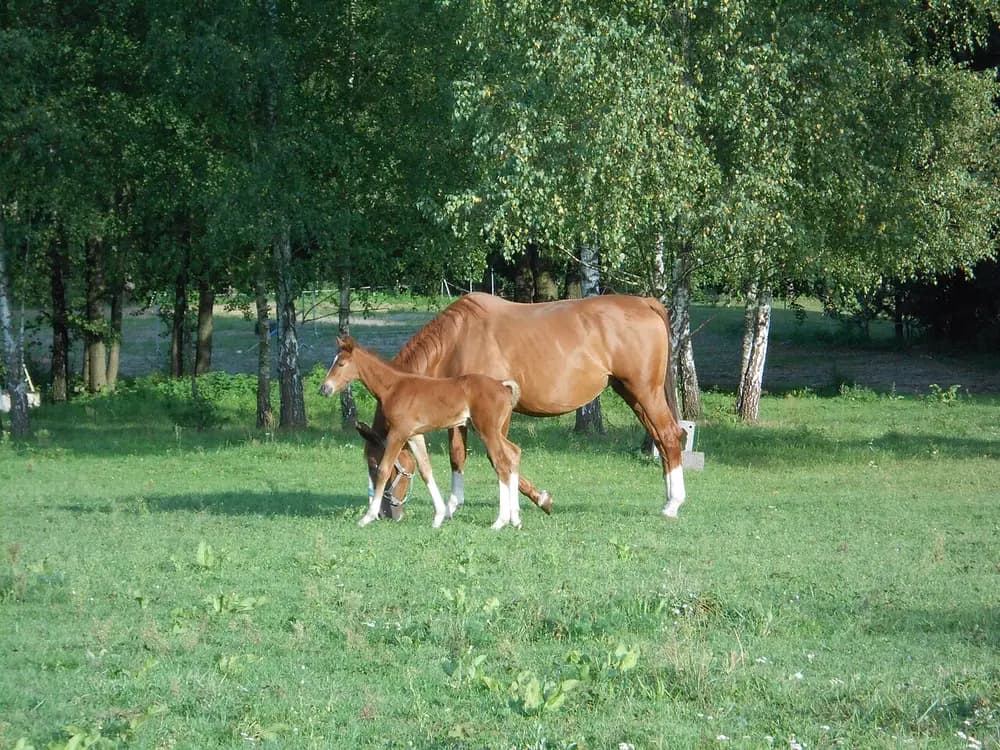
Pregnancy in horses lasts about 340 days, usually producing a single foal. Foals are precocial, able to stand and run soon after birth, and most domestic foals are weaned at five to seven months. A horse is considered mature at four years old.
Range and habitat
Habitat
Farms, stables and pasture
Miniature horses originated in Europe, where written and pictorial records of them go back to the late 18th century. In England in the first half of the 20th century, Lady Estella Mary Hope and her sister Lady Dorothea bred small horses. In Argentina, the Falabella was developed in the mid-1800s by Patrick Newtall and later by his son-in-law Juan Falabella, who added Welsh pony, Shetland pony and small Thoroughbred bloodlines and used close inbreeding to fix the small size.
The South African Miniature Horse was bred from Shetland stock from about 1945, and about 700 lived in South Africa in 2011. The American Miniature Horse developed in the 20th century, partly from British animals, possibly including pit ponies once used in coal mines of the eastern and central United States. Its first stud book opened in 1972, and the American Miniature Horse Association was formed in 1978. By 2005 the two American registries held roughly 150,000 and more than 160,000 horses.
Today miniature horses live in Argentina, Australia, France, Germany, the Netherlands, Ireland, Namibia, the Philippines, the United Kingdom and the United States, among other countries. Most are too small to ride except by the smallest riders, but they pull carts well and compete in driving and other horse-show events. A few have been trained as guide horses for blind people, especially for those who consider dogs unclean.
Miniature horse vs full-sized horse
| Feature | Miniature horse | Light riding horse |
|---|---|---|
| Height | Usually up to about 100 cm (40 in) | 142–163 cm (56–64 in) |
| Measured at | Root of the last mane hair (American breed) | Withers |
| Typical lifespan | 25–35 years | 25–30 years for domestic horses |
| Common health issues | Hyperlipaemia, dental crowding | Laryngeal hemiplegia, osteochondrosis, navicular disease |
Conservation status
Domestic horses are not assessed on the IUCN Red List, so the miniature horse is Not Evaluated. Feral horses are not true wild horses. The domestic horse is one of two living subspecies of Equus ferus, and the horses kept by the Botai culture of Kazakhstan, once thought to be the first domesticated, turned out to be Przewalski's horses rather than ancestors of modern breeds.
For breed records, the FAO rated the American Miniature Horse "not at risk" in 2007, while the DAD-IS database listed it as "at risk" in 2022. In 2005 the American Shetland Pony Club stud book held almost 150,000 horses and the American Miniature Horse Association register more than 160,000.
Where to see miniature horse in the U.S.
23 zoos across 15 states
Find the closest one
Rank the 18 zoos holding miniature horse by how far they are from you. Your location is used in your browser to sort this list and is never sent to us.
5 more zoos hold miniature horse but have no coordinates on file yet, so they aren't ranked here. They're in the full list below.
California· 1
Connecticut· 1
Florida· 1
Illinois· 2
Indiana· 1
Massachusetts· 3
Michigan· 1
New York· 1
North Carolina· 2
Ohio· 1
Oklahoma· 1
Pennsylvania· 1
Tennessee· 3
Texas· 3
Wisconsin· 1
AZAThe Association of Zoos and Aquariums. Accredited members have passed an independent inspection of animal care and welfare, safety, conservation and education, repeated every five years. Many smaller facilities never apply, so “not accredited” isn't a verdict on its own. What accreditation means · How we check this
Built from each zoo's own published animal list.
Miniature Horse: common questions
How big do miniature horses get?
Usually no more than about 100 cm (40 in) tall. American registries cap them at 86 cm (34 in) or 97 cm (38 in), depending on the registry and section.
Is a miniature horse a pony?
Not by appearance, but genetically yes, nearly. Miniature horses are bred to look like small full-sized horses, yet their genetics are much closer to pony breeds such as the Shetland.
How long do miniature horses live?
Usually 25 to 35 years, often longer than full-sized horses of some breeds.
What do miniature horses eat?
Grass and other forage, grazed steadily through the day. Like all horses they digest plant fiber in the hindgut rather than chewing cud.
Can you ride a miniature horse?
Generally no. They are too small for any but the smallest riders, but they are well suited to pulling carts and driving.
Can a miniature horse be a pet?
Yes. Miniature horses are commonly kept as companion animals, and a few have been trained as guide horses for blind people.
What health problems do miniature horses have?
They are prone to hyperlipaemia, eclampsia and dental crowding, which can lead to colic. They rarely get some problems common in large horses, such as navicular disease.