- Where to see one
- 28 U.S. zoos in our directory hold grizzly bear, confirmed against each zoo's own animal list.
- Native range
- North America, from Alaska south through western Canada into parts of the northwestern United States
- Size
- Coastal males weigh around 389 kg (858 lb) and coastal females around 207 kg (456 lb); interior males weigh around 139 kg (306 lb) and interior females around 95 kg (209 lb); average total length 198 to 240 cm (78 to 94 in), with an average shoulder height of 102 cm (40 in)
- Lifespan
- Average lifespan is about 22 years for males and 26 years for females
Conservation status
Least Concernassessed 2017
IUCN Red List category LC — step 1 of 7.
Least Concern (LC), as part of the brown bear species
The grizzly is the inland North American form of the brown bear, distinguished from coastal brown bears less by taxonomy than by diet and size: without reliable salmon runs, interior grizzlies are smaller and rely more heavily on roots, tubers, berries, insects, carrion and ungulate calves. The common name comes from the grizzled, silver-tipped guard hairs across the shoulders and back. A pronounced muscular shoulder hump, powering the forelimbs for digging, is the most reliable field mark separating a grizzly from a black bear, along with a dished facial profile and long, gently curved front claws. Grizzlies enter a winter dormancy in excavated dens, during which females give birth to cubs weighing barely a pound. Although the species is globally secure, the lower-48 population was reduced to a fraction of its historic range and remains concentrated in and around the Northern Rockies.
About the grizzly bear
The grizzly bear, also known as the North American brown bear, is a population or subspecies of the brown bear, Ursus arctos, found across North America. Other bears sometimes grouped under the "grizzly" name include the Kodiak bear, the Kamchatka bear, and the peninsular grizzly, along with the now-extinct California grizzly and Mexican grizzly. The name traces back to explorers Meriwether Lewis and William Clark, who first described the bear as "grisley" — a spelling that could mean either "grizzled," for its grey-tipped hair, or "grisly," meaning fear-inspiring. Naturalist George Ord formally classified the animal in 1815 as Ursus horribilis, reflecting the latter reading.
Grizzly bears are among the largest brown bear populations, exceeded in size only by the Kamchatka brown bear and the Kodiak bear, and their size varies by region and season. The largest are the coastal bears of the Alaskan peninsula, where males weigh around 389 kg (858 lb) and females around 207 kg (456 lb). Grizzlies in northern interior Canada run much smaller, with males around 139 kg (306 lb) and females around 95 kg (209 lb) — similar to the American black bears sharing that range. Average total length runs 198 to 240 cm (78 to 94 in), with an average shoulder height of 102 cm (40 in) and a hindfoot length of 28 cm (11 in). Newborn cubs weigh less than 500 g (18 oz).
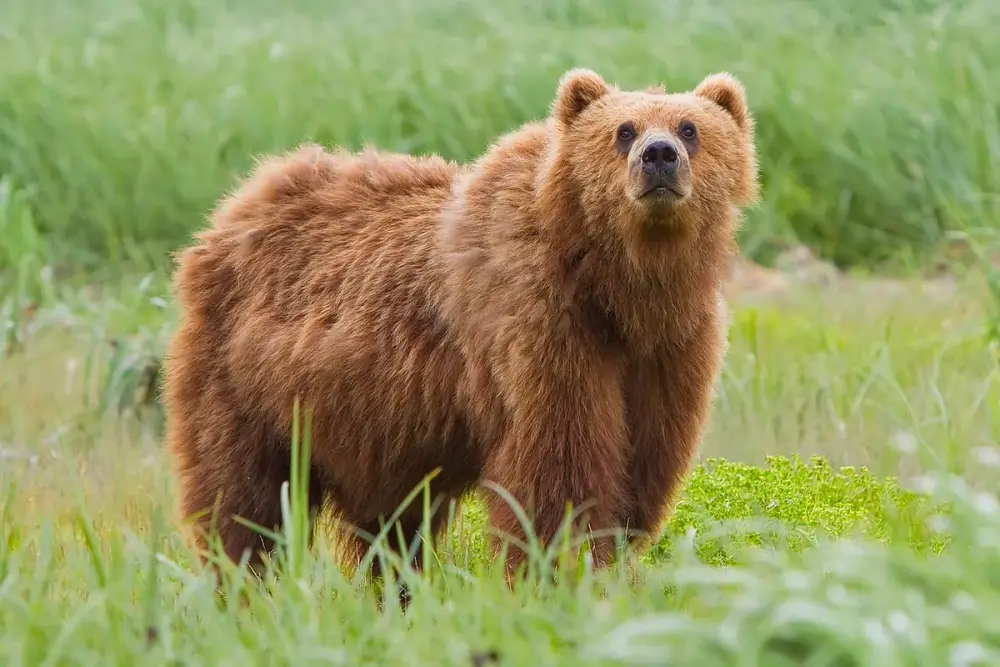
Grizzly bear fur ranges from blond to nearly black but is typically brown, often with darker legs and white- or blond-tipped fur along the flanks and back. Several features distinguish grizzlies from American black bears, which share much of their range: a pronounced muscular shoulder hump that black bears lack, a "dished-in" facial profile with short, rounded ears rather than a black bear's straight profile and longer ears, a rump set lower than the shoulders rather than higher, and front claws measuring about 51 to 102 mm (2 to 4 in), roughly double a black bear's claw length.
Genetic testing has shown that all North American grizzlies belong to a single species, Ursus arctos, rather than the dozens of separate species once described in the 19th century, though some traditionally named forms — including the Kodiak and Alaska Peninsula bears — may be more closely related to Siberian brown bear lineages than to other North American grizzlies.
Behavior and diet
Grizzly bears hibernate for five to seven months of the year, except in warm climates such as that of the now-extinct California grizzly, which did not hibernate at all. Before denning, bears enter a period of hyperphagia, gaining roughly 180 kg (400 lb) to prepare for a winter without eating, drinking, urinating, or defecating; they can partially recycle their own body wastes during this time. Bears often wait for a substantial snowstorm before entering the den, likely to reduce the chance a predator finds it, and dens are typically built above 1,800 m (5,900 ft) on north-facing slopes. Male grizzlies emerge in early to mid-March, females in April or early May. Coastal grizzlies, with better year-round food access, spend less time denned up than inland or Rocky Mountain grizzlies, which may spend nearly half their lives in dens; where food is abundant year-round, some grizzlies skip hibernation entirely.
Except for mothers with cubs, grizzlies are typically solitary, though in coastal areas they gather around streams, rivers, and lakes during salmon runs. Grizzly bears have one of the lowest reproductive rates of any terrestrial mammal in North America. Females do not reach sexual maturity until at least five years old, and after mating in summer, the female delays embryo implantation until hibernation, when the pregnancy can fail if she lacks sufficient fat reserves. Gestation lasts roughly 180 to 250 days, and cubs are always born in the mother's winter den while she is still hibernating. Litters typically hold one to four cubs, most often two, born weighing only about 450 g (16 oz). Cubs feed entirely on milk until summer, when they begin eating solid food while still nursing, and by two years old their weight has grown from about 4.5 kg to 45 kg (9.9 to 99.2 lb). A mother cares for her cubs for up to two years and will not mate again during that time; once cubs leave or are lost, she may not produce another litter for three or more years. Males hold territories of up to 4,000 km2 (1,500 sq mi), which can make finding a mate difficult where population density is low. Average lifespan is about 22 years for males and 26 for females.
Range and habitat
Habitat
Historically ranged from Alaska to Mexico; today found mainly in Alaska, western Canada, and the northwestern U.S.
Grizzly bears once ranged from Alaska down to Mexico and as far east as the western shore of Hudson Bay. That range has since contracted to Alaska, much of western Canada, and parts of the northwestern United States, including Washington, Idaho, Montana, and Wyoming, extending as far south as Yellowstone and Grand Teton National Parks. Combined, Canada and the United States retain grizzlies across roughly half of the subspecies' historical range. The bear has been extirpated from most of the Great Plains and the southwestern United States; California's grizzly, once so abundant it appeared on the state flag, was wiped out by the early 1920s, and Arizona's last grizzly was killed in 1936. There has been no confirmed sighting in Colorado since 1979.
Roughly 60,000 wild grizzly bears were estimated across North America as of 2002, with about 30,000 in Alaska and up to 29,000 in Canada, most in British Columbia, where estimates have run from about 25,000 at European settlement down to roughly 15,075 by a 2012 count. In the lower 48 states, around 1,000 grizzlies live in the Northern Continental Divide region of northwestern Montana, and roughly another 1,000 in the Greater Yellowstone Ecosystem spanning Wyoming, Idaho, and Montana. Idaho holds an estimated 70 to 100 grizzlies, and Washington's North Cascades ecosystem is thought to hold fewer than 20, though a long-term plan exists to reintroduce bears there.
Conservation status
The grizzly bear is a North American population of the brown bear, and the brown bear as a species is listed as Least Concern on the IUCN Red List, in a 2017 assessment. No separate assessment is cited for the grizzly. Worldwide there are roughly 200,000 brown bears, and as of 2012 the brown bear and the American black bear were the only bears not classed as threatened.
The global picture hides real losses. Combining Canada and the United States, grizzlies occupy only about half their historical range. The California grizzly, whose image is on the state flag, is extinct, the last confirmed bear in Arizona was killed in 1936, and none has been confirmed in Colorado since 1979. Roughly 60,000 wild grizzlies remain in North America, about half of them in Alaska.
Roads, railways and development fragment the remaining habitat and cut off gene flow between populations, while conflict over livestock and hunting add to the pressure. The bear has legal protection across the United States, in Mexico and in parts of Canada. Recovery is expected to be slow, because grizzlies breed slowly and their former range is prized for farming and ranching.
Where to see grizzly bear in the U.S.
28 zoos across 21 states
Find the closest one
Rank the 27 zoos holding grizzly bear by how far they are from you. Your location is used in your browser to sort this list and is never sent to us.
1 more zoo holds grizzly bear but has no coordinates on file yet, so it isn't ranked here. It's in the full list below.
Arizona· 2
California· 2
Colorado· 2
Idaho· 2
Illinois· 1
Kansas· 1
Michigan· 1
Missouri· 1
Montana· 2
Nebraska· 1
New Jersey· 1
New York· 1
North Carolina· 2
North Dakota· 1
Ohio· 1
Oklahoma· 1
South Carolina· 1
Tennessee· 1
Utah· 1
West Virginia· 1
Wisconsin· 2
AZAThe Association of Zoos and Aquariums. Accredited members have passed an independent inspection of animal care and welfare, safety, conservation and education, repeated every five years. Many smaller facilities never apply, so “not accredited” isn't a verdict on its own. What accreditation means · How we check this
Built from each zoo's own published animal list.
Grizzly bear: common questions
Is the grizzly bear endangered?
Not globally. The brown bear species, which includes the grizzly, is listed as Least Concern by the IUCN (2017). Grizzlies have lost about half their historical range in Canada and the U.S., and the bear is legally protected across the United States, in Mexico and in parts of Canada.
How big does a grizzly bear get?
Size varies by region: coastal males can weigh around 389 kg (858 lb), while males in northern interior Canada average about 139 kg (306 lb). Average total length runs from 198 to 240 cm (78 to 94 in).
How long do grizzly bears live?
The average lifespan is about 22 years for males and 26 years for females.
Where do grizzly bears live in the wild?
Today they live mainly in Alaska, much of western Canada, and parts of the northwestern United States, including Montana, Wyoming, Idaho, and Washington, down as far as Yellowstone and Grand Teton National Parks.
Which U.S. zoos have grizzly bears?
Fifteen U.S. zoos list a grizzly bear, including the Denver Zoo, the Saint Louis Zoo, and the Grizzly & Wolf Discovery Center.