- Where to see one
- 16 U.S. zoos in our directory hold brown bear, confirmed against each zoo's own animal list.
- Native range
- Eurasia and North America, including Alaska, Canada, and parts of the western United States
- Size
- 80 to 600 kg (180 to 1,320 lb); head-and-body length 1 to 2.8 m (3 ft 3 in to 9 ft 2 in); shoulder height about 1.5 m (4 ft 11 in)
- Lifespan
- Average of 25 years in the wild
About the brown bear
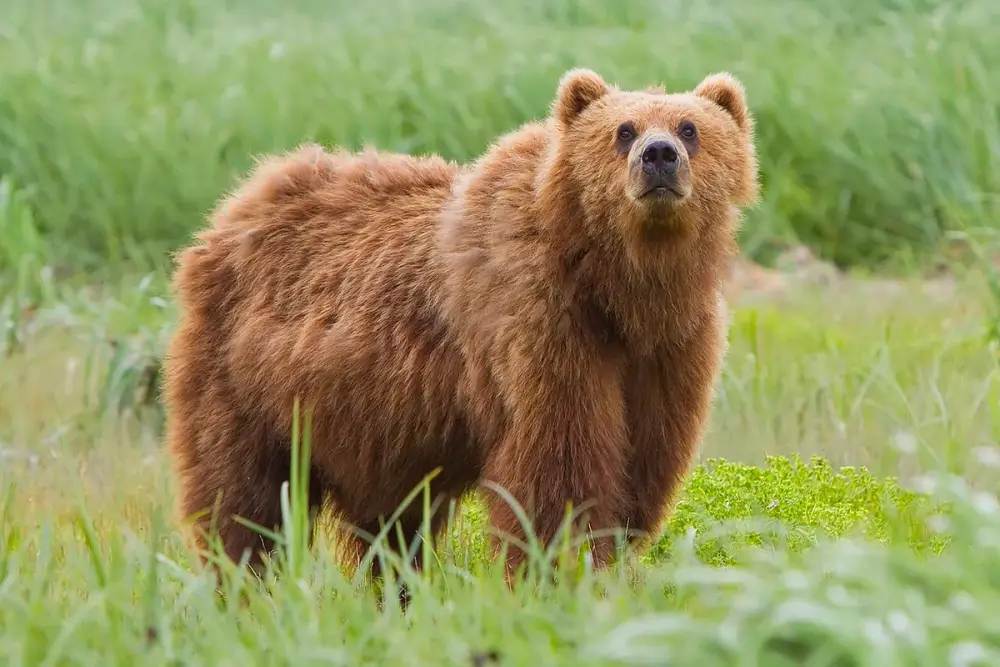
The brown bear is a large bear native to Eurasia and North America, rivaled in size among land carnivorans only by its closest relative, the polar bear, which averages slightly bigger and varies less in size. It is one of eight living species in the bear family Ursidae. Carl Linnaeus scientifically described the species as Ursus arctos in 1758, a name built from the Latin word for bear and the Greek word arktos, which also means bear. In the mid-19th-century United States it also went by the nicknames "Old Ephraim" and "Moccasin Joe." Brown bear taxonomy has been called "formidable and confusing," with as many as 90 subspecies proposed historically and 15 extant or recently extinct subspecies recognized as of 2005; DNA studies since then have identified between five and nine main genetic clades.
The species is sexually dimorphic, with adult males larger and more heavily built than females. Fur color ranges from cream to reddish to dark brown, and coloring varies widely even within well-defined subspecies — North American grizzlies, for instance, can run from nearly black to nearly white. Brown bears are the only living bears with a muscular hump at the top of the shoulders, an adaptation that adds digging power for foraging and building dens. Their paws can measure up to 21 cm (8.3 in) wide and 36 cm (14 in) long, and their claws, curved and blunt, reach 5 to 6 cm (2.0 to 2.4 in) with a 7 to 10 cm (2.8 to 3.9 in) curve — longer and stronger than those of the American black bear, though this heavy claw structure and the bear's weight make it a poor tree climber compared to black bears.
Brown bears once ranged across Europe, much of Asia, North Africa's Atlas Mountains, and North America, though they are now extirpated from parts of that range. Roughly 200,000 remain worldwide, with the largest national populations in Russia (130,000), the United States (32,500), and Canada (about 25,000). In North America, brown bears live in Alaska, the Yukon, the Northwest Territories, British Columbia, and western Alberta, and are slowly repopulating parts of the Rockies and western Great Plains in the lower 48 states.
Behavior and diet
Diet
Omnivorous — roughly 90% plant material, plus insects, rodents, and animals as large as moose or muskoxen; coastal populations feed heavily on spawning salmon
Brown bears are omnivorous with genuinely varied appetites: despite a fearsome reputation, they derive about 90% of their diet from plant material. When they do hunt, targets range from insects and rodents up to animals as large as moose or muskoxen, and in parts of coastal Alaska, brown bears feed heavily on salmon that come inshore to spawn. For most of the year the species is solitary, coming together only to mate or, for females, to raise cubs.
Females give birth to an average of one to three cubs, which stay with their mother for 1.5 to 4.5 years before becoming independent. Individual bears also change size seasonally: they weigh least in spring, after fasting through hibernation, and most in late fall, following a period of intensive feeding called hyperphagia meant to build fat reserves for the winter den.
Body size varies enormously by population and is shaped partly by sexual dimorphism, with males averaging at least 30% larger than females across most subtypes. Interior populations run smaller, close to the weight of an average lion, with males averaging 180 kg (400 lb) and females 135 kg (298 lb), while the largest coastal populations weigh roughly twice as much and rival the largest polar bears in size. Across 19 studied populations, adult males averaged 217 kg (478 lb) and, across 24 populations, adult females averaged 152 kg (335 lb). Attacks on humans, although widely reported in the media, are said to be generally rare.
Range and habitat
Habitat
Mainly forested habitats, from sea level up to 5,000 m (16,000 ft) elevation
Brown bears inhabit the broadest range of habitats of any living bear species, showing little preference for elevation — they have been recorded from sea level up to 5,000 m (16,000 ft) in the Himalayas. Across most of their range they favor semi-open country with scattered vegetation that offers daytime resting spots, but they have also been recorded in essentially every type of northern temperate forest.
Historically the species spanned Europe, much of Asia, North Africa's Atlas Mountains, and North America, though populations have shrunk or disappeared across parts of that range; the Atlas bear of North Africa and the Californian, Ungavan, and Mexican populations of the grizzly bear were all hunted to extinction in the 19th and 20th centuries. Today the largest surviving populations are in Russia, the United States, and Canada, with additional fragmented populations across Europe — including small groups in Spain, France, and Andorra's shared Pyrenees range. Some populations remain highly endangered, including the Himalayan brown bear, which now occupies just 2% of its former range, and central Italy's Marsican brown bear, believed to number only about 50 individuals.
Conservation status
The brown bear is listed as Least Concern (LC) by the IUCN, with a total estimated global population of 110,000 as of 2017. That overall status masks significant regional variation: while Russia, the U.S., and Canada hold large, stable populations, many populations across the southern parts of Eurasia are highly endangered, and some smaller regional groups, such as the Himalayan and Marsican brown bears, face serious risk of local extinction. The species has already been extirpated from several historic ranges, including North Africa's Atlas Mountains and parts of North America.
The brown bear has a long history alongside humans — kept in zoos since ancient times, and trained to perform in circuses and other acts — and it ranks among the world's most recognizable large mammals, with a long-standing presence in literature, art, folklore, and mythology.
Where to see brown bear in the U.S.
16 zoos across 14 states
Find the closest one
Rank the 14 zoos holding brown bear by how far they are from you. Your location is used in your browser to sort this list and is never sent to us.
2 more zoos hold brown bear but have no coordinates on file yet, so they aren't ranked here. They're in the full list below.
Alaska· 1
California· 2
Indiana· 1
Kansas· 1
Kentucky· 1
Maryland· 1
Minnesota· 1
North Carolina· 1
North Dakota· 1
Ohio· 1
Oregon· 1
South Dakota· 1
Washington· 1
Wisconsin· 2
AZAThe Association of Zoos and Aquariums. Accredited members have passed an independent inspection of animal care and welfare, safety, conservation and education, repeated every five years. Many smaller facilities never apply, so “not accredited” isn't a verdict on its own. What accreditation means · How we check this
Built from each zoo's own published animal list.
Brown Bear: common questions
Is the brown bear endangered?
No, the species overall is Least Concern, though several regional populations, such as the Himalayan and Marsican brown bears, are severely threatened.
How big does a brown bear get?
Brown bears generally weigh 80 to 600 kg (180 to 1,320 lb), with a head-and-body length of 1 to 2.8 m (3 ft 3 in to 9 ft 2 in) and a shoulder height around 1.5 m (4 ft 11 in).
What does a brown bear eat?
It is omnivorous and gets about 90% of its diet from plants, but it also eats insects, rodents, and larger animals up to the size of moose, and coastal bears feed heavily on spawning salmon.
How long do brown bears live?
They live an average of 25 years in the wild.
Where do brown bears live in the wild?
They range across Eurasia and North America, including Alaska, Canada, and parts of the western United States, in mostly forested habitat.
Which U.S. zoos have brown bears?
Eight zoos in our directory list them, including the San Diego Zoo, Indianapolis Zoo, and the Alaska Wildlife Conservation Center.