- Where to see one
- 9 U.S. zoos in our directory hold white's tree frog, confirmed against each zoo's own animal list.
- Native range
- Northern and eastern Australia and lowland New Guinea
- Size
- 10 cm (4 in) or more, up to 11.5 cm (4.5 in); females slightly larger than males
- Lifespan
- About 16 years on average in captivity, some over 20 years
- Eggs
- Clumps of 200–2,000 eggs; tadpoles take about six weeks to metamorphose
- Other names
- Australian green tree frog, green tree frog, dumpy tree frog
Conservation status
Least Concernassessed 2022
IUCN Red List category LC — step 1 of 7.
White's tree frog, also called the Australian green tree frog, is a plump, large tree frog native to northern and eastern Australia and the lowlands of New Guinea. It reaches 10 cm or more in length and varies from brown to bright emerald green depending on temperature and surroundings. Nocturnal and docile, it sleeps by day in tree holes or rock crevices and hunts at night, eating mainly insects such as moths, cockroaches and locusts. It often lives alongside people, turning up on window sills, in gutters and in downpipes, where insects gather around lights.
About the White's tree frog
White's tree frog is a large, plump tree frog native to northern and eastern Australia and the lowlands of New Guinea. It belongs to Pelodryadidae, a family of frogs found only in Australia and New Guinea. In Australia it is usually called the green tree frog, and it often lives around houses, gutters and water tanks.
The name honors John White, who described the species in 1790. It was the first Australian frog to be scientifically described. White called it the "blue frog," Rana caerulea, because the specimens he sent to England had turned blue in preservative. A living frog's color comes from blue and green pigments under a yellow layer, and the preservative destroyed the yellow. The Latin word caerulea, meaning blue, stuck. Scientific papers often call it Litoria caerulea, and some recent work places it in the genus Pelodryas.
This is a big frog by Australian standards, reaching 10 cm (4 in) or more and up to 11.5 cm (4.5 in). The back ranges from brown or greyish-green to bright emerald green depending on temperature and surroundings, sometimes with small white spots. The belly is creamy white and rough. A thick, fatty ridge runs over each eye, and the golden iris has a horizontal pupil.
The front legs are short and sturdy, while the hind legs are long. Each finger and toe ends in a large, round adhesive disc that grips while climbing, and the toes are almost three-quarters webbed. Males have a wrinkled grey to yellow vocal sac under the throat; females have a white, smoother throat.
In captivity, a well-fed frog can lay down fat over the head and body, which gives it a puffy look and the nickname "dumpy tree frog." Selective breeding in captivity has also produced blue-eyed, extra-spotted and pale "honey" colored frogs.
Behavior and diet
Diet
Insects such as moths, cockroaches and locusts, plus spiders, smaller frogs and even small bats
White's tree frogs are nocturnal. They come out in the early evening to call and hunt, then spend the day in cool, dark, damp places such as tree holes and rock crevices. They are docile and unafraid of people, and they are known to sleep in clumps, possibly to save moisture through skin contact.
Keeping moist is a constant job. The skin produces a waxy coating that slows evaporation, and the frogs wipe secretions from their parotoid glands across their skin, which helps it collect condensation. In dry spells they hide, sometimes burrowing, and wrap themselves in a cocoon of shed skin and mucus.
Like the red-eyed tree frog of Central America, it is a climber that hunts at night. The diet is mostly insects, especially moths, cockroaches and locusts. They also take spiders, smaller frogs and even small mammals, including microbats. Small prey is caught with a flick of the sticky tongue. Larger prey gets a pounce, after which the frog uses its hands to push the meal into its mouth, since frog teeth can't cut food into pieces.
The call is a low, slow "brawk-brawk-brawk," repeated many times. Males call from high perches like trees and gutters for much of the year, and drop down near ponds to breed. They are especially loud after rain. A frog in danger lets out a scream to startle an attacker, and it squeaks when touched.
Breeding takes place from November to February. Females lay clumps of 200–2,000 eggs in still water. The eggs float at first and sink within a day. Tadpoles hatch at about 8 mm (0.3 in), grow to 44 mm (1.7 in), and after about six weeks change into young frogs and leave the water. Snakes and birds are natural predators, along with introduced dogs and cats.
Range and habitat
Habitat
Moist forest canopy near water, old eucalyptus stands, swamps, grassland and buildings
In Australia, the species ranges from the Kimberley in Western Australia across the Northern Territory and Queensland into north and central New South Wales and the far northeast of South Australia. In New Guinea it lives in the lowlands and is most abundant on Daru Island. Its total range covers around 4,078,600 sq km (1,574,800 sq mi), mostly in warm, wet tropical climates.
It prefers moist forest but isn't a strict rainforest animal. It lives in tree canopies near water, in old eucalyptus stands with water-filled hollows, among the reeds in swamps, and in grassland in cooler areas. It also lives comfortably with people, turning up on windowsills hunting insects drawn to lights, in sinks and toilets, and in downpipes and rainwater tanks, which stay humid and cool and also amplify its calls.
The species has been introduced elsewhere. Small populations exist in two areas of Florida, possibly from the pet trade, and its ecological impact there is unknown. In New Zealand, frogs were released in 1897 and 1899 and accidentally introduced again in the 1940s, but none have been seen since the 1950s.
White's tree frog vs similar frogs
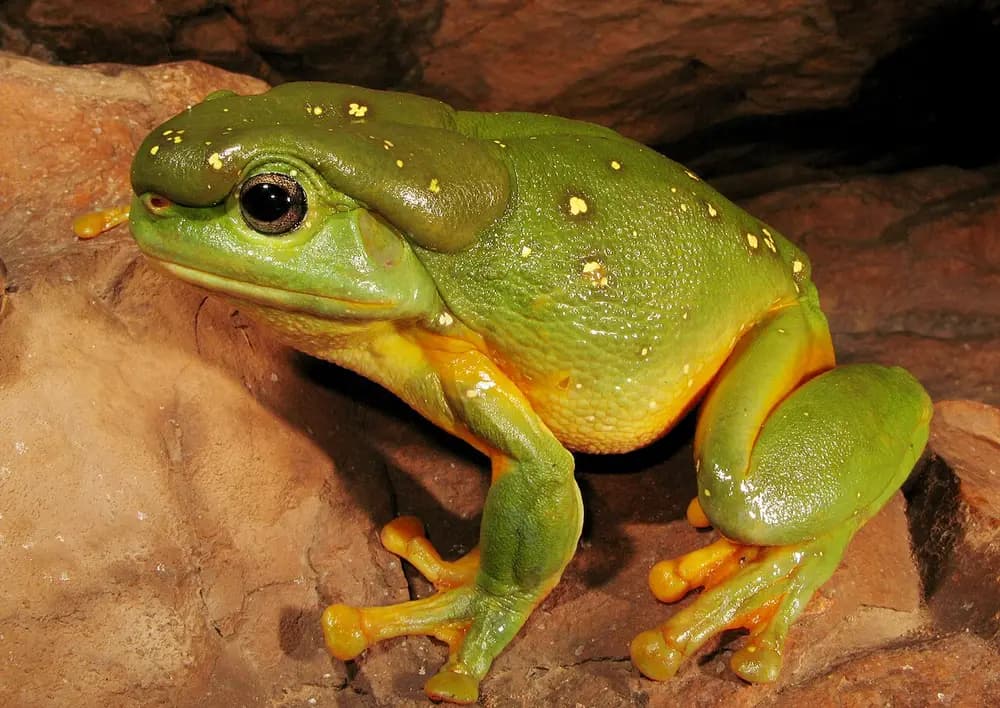
Two Australian frogs are easily mixed up with White's tree frog. The magnificent tree frog lives only in northwestern Australia, and the white-lipped tree frog, also called the giant tree frog, has a white stripe along its lower jaw.
| Feature | White's tree frog | Magnificent tree frog | White-lipped tree frog |
|---|---|---|---|
| Parotoid gland | Moderate in size | Very large in older frogs, covering the top of the head | — |
| Yellow markings | None on the back, hands or thighs | Yellow speckles on the back, yellow on hands, groin and thighs | — |
| Jaw stripe | None | — | White stripe along the lower jaw to the shoulder |
| Range | Northern and eastern Australia, New Guinea | Northwestern Australia only | — |
Conservation status
White's tree frog is listed as Least Concern on the IUCN Red List because of its wide range, large population and tolerance of many habitats. Its population trend appears stable. In Australia it is protected, like all native wildlife, under the federal Environment Protection and Biodiversity Conservation Act 1999.
Threats still exist. Suburban frogs face pollution and predation by pets, and some have been found infected with the chytrid fungus that causes the deadly disease chytridiomycosis. The main risk to the species is a widespread disease outbreak. Its skin secretions appear to help: they contain antibacterial and antiviral peptides, and they inhibit the chytrid fungus in the lab.
In New Guinea the frog's status is poorly studied. About 75,000 frogs were exported from Indonesia for the pet trade in 2002, which may affect some local populations. The frog has also been bred successfully in captivity in Australia.
Where to see white's tree frog in the U.S.
9 zoos across 9 states
Find the closest one
Rank the 6 zoos holding white's tree frog by how far they are from you. Your location is used in your browser to sort this list and is never sent to us.
3 more zoos hold white's tree frog but have no coordinates on file yet, so they aren't ranked here. They're in the full list below.
California· 1
Colorado· 1
Florida· 1
Kansas· 1
Massachusetts· 1
New York· 1
North Dakota· 1
Texas· 1
Wisconsin· 1
AZAThe Association of Zoos and Aquariums. Accredited members have passed an independent inspection of animal care and welfare, safety, conservation and education, repeated every five years. Many smaller facilities never apply, so “not accredited” isn't a verdict on its own. What accreditation means · How we check this
Built from each zoo's own published animal list.
White's Tree Frog: common questions
What is a White's tree frog?
A large tree frog from northern and eastern Australia and New Guinea, also called the Australian green tree frog or dumpy tree frog. It is known for its plump body, docile nature and long life.
How big do White's tree frogs get?
About 10 cm (4 in) or more, and up to 11.5 cm (4.5 in). Females are slightly larger than males.
How long do White's tree frogs live?
About 16 years on average in captivity, which is long for a frog. Some have lived more than 20 years.
What do White's tree frogs eat?
Mostly insects such as moths, cockroaches and locusts. They also eat spiders, smaller frogs and occasionally small bats.
Why is it called caerulea if it's green?
Because the first specimens turned blue in preservative. The preservative destroyed the yellow layer of the skin, leaving only blue pigment visible, so the frog was named after the Latin word for blue.
Can you keep a White's tree frog as a pet?
Yes. It is one of the most popular pet frogs in the world because it is docile, hardy and long-lived. Overfeeding is a common problem, since captive frogs easily become obese.
Are White's tree frogs invasive in Florida?
Small introduced populations exist in two parts of Florida, but whether they cause ecological damage is unknown.