- Where to see one
- 7 U.S. zoos in our directory hold magnificent tree frog, confirmed against each zoo's own animal list.
- Native range
- Northwestern Australia: the Kimberley of Western Australia and the Northern Territory
- Size
- Males up to 10.4 cm (4.1 in), females up to 10.6 cm (4.2 in) snout to vent
- Activity
- Nocturnal
- Other name
- Splendid tree frog
Conservation status
Least Concernassessed 2022
IUCN Red List category LC — step 1 of 7.
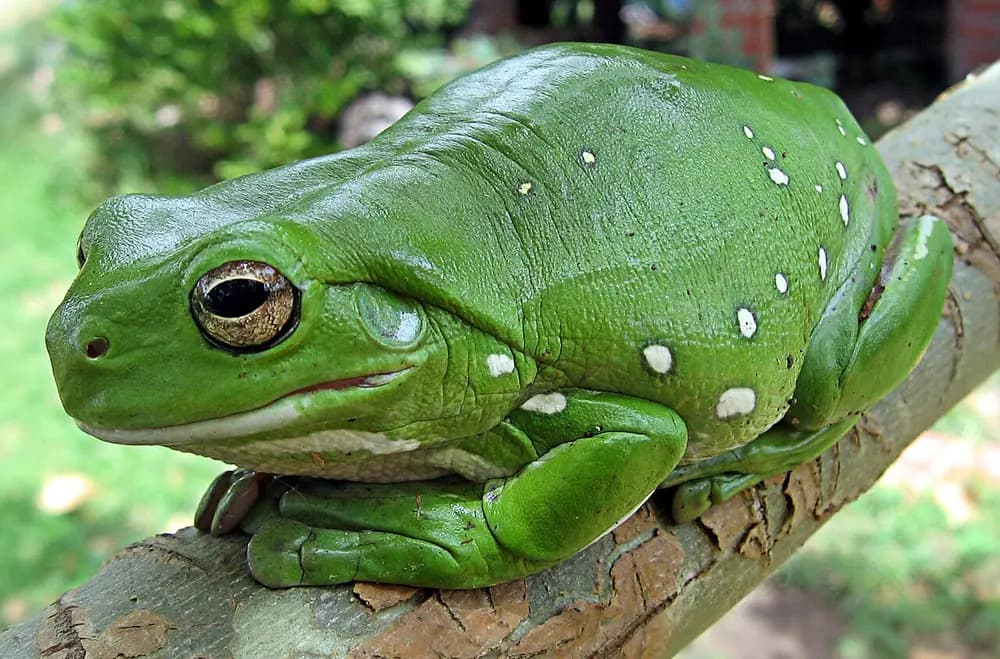
The magnificent tree frog is a large Australian tree frog with a limited range on the north-western coast, in the Northern Territory and the Kimberley of Western Australia. Males reach a snout-to-vent length of 10.4 cm and females 10.6 cm. It is olive to bright green above and white below, with bright yellow undersides to the feet and legs, and most individuals have white or sulphur-coloured dots on the back. Very large parotoid glands cover the top of the head and droop over the eardrums, which helps separate older adults from the similar White's tree frog. It is nocturnal, sheltering in caves and rock crevices by day.
About the magnificent tree frog
The magnificent tree frog (Pelodryas splendida), also called the splendid tree frog, is a large Australian tree frog found only in the Kimberley region of Western Australia and the Northern Territory. It is a close relative of the White's tree frog and looks much like it, but older adults have huge glands covering the head.
The species was first described in 1977. It has also been classified as Litoria splendida. It belongs to the family Pelodryadidae, a family of tree frogs found only in Australia and New Guinea.
It is a relatively big tree frog. Males reach a snout-to-vent length of 10.4 cm (4.1 in) and females slightly more, at 10.6 cm (4.2 in). The back is olive to bright green, and the belly is white. The undersides of the feet and legs are bright yellow. Most frogs have white or sulfur-yellow dots scattered across the back, some thickly and some sparsely, along with yellow markings on the hands, groin and thighs.
The most striking feature appears with age. Older magnificent tree frogs develop very large parotoid glands, a type of skin gland. In this species they spread across the entire top of the head and droop down over the eardrums. The eardrum, or tympanum, is itself large, nearly as big as the eye, and is partly hidden by the overhanging gland. That swollen, helmet-like head is how older adults can be told from their lookalike relative.
In July 2024, the first photograph of a blue magnificent tree frog was published. The frog was found by chance in the Charnley River–Artesian Range Wildlife Sanctuary and collected for study. Its color comes from axanthism, a mutation that affects yellow pigment. With the yellow gone, only blue is left, turning a green frog blue.
Behavior and diet
Diet
Its close relative, the White's tree frog, eats mainly insects
The magnificent tree frog is nocturnal. It hunts and breeds at night, and during the day it shelters in caves and rock crevices.
Like the other large tree frogs of Australia, the White's tree frog and the giant tree frog, it is comfortable around people. It turns up around buildings and has been found in toilets, showers and water tanks.
Its close relative the White's tree frog eats mainly insects such as moths, cockroaches and locusts, along with spiders and sometimes smaller frogs. Frog teeth are not suited to cutting up prey, so food must be small enough to fit in the mouth. The White's tree frog catches smaller items with its sticky tongue, while larger ones are pounced on and pushed into the mouth with the hands.
Breeding probably takes place during the wet season, but the magnificent tree frog's breeding habits have not been studied in much detail. The male's call is very similar to the White's tree frog's: a deep "crawk-crawk-crawk" repeated many times.
Range and habitat
Habitat
Shelters in caves and rock crevices; often near buildings and water tanks
The magnificent tree frog has a limited range. It lives only along the northwestern coast of Australia, in the Kimberley region of Western Australia and in the Northern Territory. Its lookalike, the White's tree frog, also occurs in the Kimberley but ranges far beyond it, across northern and eastern Australia and into New Guinea.
Within that range it uses caves and rock crevices as daytime shelters. It also lives close to people, around houses and other buildings, including in tanks, showers and toilets. The blue individual photographed in 2024 was found in the Charnley River–Artesian Range Wildlife Sanctuary.
Magnificent tree frog vs White's tree frog
The magnificent tree frog is easily mistaken for the White's tree frog, also called the Australian green tree frog. The two are close relatives and similar in size, color and call. The White's tree frog has a much wider range, across northern and eastern Australia and lowland New Guinea, and is one of the most popular pet frogs in the world.
| Feature | Magnificent tree frog | White's tree frog |
|---|---|---|
| Scientific name | Pelodryas splendida | Pelodryas caerulea |
| Range | Kimberley and Northern Territory, northwestern Australia | Northern and eastern Australia and lowland New Guinea |
| Parotoid glands | Very large in older frogs, covering the top of the head | Much smaller; a fatty ridge sits over the eye |
| Back markings | Usually white or sulfur-yellow dots | No yellow speckling; sometimes a few white spots |
| Yellow on hands, groin and thighs | Present | Absent |
| Size | Up to about 10.6 cm (4.2 in) | Up to 11.5 cm (4.5 in) |
| Call | Deep "crawk-crawk-crawk" | Low, slow "brawk-brawk-brawk" |
The two frogs also share their scientific history. The White's tree frog was the first Australian frog ever scientifically described, in 1790, while the magnificent tree frog was not described until 1977.
Conservation status
The magnificent tree frog is listed as Least Concern on the IUCN Red List. Its range is limited to the northwestern coast of Australia.
It is kept as a pet. In Australia, people may keep the species in captivity only with the appropriate permit. Its relative the White's tree frog is a common species, and its skin secretions have antibacterial and antiviral properties that are thought to have helped protect it from the declines affecting many amphibians.
Where to see magnificent tree frog in the U.S.
7 zoos across 5 states
Find the closest one
Rank the 7 zoos holding magnificent tree frog by how far they are from you. Your location is used in your browser to sort this list and is never sent to us.
California· 2
Georgia· 1
Massachusetts· 2
Pennsylvania· 1
Virginia· 1
AZAThe Association of Zoos and Aquariums. Accredited members have passed an independent inspection of animal care and welfare, safety, conservation and education, repeated every five years. Many smaller facilities never apply, so “not accredited” isn't a verdict on its own. What accreditation means · How we check this
Built from each zoo's own published animal list.
Magnificent Tree Frog: common questions
Where do magnificent tree frogs live?
Only in northwestern Australia, in the Kimberley region of Western Australia and the Northern Territory. They shelter in caves and rock crevices and often live around buildings.
How big do magnificent tree frogs get?
About 10.4 cm (4.1 in) for males and 10.6 cm (4.2 in) for females, measured from snout to vent.
How can you tell a magnificent tree frog from a White's tree frog?
Look at the head. Older magnificent tree frogs have huge parotoid glands that cover the top of the head and droop over the eardrums, and they usually have white or yellow dots on the back.
Are magnificent tree frogs related to White's tree frogs?
Yes. Both belong to the genus Pelodryas in the family Pelodryadidae, and they are close enough in looks and call to be easily confused.
Are magnificent tree frogs nocturnal?
Yes. They hunt and breed at night and hide in caves and rock crevices during the day.
Can you keep a magnificent tree frog as a pet?
Yes. It is kept as a pet, and in Australia a permit is required to keep one.
Is the magnificent tree frog endangered?
No. It is listed as Least Concern, though it has a limited range in northwestern Australia.
Are there blue magnificent tree frogs?
Rarely. The first photo of a blue one, caused by a pigment mutation called axanthism, was published in July 2024.