- Where to see one
- 17 U.S. zoos in our directory hold timber rattlesnake, confirmed against each zoo's own animal list.
- Native range
- Eastern United States, from southern Minnesota and southern New Hampshire south to East Texas and North Florida
- Size
- Adults typically 91 to 152 cm (36 to 60 in) long; most weigh 500 to 1,500 g (1.1 to 3.3 lb), with large specimens reaching 4.5 kg (9.9 lb)
Conservation status
IUCN Red List category LC — step 1 of 7.
Least Concern (LC) overall, though extirpated or endangered in several states
About the timber rattlesnake
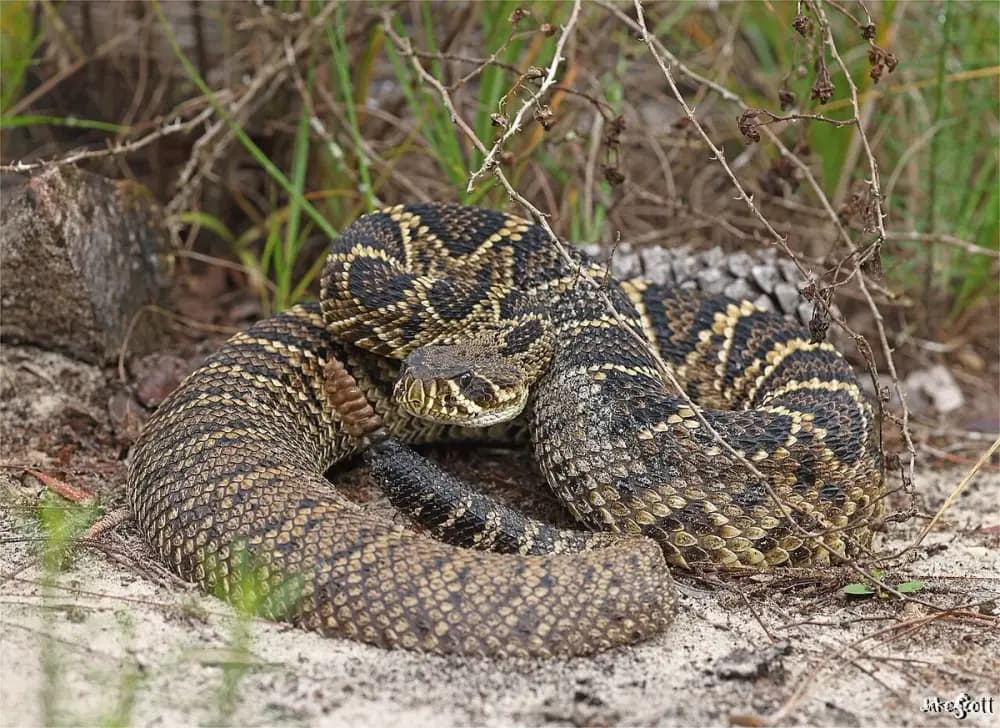
The timber rattlesnake, also known as the banded rattlesnake and, in the southern United States, the canebrake rattlesnake, is a species of pit viper native to the eastern United States. It is venomous, with a bite that can be highly toxic, and it is the only rattlesnake species found across most of the populous Northeastern United States, making it among the most northerly distributed venomous snakes in North America. Carl Linnaeus described the species in 1758, and it still carries his original name, Crotalus horridus. No subspecies are currently recognized as valid, though the name canebrake rattlesnake for southern populations still appears in older literature.
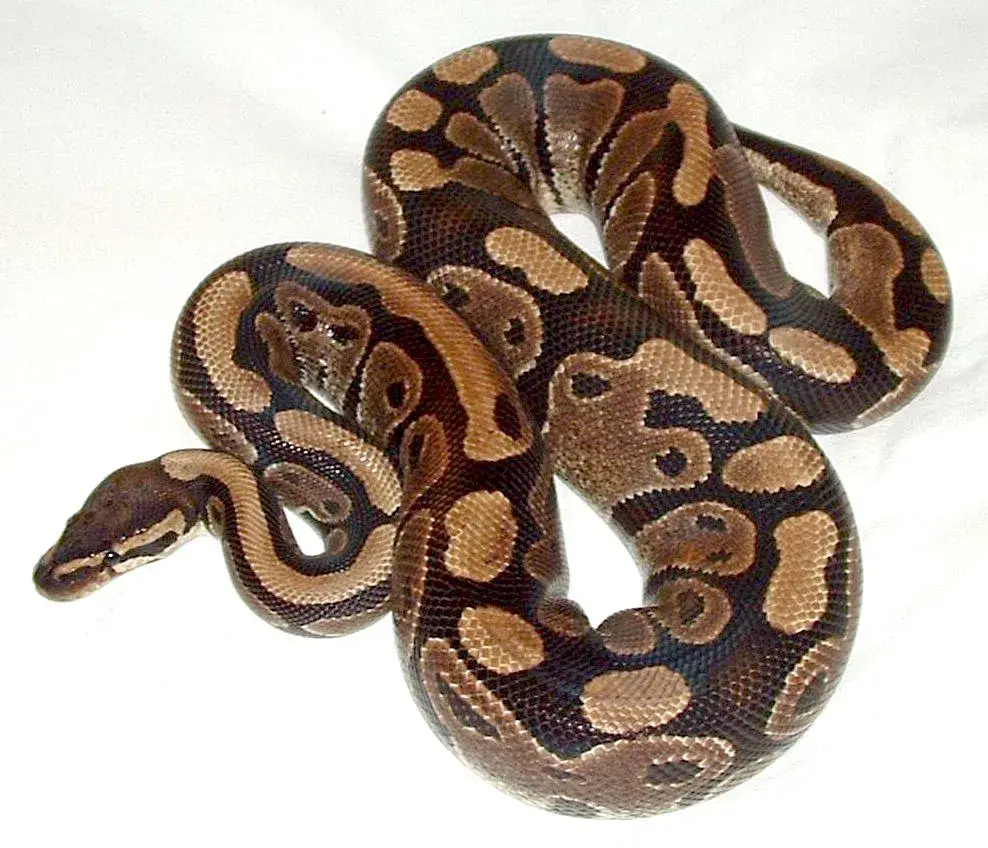
Adults usually reach a total length of 91 to 152 cm (36 to 60 in), with most measuring under 115 cm (45 in); the maximum reported length is 189.2 cm (74.5 in). Weight typically falls between 500 and 1,500 g (1.1 and 3.3 lb), often toward the lower end of that range, though large specimens can reportedly weigh as much as 4.5 kg (9.9 lb) — one historic Alabama specimen measured 159 cm (62.5 in) and weighed 2.5 kg (5.5 lb). The snake's dorsal pattern consists of dark brown or black crossbands with irregular, zig-zag, V- or M-shaped edges over a yellowish-brown or grayish background, often with a rust-colored stripe running down the back. The belly is yellowish, plain, or marked with black, and the tail is black and described as velvety. Melanism is common, and some individuals appear almost solid black.
Behavior and diet
Diet
Mainly small mammals — mice, rats, squirrels, and rabbits — plus occasional small birds and frogs
Timber rattlesnakes prey mainly on small mammals, particularly mice, rats, squirrels, and rabbits, with small birds and frogs taken less often. They use chemical cues to locate ambush sites, often waiting on fallen logs for prey to pass, and will strike and then track injured prey until it can be consumed. Almost all of their prey is caught on the ground, even species like squirrels that spend time in trees; when a squirrel stays up in a tree, a timber rattlesnake has been observed leaning against the trunk in a vertical posture, waiting for it to come down. By genus, mice of the genus Peromyscus made up the largest share of the diet in one study, followed by voles, chipmunks, cottontail rabbits, cotton rats, and squirrels. Juveniles tend toward smaller prey such as shrews, since they can't yet handle larger animals like subadult cottontails.
During the summer, gravid females favor open, rocky "basking knolls" where temperatures run higher, while males and non-gravid females spend more time in cooler, denser woodland. In winter, the snakes brumate in dens and limestone crevices, often alongside copperheads and rat snakes, and they show strong site fidelity, typically returning to the same den, or hibernaculum, year after year; snakes sharing a den, especially juveniles and pregnant females, tend to be more closely related to each other than to snakes in neighboring dens. They will still leave the den to bask briefly on warm days in midwinter. Males typically mate farther from the winter den than females do.
A lifetime study of a population in New York's Adirondack Mountains found that snakes first reproduce at a mean age of 9.6 years, with a mean reproductive cycle of 4.2 years and an average of 7.7 offspring per litter; about 20% of offspring in field litters were found to be nonviable, and most females reproduced only once in their lifetime.
Timber rattlesnakes are generally mild-tempered for a venomous species, favoring retreat over confrontation and often rattling and feinting extensively before striking. They will attack only if cornered, and one 19th-century observer in western Pennsylvania, where the species was common, reported hearing of only a single fatal bite in all his years there. Their venom, though, is genuinely dangerous: it varies geographically between a largely neurotoxic type found in parts of the southern range, a hemorrhagic and proteolytic type found in the north and parts of the southeast, a blend of the two in southwestern Arkansas and northern Louisiana, and a weaker type with neither component. CroFab antivenom, while not specific to this species, is used to treat its bites.
Range and habitat
Habitat
Deciduous forests in rugged terrain, cane thickets, river floodplains, hardwood and pine forests, and mountainous areas
Timber rattlesnakes occur across the eastern United States from southern Minnesota and southern New Hampshire south to East Texas and North Florida. The species has also historically ranged into southern Ontario and southern Quebec in Canada, where it was declared extirpated under Canada's Species at Risk Act in May 2001; a government-sponsored recovery strategy has since studied reintroducing it there. Within the U.S., it has been extirpated from Michigan, Delaware, Maine, and Rhode Island, and is close to extirpation in New Hampshire. In Pennsylvania, its range excludes areas west of Chestnut Ridge and the state's southeastern urban corridor, meaning it isn't found in either Philadelphia or Pittsburgh.
The species favors deciduous forests in rugged terrain, but it turns up in a range of terrestrial habitats, including lowland cane thickets, which is where the canebrake rattlesnake name comes from, high ground around swamps and river floodplains, hardwood and pine forests, mountainous areas, and rural farming country.
Conservation status
The timber rattlesnake is classified as Least Concern on the IUCN Red List, a status assessed in 2007 that reflects its wide distribution and presumed large overall population. That broad status, though, masks serious regional declines. The species is listed as endangered in New Jersey, Ohio, Vermont, Connecticut, Massachusetts, Virginia, Indiana, and New Hampshire, and as threatened in Illinois and New York. In New York specifically, timber rattlesnakes are extirpated at 26% of historically known dens and nearly extirpated at another 5%, with denning populations estimated to have dropped 50 to 75% from historical numbers.
Where to see timber rattlesnake in the U.S.
17 zoos across 16 states
Find the closest one
Rank the 17 zoos holding timber rattlesnake by how far they are from you. Your location is used in your browser to sort this list and is never sent to us.
District of Columbia· 1
Georgia· 1
Kansas· 1
Kentucky· 1
Louisiana· 1
Maryland· 1
Michigan· 1
Missouri· 1
New York· 1
North Carolina· 1
Ohio· 1
Pennsylvania· 1
Rhode Island· 1
Texas· 1
Virginia· 2
Wisconsin· 1
AZAThe Association of Zoos and Aquariums. Accredited members have passed an independent inspection of animal care and welfare, safety, conservation and education, repeated every five years. Many smaller facilities never apply, so “not accredited” isn't a verdict on its own. What accreditation means · How we check this
Built from each zoo's own published animal list.
Timber Rattlesnake: common questions
Is the timber rattlesnake endangered?
Overall it is listed as Least Concern, but it is endangered in New Jersey, Ohio, Vermont, Connecticut, Massachusetts, Virginia, Indiana, and New Hampshire, and threatened in Illinois and New York, and it has been extirpated from Michigan, Delaware, Maine, and Rhode Island.
How big does a timber rattlesnake get?
Adults typically run 91 to 152 cm (36 to 60 in) long and weigh 500 to 1,500 g (1.1 to 3.3 lb), though large individuals can reach 4.5 kg (9.9 lb).
What does a timber rattlesnake eat?
Mostly small mammals such as mice, rats, squirrels, and rabbits, with occasional small birds and frogs.
Where do timber rattlesnakes live in the wild?
Across the eastern United States, from southern Minnesota and New Hampshire south to East Texas and North Florida, mainly in deciduous forests and rugged terrain.
Which U.S. zoos have timber rattlesnakes?
Eleven zoos in our directory list them, including the Saint Louis Zoo, The Maryland Zoo in Baltimore, and the North Carolina Zoo.