
Venomous snakes in U.S. zoos
Venomous snakes produce venom, a modified saliva injected through hollow or grooved fangs to kill prey, defend themselves and start digestion. Around a quarter of all snake species are venomous, mainly vipers, elapids such as cobras, and some colubrids. Venom evolved more than once, so venomous snakes are not one natural group.
Most widely held
 Eastern Diamondback RattlesnakeCrotalus adamanteusAt 17 zoos · Least Concern
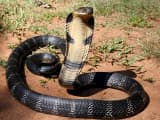 King CobraOphiophagus hannahAt 17 zoos · Vulnerable
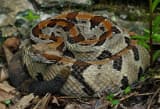 Timber RattlesnakeCrotalus horridusAt 17 zoos · Least Concern
 CopperheadAgkistrodon contortrixAt 12 zoos · Least Concern
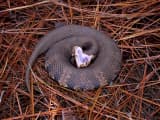 CottonmouthAgkistrodon piscivorusAt 11 zoos · Least Concern
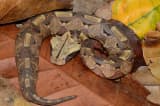 Gaboon ViperBitis gabonicaAt 8 zoos · Vulnerable
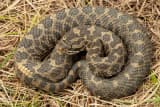 Eastern MassasaugaSistrurus catenatus catenatusAt 7 zoos · Least Concern
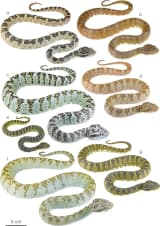 Eyelash ViperBothriechis schlegeliiAt 7 zoos · Least Concern
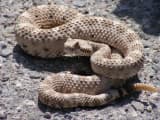 SidewinderCrotalus cerastesAt 6 zoos · Least Concern
What makes a snake venomous
Snake venom is modified saliva, stored in glands at the back of the head and delivered through hollow or grooved teeth in the upper jaw. It is a mix of proteins that can attack the nervous system, the blood or cells directly. Venom is used mainly to subdue prey, with defense secondary, and it also begins digestion.
There is no single family of venomous snakes. Venom evolved more than once, and the main venomous families are the vipers (Viperidae), the elapids (Elapidae, including cobras), the atractaspidids and some colubrids. The king cobra, the longest venomous snake, is not a true cobra at all but sits in its own genus, Ophiophagus.
Vipers and pit vipers
All vipers are venomous, with long hollow fangs on a bone that rotates. When not in use, the fangs fold back against the roof of the mouth, which lets very long fangs fit in a small head. The Gaboon viper carries this to the extreme, with the longest fangs of any snake.
Most vipers give birth to live young, and many ambush their prey at night. Pit vipers add a heat-sensing pit on each side of the face. The copperhead, cottonmouth and the rattlesnakes are all North American pit vipers.
Rattlesnakes are easy to tell apart once you know what to look for. The eastern diamondback rattlesnake, the largest rattlesnake, wears a row of cream-edged dark diamonds. The small desert sidewinder moves sideways, leaving J-shaped tracks in the sand, and has horn-like scales above each eye.
Behavior worth knowing
Many venomous snakes are less aggressive than their reputation. Copperheads usually freeze rather than flee, trusting their camouflage, which is why people step near them. In field tests, just over half of wild cottonmouths tried to escape, and most of the rest used threat displays rather than biting. The king cobra typically avoids people but raises its front body and spreads its hood when alarmed.
Vipers can control how much venom they inject. Because blood-attacking venom works slowly, a rattlesnake can strike, release its prey and then track it down.
Conservation picture
Several venomous snakes are declining. The king cobra and Gaboon viper are Vulnerable on the IUCN Red List, the king cobra mainly through habitat destruction. The timber rattlesnake is listed as endangered in several U.S. states, and the eastern massasauga has been federally threatened under the Endangered Species Act since 2016, with snake fungal disease adding to its risks.
Common questions
Is a snake poisonous or venomous?
Snakes are venomous, not poisonous, with rare exceptions. Venom must be injected, while a poison is eaten, inhaled or absorbed; keelback snakes and some Oregon garter snakes are rare exceptions that store toxins from their prey.
What percentage of snakes are venomous?
Around a quarter of all snake species are identified as venomous. Most snakes are non-venomous and kill prey by constriction or swallow it alive.
What is a pit viper?
A pit viper is a viper with an infrared-sensitive pit on each side of the head between the nostril and the eye. Rattlesnakes, copperheads and cottonmouths are all pit vipers.
How can you recognize a viper?
Almost all vipers have keeled scales, a stocky body with a short tail and a triangle-shaped head distinct from the neck, because of where the venom glands sit. Most also have vertical, slit-shaped pupils.
What is the longest venomous snake?
The king cobra is the world's longest venomous snake, averaging 3.18 to 4 m (10.4 to 13.1 ft), with a record of 5.85 m (19.2 ft).
Which snake has the longest fangs?
The Gaboon viper of sub-Saharan Africa has the longest fangs and the highest venom yield of any snake. It is also placid and rarely bites.
Are there vipers in Australia?
No. Wild vipers are not found in Australia, Antarctica, Hawaii, Madagascar or Ireland, though they occur across most of the Americas, Africa and Eurasia.
Sources
Last reviewed