- Where to see one
- 36 U.S. zoos in our directory hold elk, confirmed against each zoo's own animal list.
- Native range
- North America, and Central, East and North Asia
- Size
- Shoulder height 2 ft 6 in–4 ft 11 in (0.75–1.5 m); nose-to-tail length 5 ft 3 in–8 ft 10 in (1.6–2.7 m); males 392–1,096 lb (178–497 kg), females 377–644 lb (171–292 kg)
About the elk
The elk, also known as the wapiti, is the second-largest species in the deer family, Cervidae, and one of the largest terrestrial mammals in its native range. The name "elk" was originally the European term for the moose, but North American colonists transferred it to this animal instead; "wapiti" comes from a Shawnee and Cree word meaning "white rump," a reference to the pale fur around the tail that elk fluff up when agitated or fleeing.
Elk were long thought to be a subspecies of the European red deer, but mitochondrial DNA studies beginning in 1998, and confirmed by broader genetic work in 2004, showed the two to be distinct species. A wider rump patch and paler antlers separate Cervus canadensis from the true red deer, Cervus elaphus. DNA evidence also shows elk are more closely related to Thorold's deer and sika deer than to red deer.
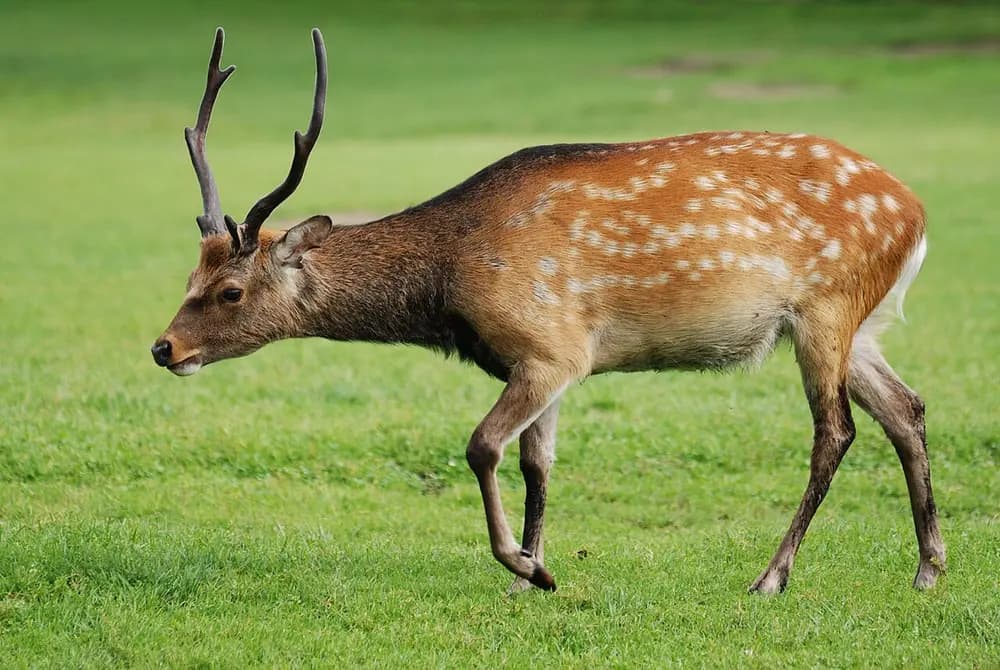
Elk have thick bodies, slender legs and short tails. Males are considerably larger than females and carry large, blood- and nerve-filled antlers made of bone that can grow 2.5 centimeters (about an inch) per day while covered in a soft, vascular skin called velvet. The antlers are shed each year as the weather warms and testosterone levels drop; a typical bull antler carries around six tines, and the largest, from Roosevelt elk, can weigh 18 kg (40 lb). Coloring shifts with the seasons — grayer and lighter in winter, more reddish-brown in summer — with forest-dwelling subspecies generally darker than those in arid habitats. Calves are born spotted and lose the spots by the end of their first summer.
Several subspecies are recognized, though taxonomists disagree on exact counts. Of six historic North American subspecies, four survive today: the Roosevelt, Tule, Manitoban and Rocky Mountain elk. The Roosevelt elk, found west of the Cascade Range in California, Oregon and Washington, is the largest, with males typically weighing 701–1,100 lb (318–499 kg) and occasionally reaching 1,300 lb (600 kg) in introduced Alaskan populations.
Behavior and diet
Diet
Grasses and sedges, plus higher-growing plants, leaves, twigs and bark
Elk are among the most gregarious deer species; summer groups can reach 400 animals. For most of the year, males and females live in separate herds, with female herds generally larger and bull herds smaller or even solitary. The two sexes come together for the mating season, or rut, which can begin in late August and run into early winter.
During the rut, bulls try to intimidate rivals through vocal displays and antler posturing, and if neither backs down they wrestle antlers, sometimes causing serious injury. The signature sound of the rut is bugling — a loud, high-pitched whistle-like call that can reach 4,000 Hz and carries over long distances, produced by forcing air from the glottis through the nasal cavities. Elk can also produce lower sounds around 150 Hz using the larynx; cows bark to warn the herd of danger, and calves scream when attacked.
Elk graze on grasses and sedges and browse on higher plants, leaves, twigs and bark. A dominant bull defends a harem of 20 or more cows from rivals and predators, herding stray females back into the group and courting receptive ones with a raised head and antlers. Bulls also dig wallows in which they urinate and roll, coating themselves in a scent that attracts cows. Females have a short, one-to-two-day estrus cycle, and by their second autumn most cows can produce a calf, very rarely two; reproduction is most common once a cow weighs at least 200 kilograms (440 lb).
Range and habitat
Habitat
Open forest and forest-edge habitat
Elk are currently native to North America and to Central, East and North Asia, though the species had a far wider range in the past: prehistoric populations spanned Eurasia into Western Europe during the Late Pleistocene, and survived into the early Holocene in southern Sweden and the Alps. A now-extinct North American subspecies, Merriam's elk, once ranged as far south as Mexico.
The animals live in open forest and forest-edge habitat, grazing and browsing along the transition between woodland and open ground. Elk have also been introduced successfully outside their natural range, including in Argentina and New Zealand, where their adaptability has been strong enough to raise concern about impacts on sensitive native ecosystems and species.
Conservation status
Elk are listed as Least Concern (LC) on the IUCN Red List.
As members of the order Artiodactyla, elk are susceptible to several infectious diseases that can pass between them and domesticated livestock, and vaccination efforts aimed at controlling these diseases in wild herds have had mixed results. Elk are also hunted as a game species for their lean, high-protein meat, and antler velvet is harvested for use in traditional medicine and naturopathic supplements in the United States, China and Canada.
Where to see elk in the U.S.
36 zoos across 21 states
Find the closest one
Rank the 30 zoos holding elk by how far they are from you. Your location is used in your browser to sort this list and is never sent to us.
6 more zoos hold elk but have no coordinates on file yet, so they aren't ranked here. They're in the full list below.
Alaska· 2
Arizona· 2
Idaho· 1
Illinois· 2
Kansas· 2
Kentucky· 1
Louisiana· 1
Michigan· 1
Minnesota· 1
New Jersey· 2
New York· 1
North Carolina· 2
North Dakota· 2
Ohio· 2
Pennsylvania· 2
Tennessee· 2
Texas· 1
Utah· 1
Virginia· 1
Washington· 1
Wisconsin· 6
AZAThe Association of Zoos and Aquariums. Accredited members have passed an independent inspection of animal care and welfare, safety, conservation and education, repeated every five years. Many smaller facilities never apply, so “not accredited” isn't a verdict on its own. What accreditation means · How we check this
Built from each zoo's own published animal list.
Elk: common questions
Is the elk endangered?
No. Elk are listed as Least Concern by the IUCN, meaning the species is not currently at risk of extinction.
How big does an elk get?
Elk stand 2 ft 6 in to 4 ft 11 in (0.75–1.5 m) at the shoulder and measure 5 ft 3 in to 8 ft 10 in (1.6–2.7 m) nose to tail. Males weigh 392–1,096 lb (178–497 kg) and females weigh 377–644 lb (171–292 kg).
What does an elk eat?
Elk graze on grasses and sedges and browse on higher-growing plants, leaves, twigs and bark.
Where do elk live in the wild?
Elk are native to North America and to Central, East and North Asia, favoring open forest and forest-edge habitats. They have also been introduced to Argentina and New Zealand.
Which U.S. zoos have elk?
Eight zoos in the Feather & Fang directory list elk, including the Alaska Wildlife Conservation Center, North Carolina Zoo and Dakota Zoo.
Do elk keep their antlers year-round?
No. Male elk shed their antlers each year as the weather warms and their testosterone levels drop, then regrow a new set covered in velvet.