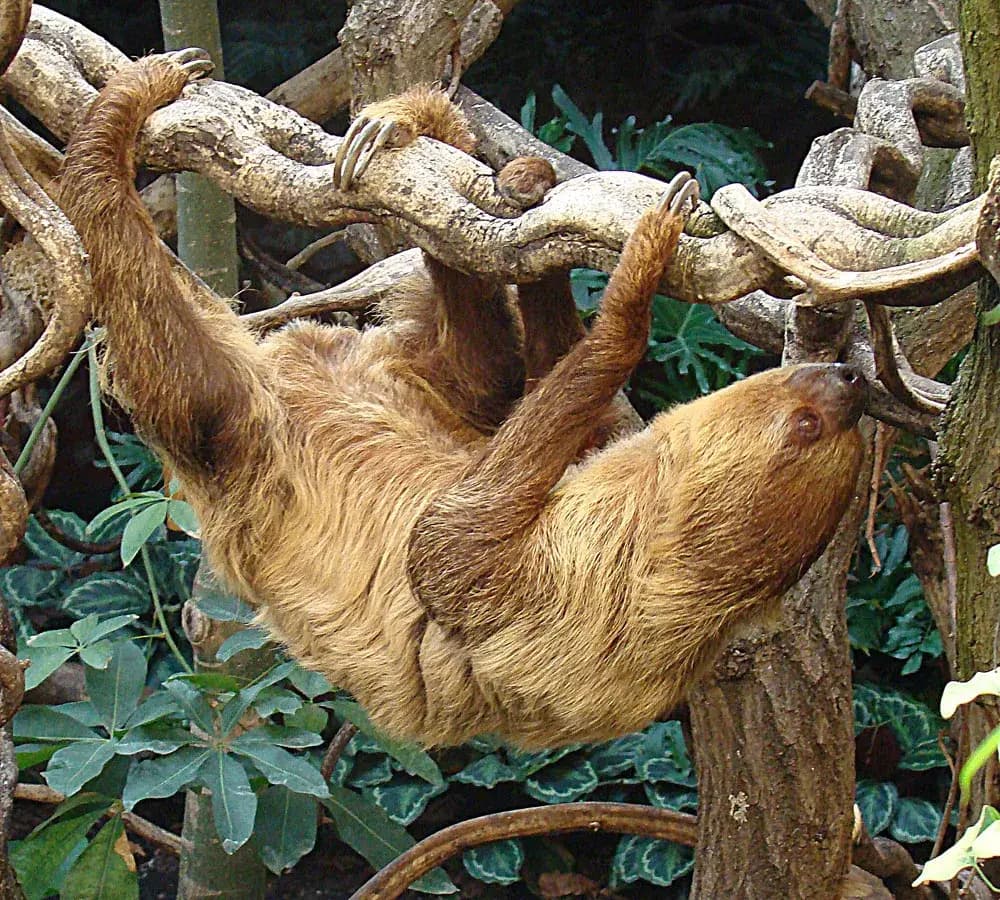
Linnaeus's Two-toed Sloth
Choloepus didactylus
Also known as Linne'S Two-Toed Sloth
- Where to see one
- 36 U.S. zoos in our directory hold linnaeus's two-toed sloth, confirmed against each zoo's own animal list.
- Native range
- Northern South America — Venezuela, Guyana, Suriname, French Guiana, Colombia, Ecuador, Peru, and Brazil north of the Amazon River, with some evidence of range into Bolivia
- Size
- Head-body length 21–35 in (53–89 cm), not including tail; weight 9–24 lb (4–11 kg)
Linnaeus's two-toed sloth, also called the southern two-toed sloth or unau, is the largest living sloth. It lives in the rainforests of Venezuela, Suriname, Guyana, French Guiana, Colombia, Ecuador, Peru and Brazil north of the Amazon. It is solitary, nocturnal and arboreal, growing 53 to 89 cm long excluding the tail and weighing 4 to 11 kg. Its fur is brownish yellow to pale brown and in the rainy season may take on a green hue from algae. It mainly eats leaves, with a low metabolism and slow digestion. Predators include ocelots, jaguars and harpy eagles, mostly when the sloth descends to the ground to defecate or change trees.
About the two-toed sloth
Linnaeus's two-toed sloth, also known as the southern two-toed sloth or unau, is native to northern South America, found in Venezuela, Guyana, Suriname, French Guiana, Colombia, Ecuador, Peru, and Brazil north of the Amazon River, with some evidence that its range extends into Bolivia as well. It's the largest living sloth species.
Males and females are the same size, growing to a head-body length of about 21 to 35 inches (53 to 89 cm), not counting the tail, and weighing roughly 9 to 24 pounds (4 to 11 kg). Fur color ranges from brownish yellow to pale brown, and in the wild it can take on a greenish tint during the rainy season as algae grows on it. Belly fur runs slightly lighter than the rest of the coat, and the species has no undercoat at all. Oddly, the hair on its belly is parted down the midline and flows toward the spine — the opposite direction fur grows on most other mammals. Young sloths have softer, darker fur than adults do. Compared with three-toed sloths, this species is larger, with longer hair, bigger eyes, longer arms, and front and back legs closer to equal length, though its tail is shorter.
Sloths belong to the order Pilosa, which also includes anteaters, within the larger superorder Xenarthra, which includes armadillos as well. Xenarthrans are edentate, or toothless in the conventional sense — they lack incisors — and Linnaeus's two-toed sloth itself has only four or five sets of teeth remaining, including canines. Modern sloths split into two families based on how many toes their front feet carry. Linnaeus's two-toed sloth and its close relative, Hoffmann's two-toed sloth, belong to family Choloepodidae, a family that also included the now-extinct ground sloths, while the three-toed sloths make up the separate family Bradypodidae. Its ears, hind feet, and head also tend to run larger than a three-toed sloth's. Its teeth are unusual too: molars are indistinguishable from premolars, and none are rooted or covered in enamel — each tooth is just two layers of ever-growing dentin, and extra, supernumerary teeth turn up occasionally, a quirk reported across nearly every mammalian order.
Behavior and diet
Diet
Mainly leaves
Linnaeus's two-toed sloth is solitary, nocturnal, and arboreal, spending nearly all its time in the rainforest canopy. It comes down mainly to defecate or move to a different tree, and that's when it's most vulnerable to predators such as ocelots and jaguars, and to large birds of prey including harpy eagles and crested eagles. Green anacondas are also known to hunt sloths, and because the species can swim to cross rivers and creeks, it may be exposed to anacondas hunting in the water as well.
It lives in hot, humid, ever-wet rainforest, favoring stretches thick with vines that make it easier to move between trees through the canopy. Diet is mainly leaves, though the full range of what the species eats isn't well documented — a gap tied to its nocturnal habits and effective camouflage. Like other two-toed sloths, it runs on an unusually low metabolism, eating and defecating far less often than most mammals of similar size and retaining digested material for long stretches thanks to slow defecation and an oversized digestive system. That slow digestion also drives surprisingly high methane production, more than similar-sized plant-eating mammals typically generate, possibly linked to high formate levels in its digested material.
Range and habitat
Habitat
Ever-wet tropical rainforest canopy
Linnaeus's two-toed sloth is native to northern South America — Venezuela, Guyana, Suriname, French Guiana, Colombia, Ecuador, Peru, and Brazil north of the Amazon River — with some evidence that its range extends into Bolivia as well. It lives almost entirely in the rainforest canopy rather than on the ground, favoring forest with heavy vine growth that makes travel between trees easier. It is also able to swim, which lets it cross rivers and creeks, though this may also expose it to predators such as green anacondas.
Conservation status
Linnaeus's two-toed sloth is listed as Least Concern. The material here doesn't detail specific threats to the species, though it does note that predation is a regular risk whenever the sloth leaves the canopy — by cats such as jaguars and ocelots, by large birds of prey, and occasionally by green anacondas.
Where to see linnaeus's two-toed sloth in the U.S.
36 zoos across 24 states
Find the closest one
Rank the 34 zoos holding linnaeus's two-toed sloth by how far they are from you. Your location is used in your browser to sort this list and is never sent to us.
2 more zoos hold linnaeus's two-toed sloth but have no coordinates on file yet, so they aren't ranked here. They're in the full list below.
Alabama· 1
Arizona· 2
California· 2
Colorado· 1
Florida· 2
Idaho· 1
Illinois· 2
Kansas· 2
Louisiana· 2
Massachusetts· 2
Michigan· 2
Minnesota· 2
New Jersey· 1
New York· 2
North Carolina· 1
North Dakota· 1
Ohio· 2
Oregon· 1
Rhode Island· 1
South Dakota· 1
Tennessee· 2
Texas· 1
Virginia· 1
West Virginia· 1
AZAThe Association of Zoos and Aquariums. Accredited members have passed an independent inspection of animal care and welfare, safety, conservation and education, repeated every five years. Many smaller facilities never apply, so “not accredited” isn't a verdict on its own. What accreditation means · How we check this
Built from each zoo's own published animal list.
Linnaeus's Two-toed Sloth: common questions
Is the two-toed sloth endangered?
No. Linnaeus's two-toed sloth is classified as Least Concern.
How big does a two-toed sloth get?
It's the largest living sloth species, with a head-body length of 21 to 35 inches (53–89 cm) and a weight of 9 to 24 pounds (4–11 kg).
What does a two-toed sloth eat?
Its diet is mainly leaves, though the full extent of what it eats in the wild isn't well documented because it's nocturnal and well camouflaged.
Where do two-toed sloths live in the wild?
Linnaeus's two-toed sloth lives in the rainforests of northern South America, including Venezuela, Guyana, Suriname, French Guiana, Colombia, Ecuador, Peru, and Brazil north of the Amazon.
Which U.S. zoos have two-toed sloths?
Sixteen zoos in our directory list Linnaeus's two-toed sloth, including the Los Angeles Zoo, the Denver Zoo, and the Minnesota Zoo.