Hoffmann's Two-toed Sloth
Choloepus hoffmanni
Also known as Hoffman'S Two-Toed Sloth
- Where to see one
- 14 U.S. zoos in our directory hold hoffmann's two-toed sloth, confirmed against each zoo's own animal list.
- Native range
- Central and South America, in two populations separated by the Andes
- Size
- head-body length 54 to 72 cm (21 to 28 in); weight 2.1 to 9 kg (4.6 to 19.8 lb); claws 5 to 6.5 cm (2.0 to 2.6 in) long
- Lifespan
- reported up to 43 years in captivity
About the Hoffmann's two-toed sloth
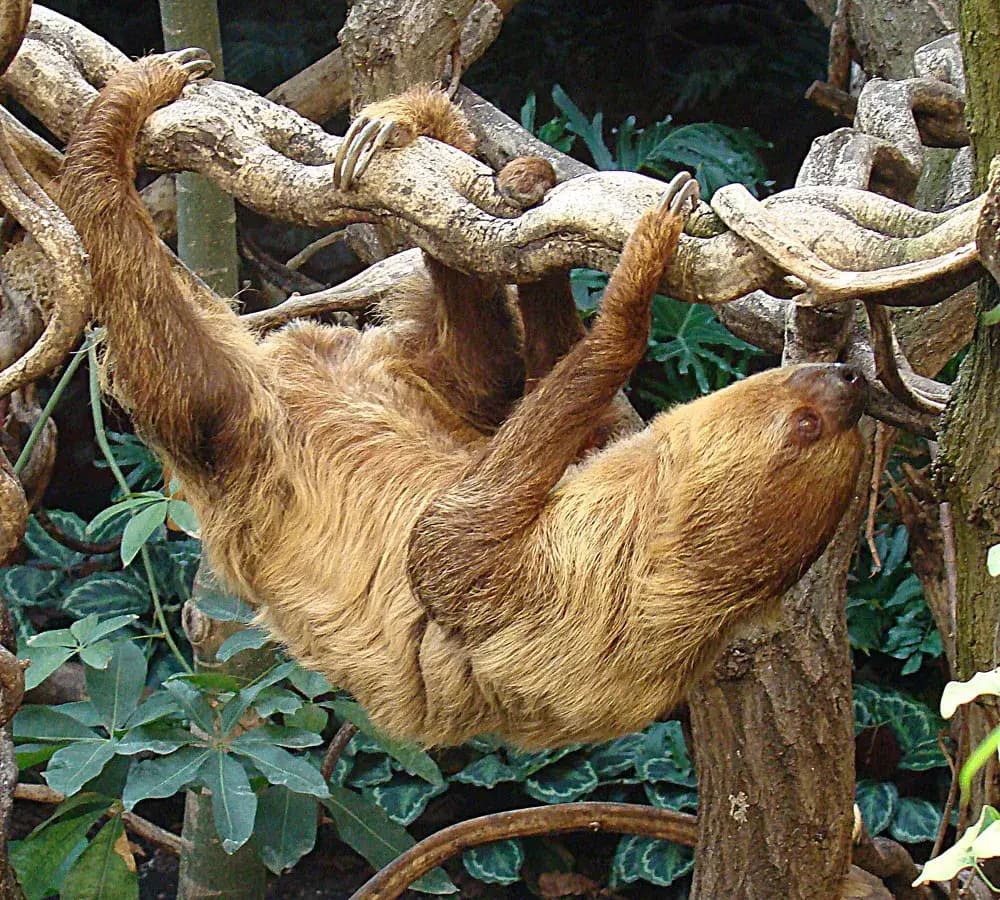
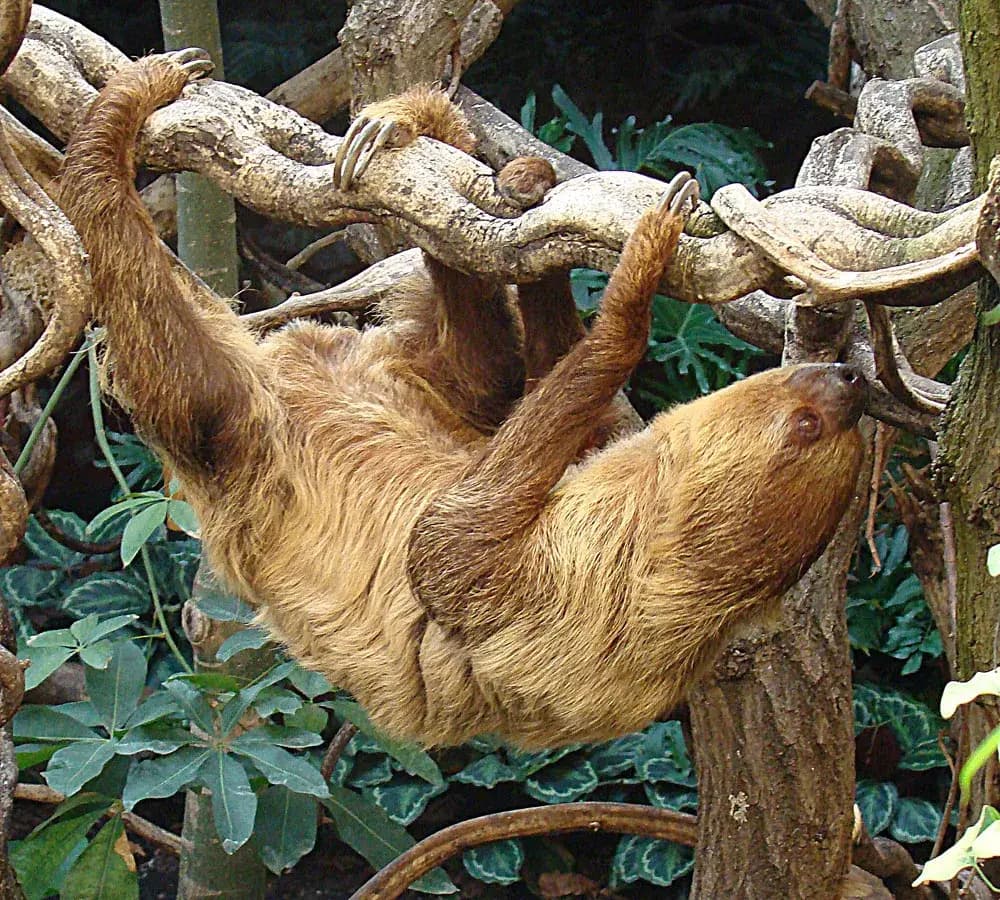
The Hoffmann's two-toed sloth, also known as the northern two-toed sloth, is a species of sloth native to Central and South America. Its common name honors the German naturalist Karl Hoffmann, who discovered it. It is a solitary, largely nocturnal, arboreal animal, heavily built with shaggy fur and slow, deliberate movements. The front feet carry only two toes, each tipped with a long, curved claw, while the hind feet have three clawed toes each.
Several features separate it from three-toed sloths sharing the same forests: a longer snout, toes on the front feet that are separate rather than fused, bare soles without hair, fewer dark markings around the eyes, and a larger overall size. It is easier to confuse with the closely related Linnaeus's two-toed sloth, and the two are mainly told apart by subtle skeletal differences, such as the number of openings in the skull's interpterygoid space. Adults measure 54 to 72 cm (21 to 28 in) in head-body length and weigh 2.1 to 9 kg (4.6 to 19.8 lb); females run larger on average than males, though the size ranges overlap. The stubby tail, just 1.5 to 3 cm (0.59 to 1.18 in) long, is hidden by the long fur, and the claws reach 5 to 6.5 cm (2.0 to 2.6 in). Fur color runs tan to light brown, lighter on the face, usually with a greenish tinge from algae growing in the hair itself.
In the wild, Hoffmann's two-toed sloth lives in the rainforest canopy across two separate regions of Central and South America divided by the Andes: one stretching from eastern Honduras south to western Ecuador, the other covering eastern Peru, western Brazil, and northern Bolivia. Genetic evidence points to these two populations having diverged from each other roughly 7 million years ago.
Behavior and diet
Diet
mostly tree leaves, plus buds, tender twigs, young plant shoots, fruits, and flowers
Sloths spend most of their time in trees, descending to the ground mainly to move to a new tree. On Barro Colorado Island, researchers found local Hoffmann's two-toed sloths were almost exclusively nocturnal, even though the species is active by day elsewhere — a difference attributed partly to competition with the brown-throated sloth. They typically move through the canopy for about eight hours each night and spend much of the day asleep in tangles of lianas, moving at around 0.14 m/s (0.46 ft/s), though they can move up to 50% faster when excited. Outside of mothers with young, it is unusual to find two individuals in the same tree at once.
Sloths hang from branches using huge, hook-like claws, a clinging grip so reflexive that sloths are sometimes found still hanging after death. Nearly everything in a sloth's life — eating, sleeping, mating, giving birth — happens upside down in the branches. The main exception is defecation: sloths descend to the ground to do so roughly once every three to eight days, righting themselves for the trip, and also come down to urinate, switch trees, or mate. Their slow pace is not laziness but an adaptation to a low-energy leaf diet; two-toed sloths run at about half the metabolic rate of a typical mammal their size.
Diet centers on tree leaves, though sloths also eat buds, tender twigs, young plant shoots, fruits, and flowers, favoring younger leaves for their higher nutrition and easier digestion. They tear food with their lips and grind it with peg-like, enamel-free teeth that grow continuously, sometimes supplementing their diet at mineral licks. Digestion is slow: a three-chambered stomach houses symbiotic bacteria to break down cellulose, and a single meal can take up to a month to fully digest, with leaves in the gut making up as much as two-thirds of a sloth's body weight at a time.
Hoffmann's two-toed sloths mate year-round rather than on a fixed schedule. Courtship involves the female licking the male's face and rubbing against him; when ready to mate, females let out a loud scream that draws males, who fight each other if more than one responds. Gestation runs 355 to 377 days, typically with mating in the rainy season and birth in the dry season, and results in a single young weighing 340 to 454 g (12.0 to 16.0 oz) at birth. Newborns are precocial, already able to cling to their mother's underside, and begin taking solid food at 15 to 27 days, fully weaned by nine weeks. Mothers alone raise the young for the first six to nine months. Sloths reach sexual maturity by age three.
Range and habitat
Habitat
mature and secondary rainforests and deciduous forests, from sea level to 3,300 m (10,800 ft)
Hoffmann's two-toed sloth inhabits tropical forests from sea level up to 3,300 m (10,800 ft), living in the rainforest canopy across two regions of Central and South America split by the Andes — one running from eastern Honduras to western Ecuador, the other across eastern Peru, western Brazil, and northern Bolivia. Five recognized subspecies occupy different parts of this range, from Honduras and Costa Rica in the north to Peru in the south.
Within its habitat, the species favors trees with plentiful lianas and direct sunlight. A typical home range covers about 2 to 4 ha (4.9 to 9.9 acres), and an individual sloth may spend most of its life moving among as few as 25 trees.
Conservation status
Hoffmann's two-toed sloth is rated Least Concern (LC) by the IUCN, but it still faces real pressure, including deforestation, habitat disruption, and illegal poaching of juvenile sloths for trade. Natural predators include jaguars, cougars, ocelots, harpy eagles, margays, and anacondas, and attacks by domestic dogs have increased in arboreal areas undergoing development and urbanization. The sloth's main defense against predators is avoidance: its slow, deliberate movement and algae-covered fur make it hard to spot from a distance, and its treetop range keeps it out of reach of many ground predators. If cornered, it can slash with its large claws or bite.
Where to see hoffmann's two-toed sloth in the U.S.
14 zoos across 11 states
Find the closest one
Rank the 13 zoos holding hoffmann's two-toed sloth by how far they are from you. Your location is used in your browser to sort this list and is never sent to us.
1 more zoo holds hoffmann's two-toed sloth but has no coordinates on file yet, so it isn't ranked here. It's in the full list below.
Colorado· 1
Florida· 1
Georgia· 1
Illinois· 1
Kansas· 1
Kentucky· 1
Massachusetts· 1
Michigan· 2
Missouri· 1
New York· 3
Virginia· 1
AZAThe Association of Zoos and Aquariums. Accredited members have passed an independent inspection of animal care and welfare, safety, conservation and education, repeated every five years. Many smaller facilities never apply, so “not accredited” isn't a verdict on its own. What accreditation means · How we check this
Built from each zoo's own published animal list.
Hoffmann's Two-toed Sloth: common questions
Is the Hoffmann's two-toed sloth endangered?
No. It is rated Least Concern (LC), though it still faces deforestation, habitat disruption, and poaching of juveniles for trade.
How big does a Hoffmann's two-toed sloth get?
It reaches 54 to 72 cm (21 to 28 in) in head-body length and weighs 2.1 to 9 kg (4.6 to 19.8 lb), with claws 5 to 6.5 cm (2.0 to 2.6 in) long.
What does a Hoffmann's two-toed sloth eat?
Mostly tree leaves, along with buds, tender twigs, young plant shoots, fruits, and flowers.
How long do Hoffmann's two-toed sloths live?
They have been reported to live up to 43 years in captivity.
Where do Hoffmann's two-toed sloths live in the wild?
In two separate regions of Central and South America split by the Andes: from eastern Honduras to western Ecuador, and across eastern Peru, western Brazil, and northern Bolivia.
Which U.S. zoos have Hoffmann's two-toed sloths?
Eight zoos in our directory list this species, including Zoo Atlanta, the Lincoln Park Zoo, and the Saint Louis Zoo.