- Where to see one
- 37 U.S. zoos in our directory hold two-toed sloth, confirmed against each zoo's own animal list.
- Native range
- Venezuela, Suriname, Guyana, French Guiana, Colombia, Ecuador, Peru, and Brazil north of the Amazon River, with evidence suggesting the range also extends into Bolivia
- Size
- Body length approximately 53 to 89 cm (21 to 35 in), not including tail; weight approximately 4 to 11 kg (9 to 24 lb)
About the two-toed sloth
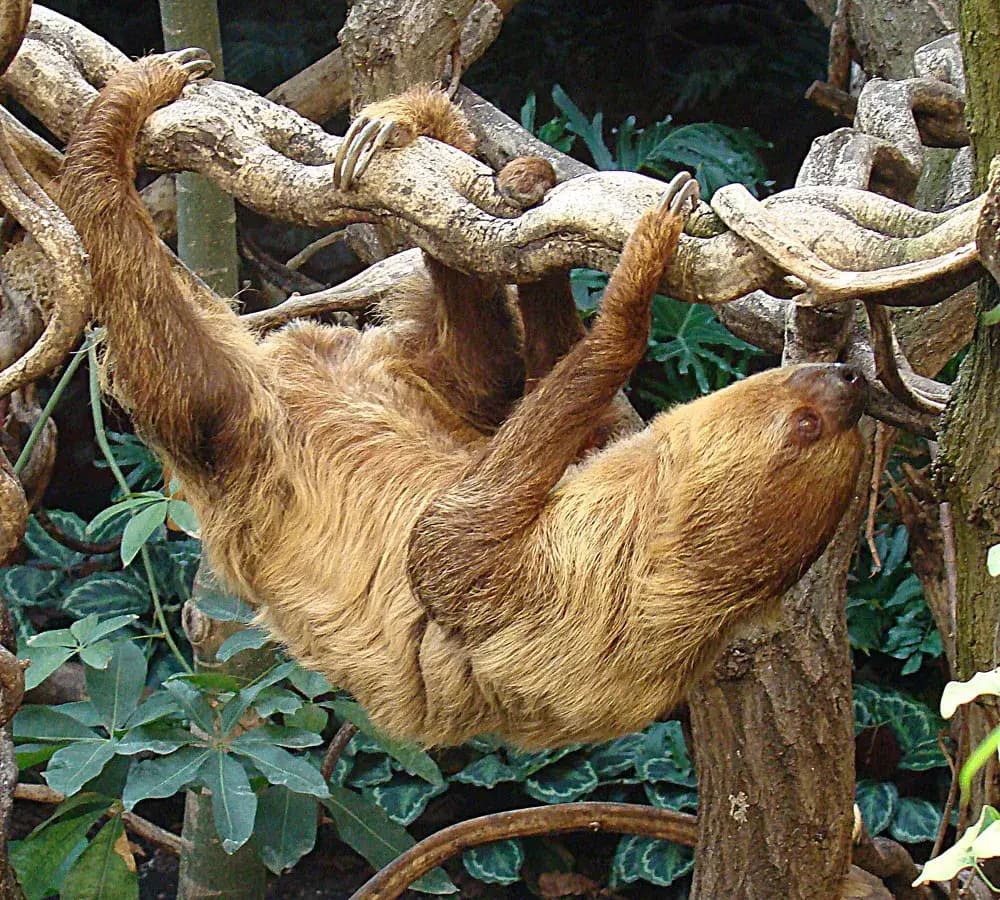
Linnaeus's two-toed sloth, also known as the southern two-toed sloth or unau, is a species of sloth native to South America, found in Venezuela, Suriname, Guyana, French Guiana, Colombia, Ecuador, Peru, and Brazil north of the Amazon River, with evidence now suggesting its range extends into Bolivia as well. It is the largest extant sloth species alive today.
Males and females are the same size, growing to a body length of roughly 53 to 89 cm (21 to 35 in), not counting the tail, and weighing about 4 to 11 kg (9 to 24 lb). Fur color runs from a brownish yellow to pale brown, and in the wild it can take on a green tinge during the rainy season from algae growing in the coat. Belly fur is slightly lighter than the body and lacks an undercoat, and unlike most mammals, the hair on the belly parts along the midline and flows toward the spine rather than away from it. Young sloths have softer, darker fur than adults.
Sloths belong to the order Pilosa, which also contains anteaters, within the larger superorder Xenarthra, which includes armadillos (Cingulata). Xenarthrans are edentate, or nearly toothless, and this species has a sharply reduced tooth count of only four to five sets, including canines, with no incisors at all. Modern sloths split into two families based on front-foot toe count: Linnaeus's two-toed sloth and Hoffmann's two-toed sloth belong to Choloepodidae, a family that also included extinct ground sloths, while three-toed sloths belong to Bradypodidae. Compared to three-toed sloths, this species is larger, with longer hair, bigger eyes, more evenly matched front and back leg lengths, larger ears, hind feet, and head, and a shorter tail. Its longer shoulder height — the distance from shoulder blade to claw tips — reflects correspondingly longer arms. Its few teeth are rootless, lack enamel, and consist of two layers of ever-growing dentin, with molars indistinguishable from premolars; supernumerary teeth are occasionally observed, as in many other mammal orders.
Behavior and diet
Diet
Mainly leaves
The two-toed sloth is solitary, nocturnal, and arboreal, living in rainforests where thick vine growth lets it move easily between trees in the canopy. It mainly eats leaves, though data on the full extent of its diet is limited because of its nocturnal habits and effective camouflage.
Like other sloth species, it has a notably low rate of metabolism, food intake, and defecation despite a relatively large body mass, and it produces unusually high volumes of methane. Slow defecation combined with a large digestive system means digested material is retained for long periods, which appears to drive the elevated methane output — more than is typical for similarly sized herbivores — possibly linked to high formate levels in its digested material. The species is capable of swimming, which lets it cross rivers and creeks, though this ability may also expose it to aquatic predators.
Range and habitat
Habitat
Ever-wet tropical rainforest, especially areas with dense vine growth
The two-toed sloth lives in ever-wet tropical rainforests that are hot and humid, favoring areas with heavy vine growth that make it easy to travel between trees in the forest canopy. Its confirmed range covers Venezuela, Suriname, Guyana, French Guiana, Colombia, Ecuador, Peru, and Brazil north of the Amazon River, and evidence now suggests the range extends into Bolivia as well.
Conservation status
The two-toed sloth is classified as Least Concern (LC). Specific threats to the species and conservation programs are not described here; the focus instead is on its natural predators: wild cats such as the ocelot and jaguar, large birds of prey including the harpy and crested eagles, and green anacondas, which have also been known to hunt sloths. Predation mainly occurs when a sloth descends to the ground to defecate or move between trees.
Where to see two-toed sloth in the U.S.
37 zoos across 24 states
Find the closest one
Rank the 28 zoos holding two-toed sloth by how far they are from you. Your location is used in your browser to sort this list and is never sent to us.
9 more zoos hold two-toed sloth but have no coordinates on file yet, so they aren't ranked here. They're in the full list below.
California· 3
Connecticut· 1
Delaware· 1
District of Columbia· 1
Florida· 4
Georgia· 1
Hawaii· 1
Illinois· 1
Indiana· 1
Kentucky· 1
Louisiana· 1
Maine· 1
Maryland· 2
Massachusetts· 1
Michigan· 3
Mississippi· 1
New York· 1
North Carolina· 1
Ohio· 1
Oklahoma· 1
Pennsylvania· 2
Tennessee· 3
Texas· 2
Virginia· 2
AZAThe Association of Zoos and Aquariums. Accredited members have passed an independent inspection of animal care and welfare, safety, conservation and education, repeated every five years. Many smaller facilities never apply, so “not accredited” isn't a verdict on its own. What accreditation means · How we check this
Built from each zoo's own published animal list.
Two-toed Sloth: common questions
Is the two-toed sloth endangered?
No. It is listed as Least Concern.
How big does a two-toed sloth get?
Its body reaches roughly 53 to 89 cm (21 to 35 in) in length, not counting the tail, and it weighs about 4 to 11 kg (9 to 24 lb).
What does a two-toed sloth eat?
Mainly leaves, though the extent of its full diet is not well documented due to its nocturnal, camouflaged lifestyle.
Where do two-toed sloths live in the wild?
In tropical rainforests across Venezuela, Suriname, Guyana, French Guiana, Colombia, Ecuador, Peru, and Brazil north of the Amazon, with evidence its range extends into Bolivia too.
Which U.S. zoos have two-toed sloths?
Fourteen zoos in our directory, including the San Diego Zoo, the Cincinnati Zoo and Botanical Garden, and the Nashville Zoo at Grassmere.