Blue Poison Dart Frog
Dendrobates tinctorius
Also known as Blue Poison Arrow Frog
- Where to see one
- 7 U.S. zoos in our directory hold blue poison dart frog, confirmed against each zoo's own animal list.
- Native range
- Forest islands within the Sipaliwini Savanna of southern Suriname
- Size
- 3–4.5 cm (1.2–1.8 in) snout to vent; weight given as about 3–8 g (0.1–0.3 oz)
- Lifespan
- 4–6 years in the wild; about 10 years, and up to 12, in captivity
- Clutch size
- 5 to 10 eggs
- Indigenous name
- Okopipi, in the Tiriyó language
Conservation status
Least Concernassessed 2023
IUCN Red List category LC — step 1 of 7.
Least Concern (LC), assessed as part of the dyeing poison dart frog
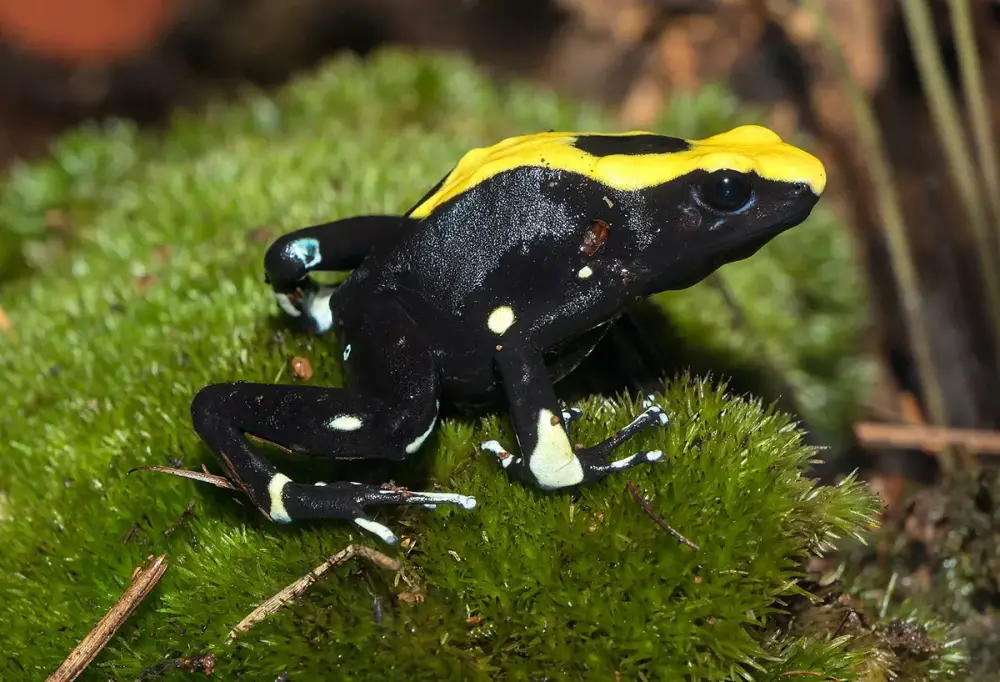
The dyeing poison dart frog, also known as the cobalt or blue poison dart frog, is one of the largest and most variably coloured poison dart frogs. It lives in the eastern Guiana Shield, in parts of French Guiana, Guyana, Suriname and Brazil, mostly in primary rainforest near canopy gaps and at altitudes up to 600 m. It tends to stay on the ground, though it sometimes climbs trees, and tadpoles develop in water pooled on fallen trees. The frog makes none of its own poison but collects alkaloids from its prey of mostly ants and mites. Its bright colours warn predators of the unpleasant, toxic skin secretions.
About the blue poison dart frog
The blue poison dart frog is a small, bright blue, toxic frog from the rainforest islands of southern Suriname. It was first described as its own species, but recent authorities generally treat it as a color form, or morph, of the dyeing poison dart frog. Like other poison dart frogs, it gets its skin toxins from the insects it eats.
Its scientific name is usually written Dendrobates tinctorius "azureus," the second part referring to its azure color. A few authorities treat it as a subspecies of D. tinctorius or still treat it as its own species. How far it differs from the blue D. tinctorius of southern Guyana and neighboring Pará, Brazil, is disputed, and many herpetologists and frog keepers do not separate them, so all of them commonly go by "azureus." The dyeing poison dart frog itself is one of the most variable poison frogs, with more than 30 recognized color morphs that differ very little genetically.
This is a medium-sized poison dart frog, 3–4.5 cm (1.2–1.8 in) long from snout to vent. Females are a bit larger and plumper, averaging about 4.5 cm (1.8 in) against about 4 cm (1.6 in) for males, while males have larger toe pads. The toe tips give the sexes away: they are heart-shaped in males and round in females. Each foot has four toes, each ending in a flattened pad that grips like a suction cup.
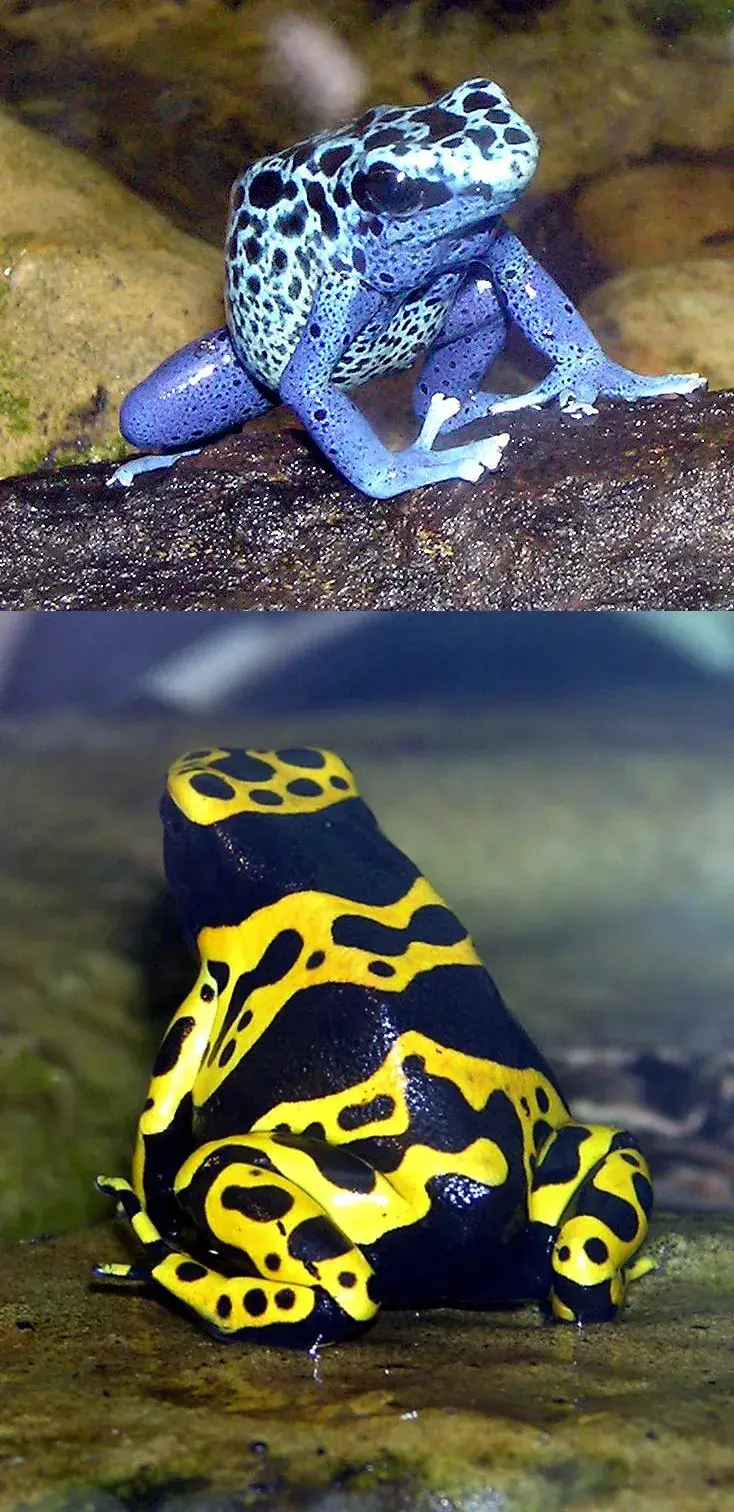
The color is the frog's warning sign. The back is sky blue, the legs azure, and the belly a darker blue, all scattered with black and dark blue spots, most of them on the head and back. No two frogs have the same spot pattern, so the spots work like a fingerprint for telling individuals apart. Compared with other dyeing dart frog morphs, the blue form also has a distinctive hunched posture and a smaller, more oval eardrum. Its skin stays sticky with mucus, which holds in moisture and gives tadpoles something to cling to when they are carried on a parent's back.
Behavior and diet
Diet
Ants, termites, beetles, flies, mites, spiders, caterpillars and other small arthropods
Blue poison dart frogs live on the ground and stay close to water, such as a stream. They are diurnal, spending their active hours hopping in short leaps and hunting. They are solitary, bold and very territorial, chasing off members of their own species and other frogs alike. Territorial disputes involve calls, chases and wrestling, usually between frogs of the same sex.
They eat a wide range of small arthropods: ants, including fire ants and similar species, plus beetles, flies, mites, spiders, termites, maggots and caterpillars. Frogs in human care are usually fed fruit flies, small crickets, beetle larvae, isopods and springtails.
The frog does not make its own poison. It collects alkaloid compounds from the insects it eats, especially ants, and stores them in skin glands, a process called sequestration. Its main toxins are pumiliotoxins, nerve poisons that force open ion channels and disrupt signaling. They are less powerful than the batrachotoxins of the golden poison dart frog, but dyeing dart frogs can convert pumiliotoxin into allopumiliotoxin, which is about five times as potent. Animal Diversity Web reports that a blue poison dart frog carries an average of about 200 micrograms of poison, and that only about 2 micrograms could be fatal to a human.
Because the toxins come from wild food, frogs bred in captivity do not develop poison unless they are fed insects that carry the right compounds, and wild-caught frogs become less toxic over time in captivity. The bright color still deters predators, though snakes and large spiders do eat these frogs, and snakes eat the tadpoles. Despite the name, only frogs of a different genus, Phyllobates, were actually used to poison darts and arrows.
In the wild, the frogs breed in the rainy season, usually February and March. Males sit on a rock or leaf and give quiet calls, and females track the sound and then fight each other over a male. The winning female courts him by stroking his snout and back. He then leads her to a quiet, moist spot near water. Unlike most frogs, the eggs are laid on land, in damp moss under rocks or logs, and fertilized outside the body. A clutch has 5 to 10 eggs.
The male guards the eggs in his territory and keeps them moist, sometimes with help from the female. After 14 to 18 days the eggs hatch, and the male carries the tadpoles on his back to small pools of water, such as the center of a bromeliad, a leaf axil or a tiny tree hole. Tadpoles are often placed in separate pools because they eat each other. The mother keeps visiting to lay unfertilized eggs as food. Tadpoles transform into frogs in 10 to 12 weeks, and both sexes are mature at two years old.
Range and habitat
Habitat
Humid forest patches near small streams, among mossy rocks, at 315–430 m (1,030–1,410 ft)
The blue poison dart frog is found only in a small area of southernmost Suriname, in patches of forest, the "forest islands," surrounded by the dry, prairie-like Sipaliwini Savanna. These forests sit at about 315–430 m (1,030–1,410 ft) above sea level. They are humid and warm, around 22–27 °C (72–81 °F) by day and about 20 °C (68 °F) at night.
Within these forests the frog prefers dark, damp spots near small streams, among moss-covered rocks. It usually stays on the ground but sometimes climbs into trees. The wider dyeing poison dart frog lives in scattered patches of rainforest across the eastern Guiana Shield, in French Guiana, Guyana, Suriname and Brazil, often in gaps where trees have fallen.
Blue poison dart frog vs dyeing poison dart frog
The two names often cause confusion because the blue frog is now treated as one form of the dyeing poison dart frog rather than its own species.
| Trait | Blue poison dart frog ("azureus") | Dyeing poison dart frog (typical forms) |
|---|---|---|
| Classification | A morph of Dendrobates tinctorius; once its own species | The species Dendrobates tinctorius, with 30 or more morphs |
| Color | Mostly blue with black spots | Usually black with yellow or white stripes and blue legs and belly |
| Size | 3–4.5 cm (1.2–1.8 in) | Most about 5 cm (2 in); range 3.5–7 cm (1.4–2.8 in) |
| Range | Forest islands in southern Suriname | Eastern Guiana Shield: French Guiana, Guyana, Suriname, Brazil |
| Posture | Distinctly hunched, with a smaller oval eardrum | Varies by morph |
Conservation status
Because it is not treated as a separate species, the blue poison dart frog has no assessment of its own. It falls under the dyeing poison dart frog, which is listed as Least Concern on the IUCN Red List in a 2023 assessment by the IUCN SSC Amphibian Specialist Group.
The blue form's tiny range tells a more worrying story. Animal Diversity Web describes it as one of the most threatened poison dart frogs in the neotropics, pointing to habitat loss from fires and farming and to illegal collection, with hundreds of frogs smuggled out of Suriname for the pet trade. Captive breeding programs, research trips to Suriname, and education for collectors have all been part of the response. Dendrobatid frogs, including this one, have also been used as model animals in research on chytridiomycosis, a fungal disease killing amphibians worldwide.
Where to see blue poison dart frog in the U.S.
7 zoos across 6 states
Find the closest one
Rank the 7 zoos holding blue poison dart frog by how far they are from you. Your location is used in your browser to sort this list and is never sent to us.
Connecticut· 1
Florida· 1
Hawaii· 1
Michigan· 1
New York· 2
Virginia· 1
AZAThe Association of Zoos and Aquariums. Accredited members have passed an independent inspection of animal care and welfare, safety, conservation and education, repeated every five years. Many smaller facilities never apply, so “not accredited” isn't a verdict on its own. What accreditation means · How we check this
Built from each zoo's own published animal list.
Blue Poison Dart Frog: common questions
Are blue poison dart frogs poisonous to touch?
Yes, in the wild. Their skin carries alkaloid toxins, and Animal Diversity Web reports that the poison in one frog could be enough to kill a person. Captive-bred frogs are not toxic unless fed insects that supply the toxins.
How big do blue poison dart frogs get?
About 3–4.5 cm (1.2–1.8 in) long, with females slightly larger than males.
What do blue poison dart frogs eat?
Small arthropods, especially ants, termites, beetles, flies, mites, spiders and caterpillars.
How long do blue poison dart frogs live?
About 4–6 years in the wild and around 10 years in captivity, sometimes up to 12.
Where do blue poison dart frogs live?
Only in forest patches surrounded by the Sipaliwini Savanna in southern Suriname, near small streams.
Is the blue poison dart frog a separate species?
Usually not. Recent authorities generally treat it as a color morph of the dyeing poison dart frog, Dendrobates tinctorius, though a few still list it as its own species or a subspecies.
How can you tell a male from a female?
By the toes. Males have larger, heart-shaped toe pads, while females have round toe pads and are slightly bigger overall.