- Where to see one
- 7 U.S. zoos in our directory hold egyptian tortoise, confirmed against each zoo's own animal list.
- Native range
- Coastal Libya, Egypt (where it is close to extinction) and southern Israel
- Size
- Shell length about 9–10 cm (3.5–3.9 in) in males and up to 13 cm (5.1 in) in females
- Lifespan
- 20–30 years in the wild; up to 50 years in captivity
- Other names
- Kleinmann's tortoise, Leith's tortoise, Negev tortoise
- Clutch
- 1–5 eggs, usually followed by two more clutches about three weeks apart
Conservation status
Critically Endangeredassessed 2003
IUCN Red List category CR — step 5 of 7.
Kleinmann's tortoise, also called the Egyptian tortoise, is the smallest tortoise in the Northern Hemisphere. It lives in deserts and semiarid habitats such as compact sand and gravel plains, shallow sandy wadis, dry woodland and coastal salt marsh, in places receiving less than 50 mm of rain a year. Its high-domed shell ranges from ivory to pale gold to dark brown, which camouflages it and lets paler animals stay out longer in the heat. It avoids extreme cold and heat, spending the rest of the day under bushes or in rodent burrows. The wild diet is unknown. Unlike other Mediterranean tortoises, it may make a mating call like a mourning dove.
About the Egyptian tortoise
The Egyptian tortoise is a tiny, critically endangered land tortoise of the North African and Middle Eastern coastal desert, found in Libya and southern Israel and nearly gone from Egypt. A member of the Mediterranean tortoise genus Testudo, it is the smallest tortoise in the Northern Hemisphere and the smallest of its genus.
It is also called Kleinmann's tortoise, after Edouard Kleinmann, a French stockbroker who collected the first scientific specimen in 1875. Its scientific name, Testudo kleinmanni, honors him as well. Other common names include Leith's tortoise and the Negev tortoise. Its closest relatives appear to be the marginated tortoise and the common, or Greek, tortoise, and some researchers have proposed placing it with the marginated tortoise in a separate genus.
Size is the first thing people notice. Males measure only about 9 to 10 cm (3.5 to 3.9 in) along the shell, and females, the larger sex, reach up to about 13 cm (5.1 in). Males are also slimmer, with a more elongated shell and a longer tail. Unusually for the genus, males lack the concave lower shell typical of other male Testudo tortoises.
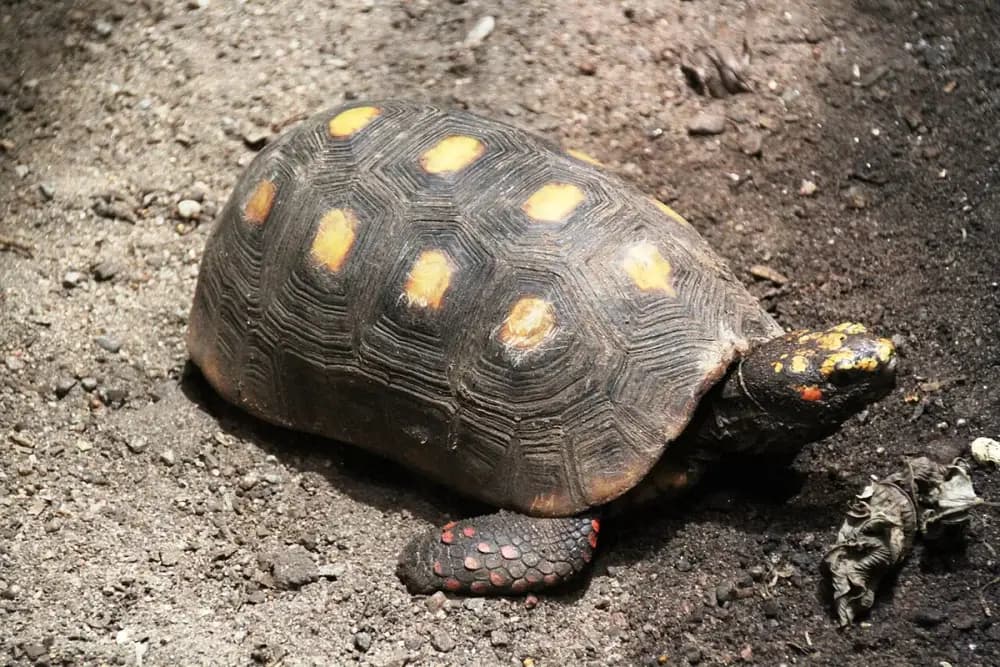
The upper shell, or carapace, is highly domed. Its color ranges from ivory and pale gold to dull yellow, pink, or dark brown, and the scutes have no central markings, though some have brown edges that can disappear entirely in older animals. This pale shell helps shield it from the desert sun, letting the tortoise stay out in the heat longer, and it blends with sand and gravel as camouflage. The lower shell, or plastron, is light yellow, usually with a pair of dark triangles on each abdominal scute. Dark edges on the plastron scutes fade with age.
The skin of the head and legs is a very pale ivory-yellow to yellowish-brown. Besides its small size, a few features separate it from other Testudo tortoises: there are no spurs on the thighs, the tail has no horny tip, the front legs carry noticeably large scales, and the rear lobe of the plastron is movable in both sexes.
Behavior and diet
Diet
Wild diet unknown; captive animals eat grasses, fruits, and vegetables
Activity follows the temperature. The tortoise is least active when the weather is very cold or very hot. In the cooler months it comes out mostly around midday, and in the warm season it is active in the mornings and evenings. The rest of the day it shelters under bushes or in empty rodent burrows. From June to August, when it is simply too hot, it buries itself and rests through the summer. On cold winter nights near freezing it digs in briefly and emerges again when the sun is out.
What it eats in the wild is unknown. In captivity it eats grasses, fruits, and vegetables. Food in its desert range is most plentiful in spring, when the desert briefly turns green and flowers.
Courtship is rough. The male rams the female and sometimes chases her. These tortoises are otherwise silent, but during mating the male calls in bursts with his mouth wide open, a sound compared to the cooing of a mourning dove or pigeon. In the wild, mating has been observed in March; in captivity it happens in April and from August to November.
Females dig shallow nests about 5 cm (2 in) deep under bushes or in vacant burrows. Each clutch holds one to five elongated eggs, averaging about 32 by 23 mm (1.3 by 0.9 in) and 7.8 g (0.3 oz), and a female usually lays two more clutches at roughly three-week intervals. In incubators at 31 to 32.5 °C (88 to 90.5 °F), eggs hatched after 90 to 105 days. Hatchlings weigh just 5.5 to 6.8 g (about 0.2 oz). As in other tortoises of the genus, incubation temperature decides whether a hatchling is male or female. Young reach sexual maturity at about 5 years old.
Range and habitat
Habitat
Desert and semi-arid land with compact sand, gravel plains, shallow wadis, scrub, and coastal salt marsh
The Egyptian tortoise lives in a narrow coastal band along the southeastern Mediterranean, no more than about 120 km (75 mi) inland. Its historic range covered Libya, Egypt, and southern Israel, including the northern Sinai and the northern Negev.
It is a desert and semi-desert animal. Typical habitat has compact sand and gravel plains, scattered rocks, shallow sandy wadis, dry woodland, shrubby areas, and coastal salt marsh. Rainfall in its range is very low, around 50 mm (2 in) a year. Winter days stay around 17 to 18 °C (63 to 64 °F), with nights of 9 to 10 °C (48 to 50 °F), and humidity can be high in winter.
Today the species survives in scattered pockets. Two populations remain in Libya. In Israel it is found in the northwestern Negev and the Yemin Plain, with occasional lone animals near Yeruham. In Egypt only 10 wild individuals were known in 2006, near Lake Bardawil, and the species may now be extinct there.
Egyptian tortoise vs Negev tortoise
The tortoises of Israel's Negev were once described as a separate species, the Negev tortoise (Testudo werneri). Genetic work found no meaningful mitochondrial DNA difference between Negev animals and those from western Libya, and the name was folded back into Testudo kleinmanni in 2006. The 2017 checklist of the world's turtles kept it as a synonym.
| Name | Status today | Where |
|---|---|---|
| Testudo kleinmanni (Egyptian or Kleinmann's tortoise) | Valid species | Libya, Egypt, southern Israel |
| Testudo werneri (Negev tortoise) | Synonym of T. kleinmanni | Northwestern Negev and Yemin Plain, Israel |
Even so, mixing animals from different populations for reintroduction is discouraged, because the habitats differ, and a genetic type found only in Egyptian animals may exist.
Conservation status
The Egyptian tortoise is listed as Critically Endangered on the IUCN Red List, based on a 2003 assessment. It is also on CITES Appendix I, which bans international commercial trade.
The decline is steep. An estimated 55,000 to 56,000 adults existed less than three generations ago, and about 7,500 are thought to remain. Illegal collection for the pet trade may have cut the number of adults to perhaps 1,000 across the two or three remaining populations. Just before trade protections took effect, about 2,800 animals, around half the known population at that time, were taken into the pet trade. Israel's population was estimated at fewer than 2,000 in 2010.
Threats include habitat loss to farming, overgrazing, industrial development, and building on the sand dunes of the western Negev, as well as hunting for folk medicine. Because the species matures slowly, lives long, and lays few eggs, it recovers poorly from losses, and remaining numbers may already be below a viable size. In Israel it is protected by law and by new protected areas. Smuggling continues, but confiscated tortoises are used to establish a captive safeguard population.
Where to see egyptian tortoise in the U.S.
7 zoos across 6 states
Find the closest one
Rank the 7 zoos holding egyptian tortoise by how far they are from you. Your location is used in your browser to sort this list and is never sent to us.
Colorado· 1
Kansas· 2
Maryland· 1
Michigan· 1
Oregon· 1
Virginia· 1
AZAThe Association of Zoos and Aquariums. Accredited members have passed an independent inspection of animal care and welfare, safety, conservation and education, repeated every five years. Many smaller facilities never apply, so “not accredited” isn't a verdict on its own. What accreditation means · How we check this
Built from each zoo's own published animal list.
Egyptian Tortoise: common questions
How big do Egyptian tortoises get?
Very small. Males reach about 9–10 cm (3.5–3.9 in) in shell length and females up to about 13 cm (5.1 in), making it the smallest tortoise in the Northern Hemisphere.
Are Egyptian tortoises endangered?
Yes. They are Critically Endangered, with roughly 7,500 left in the wild and perhaps as few as 1,000 adults.
Where do Egyptian tortoises live?
In coastal desert and semi-desert in Libya and southern Israel. They are nearly or entirely gone from Egypt.
What do Egyptian tortoises eat?
Their wild diet is unknown. In captivity they eat grasses, fruits, and vegetables, and in the wild food is most plentiful in spring, when the desert greens.
How long do Egyptian tortoises live?
About 20 to 30 years in the wild and up to 50 years in captivity.
Can you keep an Egyptian tortoise as a pet?
Generally no. International trade is banned under CITES Appendix I, the species is not generally available to hobbyists, and illegal collection for the pet trade is one of its biggest threats.
Do Egyptian tortoises make noise?
Yes, males do during mating. With mouths wide open, they give bursts of sound compared to the cooing of a mourning dove.