Copperhead
Agkistrodon contortrix
Also known as Northern Copperhead, Northern Copperhead Snake
- Where to see one
- 12 U.S. zoos in our directory hold copperhead, confirmed against each zoo's own animal list.
- Native range
- Eastern and central United States, from southern New England to eastern Kansas and Texas, plus Chihuahua and Coahuila in Mexico
- Size
- Usually 50–95 cm (20–37 in) long; record about 134.6 cm (53 in)
- Lifespan
- Up to 18 years recorded in the wild; 20–29 years in captivity
- Venom
- Mild for a pit viper; bites are rarely fatal
- Young
- Born live, typically 4–7 per litter
Conservation status
Least Concernassessed 2007
IUCN Red List category LC — step 1 of 7.
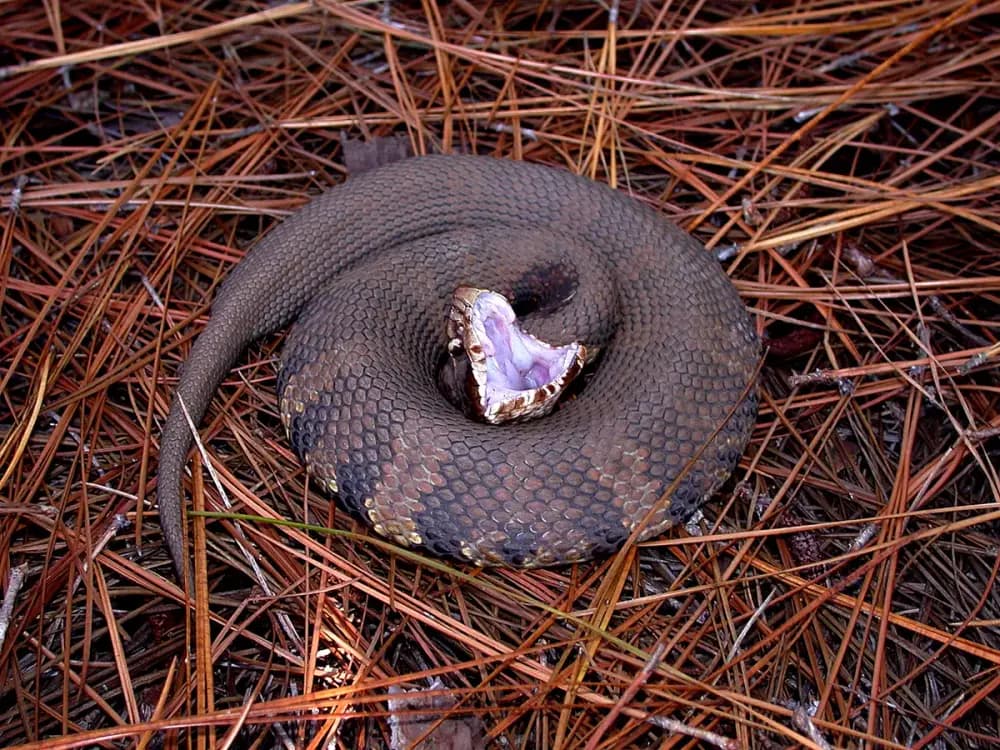
The copperhead is a widespread venomous pit viper endemic to the eastern United States. It has a heavy body marked with dark brown, hourglass-shaped bands over a light reddish brown or brown-gray background, and adults typically measure 50 to 95 cm including the tail. It favors deciduous forest and mixed woodland, rocky ledges and low swampy ground. An ambush predator, it waits in a promising spot for prey and eats a wide variety of invertebrates and vertebrates. In winter it hibernates in dens or limestone crevices, often alongside timber rattlesnakes and black rat snakes.
About the copperhead
The copperhead is a venomous pit viper of the eastern and central United States, a stout snake banded in tan, copper and rich brown. It belongs to the viper family, Viperidae, and shares its genus with the cottonmouth. It lives mainly in woodland, rocky hillsides and swamp edges and relies on camouflage among dead leaves.
Its scientific name is Agkistrodon contortrix, also called the eastern copperhead. The genus name comes from Greek words meaning "fishhook" and "tooth," while contortrix comes from the Latin for "twisted," usually read as a reference to the snake's pinched, hourglass-shaped bands.
Copperheads are heavy-bodied rather than slender. The head is broad and clearly wider than the neck, and a heat-sensing pit sits on each side of the face between the eye and the nostril. Males are larger than females: males rarely exceed 74–76 cm (29–30 in) and average about 197 g (7 oz), while females seldom pass 60–66 cm (23.5–26 in). The longest reliable records are around 132–135 cm (52–53 in).
The hourglass pattern
The pattern is the best field mark. Ten to eighteen dark, hourglass-shaped crossbands sit on a pale tan to pinkish-tan background. Each band is narrow along the spine and wide on the sides, and in many snakes the bands are split at the midline and staggered. The crown of the head is usually plain except for two tiny dark spots.
Newborns look like small, greyer adults but have a bright yellow or greenish tail tip. The tip darkens to brown or black as the snake grows; estimates of how long the yellow tint lasts range from about one year to three or four years.
Behavior and diet
Diet
Rodents, lizards, frogs, insects such as cicadas and caterpillars, and other small animals
The copperhead's main defense is staying still. Unlike many other vipers, it usually freezes rather than slithering off, because its camouflage works so well on leaf litter or red clay. That habit is why so many bites happen: people step on or beside a snake they never saw. Copperheads are generally not aggressive and strike only as a last resort. When closely approached they may vibrate the tail more than 40 times per second, faster than almost any snake other than a rattlesnake.
Activity shifts with the seasons. In spring and fall copperheads are active by day, but in the heat of a southern summer they become nocturnal, hunting in the cooler evening hours. In the north they are active from about March or April to early November. Winter is spent in dens, rock crevices, old mines or hollow logs, often shared with timber rattlesnakes and black rat snakes.
What copperheads eat
Copperheads are diet generalists. Adults rely mostly on small mammals such as voles and mice, while juveniles take more invertebrates, frogs, lizards and salamanders. Studies across Tennessee, Kentucky, Kansas and Texas found cicadas, caterpillars, small lizards, voles and mice to be consistently important prey. In Texas, copperheads have been found high in trees and vines, some as much as 40 ft (12 m) up, hunting freshly emerged cicadas.
Most hunting is by ambush. The snake picks a good spot and waits, using sight, smell and its heat-sensing pits to strike accurately. Small prey is held in the mouth until it dies; larger prey is bitten, released and tracked by scent. Young copperheads wiggle their yellow tail tips to lure frogs and lizards within range, a tactic called caudal luring. A copperhead may eat up to twice its own body mass in a year.
Reproduction
Copperheads give birth to live young. Litters are typically four to seven, with as few as one or as many as 20 or 21, and newborns are about 20 cm (8 in) long. Females can store sperm for up to a year and often skip breeding for one or more years. Before mating, rival males may wrestle with their front halves raised, each trying to stay higher than the other.
Copperheads are also one of a handful of vertebrates capable of facultative parthenogenesis: a female can occasionally produce young without a male. This has been recorded in captive and wild snakes.
Range and habitat
Habitat
Deciduous and mixed woodland, rocky outcrops, swamp edges and streamside habitat; also suburbs
Copperheads live in roughly 28 U.S. states, from southern New England and southeastern New York west to eastern Kansas and Nebraska and south to Texas and the Florida panhandle. Isolated populations occur in western Texas and in Chihuahua and Coahuila, Mexico. Unlike the timber rattlesnake and eastern massasauga, the copperhead mostly never spread back north of the line reached by glaciers in the last ice age.
They are habitat generalists. In the Northeast and the Appalachians they favor deciduous forest and open woodland with rock outcrops, ledges and fallen timber. On the southern coastal plain they live in low, wet woods and at swamp edges, and around the Gulf of Mexico in coniferous forest too. In the Chihuahuan Desert they stay near water along streams and dry washes. They also turn up around houses, sawdust piles and construction sites, which brings them into frequent contact with people.
Copperhead vs cottonmouth
The copperhead's closest familiar relative is the cottonmouth, which shares its genus and part of its range, and the cottonmouth even preys on copperheads.
| Feature | Copperhead | Cottonmouth |
|---|---|---|
| Scientific name | Agkistrodon contortrix | Agkistrodon piscivorus |
| Snout | Slopes down and back, so it looks less blunt | Blunter in profile |
| Venom potency | Among the lowest of all pit vipers | Slightly stronger than the copperhead's |
| Juvenile tail | Yellow or greenish tip used as a lure | Also has a yellow-tinted tail tip |
Conservation status
The copperhead is listed as Least Concern on the IUCN Red List, based on a 2007 assessment by Frost, Hammerson and Santos-Barrera that found a stable population trend. Its large range and population put it at little risk of extinction.
Some local populations are declining. Copperheads are considered endangered in Iowa and Massachusetts, and threats include habitat destruction, invasive plants, insecticides and road deaths. Habitat fragmentation can cut snakes off from feeding, wintering and breeding sites; in one tracking study, copperheads in fragmented areas never left the patch where they were first caught.
The venom has research value. Contortrostatin, a protein from the venom of the southern form, slowed the growth and spread of cancer in mice, though this has not been shown to work in people.
Where to see copperhead in the U.S.
12 zoos across 11 states
Find the closest one
Rank the 12 zoos holding copperhead by how far they are from you. Your location is used in your browser to sort this list and is never sent to us.
District of Columbia· 1
Georgia· 1
Kansas· 1
Kentucky· 1
Louisiana· 2
Mississippi· 1
North Carolina· 1
Ohio· 1
Pennsylvania· 1
Rhode Island· 1
Tennessee· 1
AZAThe Association of Zoos and Aquariums. Accredited members have passed an independent inspection of animal care and welfare, safety, conservation and education, repeated every five years. Many smaller facilities never apply, so “not accredited” isn't a verdict on its own. What accreditation means · How we check this
Built from each zoo's own published animal list.
Copperhead: common questions
Are copperheads dangerous?
Yes, but rarely deadly. Their venom is among the weakest of the pit vipers and bites are rarely fatal, though they cause severe pain and swelling and always need prompt medical care.
How common are copperhead bites?
Very common. Copperhead bites account for about half of treated snake bites in the United States, mostly because people step on or near a snake that is frozen in place.
Do all copperhead bites need antivenom?
No. Many bites are dry, with little or no venom, and antivenom is given only when there is a reaction such as swelling. In one study of 88 bite victims, all survived and none needed antivenom.
How big do copperheads get?
Usually 50–95 cm (20–37 in). Lengths over 1 m (3 ft 3 in) are exceptional, and the record is about 134.6 cm (53 in).
What do copperheads eat?
Mostly mice, voles and other small mammals as adults, plus lizards, frogs, salamanders and insects such as cicadas and caterpillars. Juveniles eat more insects and cold-blooded prey.
Do baby copperheads have yellow tails?
Yes. Newborns have a yellow or greenish tail tip that they wiggle to lure frogs and lizards. It darkens as the snake grows.
How long do copperheads live?
Up to 18 years recorded in the wild, with captive snakes living 20 to 29 years.
Where do copperheads live?
In the eastern and central United States, from southern New England to Texas and the Florida panhandle, plus northern Mexico. They favor woodland, rocky hillsides and swamp edges.