- Where to see one
- 11 U.S. zoos in our directory hold cottonmouth, confirmed against each zoo's own animal list.
- Native range
- southeastern United States, from the Great Dismal Swamp in Virginia south through the Florida peninsula and west to Arkansas and Oklahoma
- Size
- adults commonly exceed 80 cm (31 in); one study found adult total length of 65–90 cm (26–35 in), with a record specimen of 189.2 cm (74.5 in)
Conservation status
Least Concernassessed 2007
IUCN Red List category LC — step 1 of 7.
Least Concern (LC), assessed 2007
About the cottonmouth
The cottonmouth is a species of venomous snake, a pit viper in the subfamily Crotalinae within the family Viperidae, native to the southeastern United States. It is one of the world's few semiaquatic vipers, sharing that distinction with the closely related Florida cottonmouth, and it is a capable swimmer that appears to float on top of the water rather than swim beneath the surface. As an adult, it is large and capable of delivering a painful and potentially fatal bite, and it will bite if it feels threatened or is handled.
Its scientific name translates to "hook-toothed fish-eater," combining Greek words for a fish-hook and a tooth with Latin for fish and devour. Common names for the species include cottonmouth, northern cottonmouth, water moccasin, swamp moccasin, black moccasin, and simply viper; many scientists avoid the term water moccasin because it invites confusion with harmless water snakes. Most of its common names, including cottonmouth itself, refer to its signature threat display, in which the snake gapes its mouth open to expose the strikingly white lining inside.
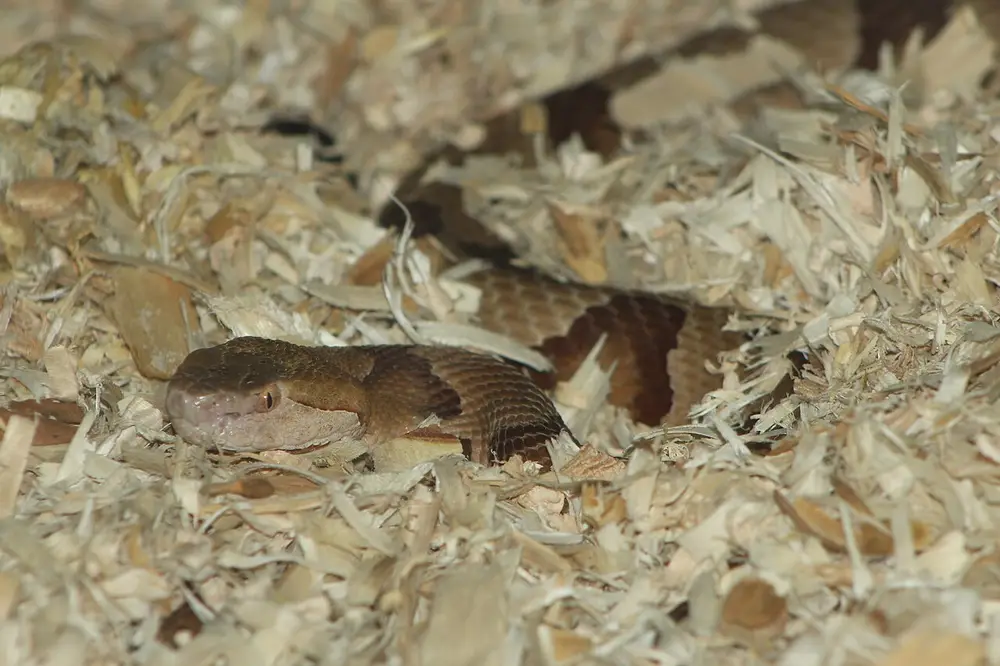
Physically, the cottonmouth is the largest species in its genus. Adults commonly exceed 80 cm (31 in) in total length, and one study of adults found a range of 65 to 90 cm (26 to 35 in), with females typically smaller than males. Occasionally individuals exceed 180 cm (71 in), especially in the eastern part of the range, and the record specimen measured 189.2 cm (74.5 in). A large specimen around 180 cm (71 in) long has been recorded weighing 4.6 kg (10 lb). Rather than the narrow, tapered head one might expect of an aquatic snake, the cottonmouth has a bulky, triangular head distinct from its neck, with a blunt snout. Its body color ranges from brown, gray, tan, or yellowish-olive to nearly black, overlaid with 10 to 17 dark crossbands that fade with age until older individuals appear an almost uniform olive-brown or black; the belly is white, yellowish-white, or tan with dark spots.
Behavior and diet
Diet
fish and other prey suited to a semiaquatic predator
The cottonmouth is the most aquatic species in its genus and is usually found in or near bodies of water such as creeks, streams, marshes, swamps, and the shores of ponds and lakes. It favors slow-moving, shallow water and is not typically found in swift, deep, or cool water. It also turns up in brackish habitats and is sometimes seen swimming in salt water, though a study found it is not particularly salt-tolerant, and even on barrier islands it tends to favor freshwater marshes. The species is not confined to water, however; large specimens have been found more than a mile (1.6 km) from the nearest water source, and in some parts of its range it inhabits drier environments such as palmetto thickets, pine-palmetto forest, and dune and beach areas.
Despite a longstanding reputation for aggression, the evidence paints a more nuanced picture. In tests of how wild cottonmouths respond to encounters with people, just over half tried to escape, and most of the rest resorted to threat displays and other defensive behavior rather than attacking. Snakes were far more likely to bite when they were physically picked up than when they were simply approached or even stepped on, and none attempted to bite when researchers merely stood next to them. When a cottonmouth does feel sufficiently threatened, it performs a distinctive display: it throws its head back, opens its mouth to show the white interior, vibrates its tail, often hisses loudly, and pulls its body into an S-shaped coil. It may also flatten its body and release a strong-smelling musk from glands at the base of the tail, sometimes in thin jets if the snake is especially agitated.
The cottonmouth's venom is cytotoxic, meaning it destroys tissue, and it is described as more toxic than that of the copperhead. Bites can leave scars and, in rare cases, require amputation, though deaths are uncommon and the venom does not carry the neurotoxic components found in some rattlesnakes. Bites can be treated effectively with CroFab antivenom, which is derived from the venom of four American pit viper species, including the cottonmouth itself. Historical records from Florida show a steady but low number of bites and only a handful of fatalities recorded in the 1930s, with none reported after 1934, supporting the assessment that the species is not particularly aggressive by nature.
Range and habitat
Habitat
creeks, streams, marshes, swamps, and the shores of ponds and lakes; also found well away from water
The cottonmouth's native range runs through the eastern United States, from the Great Dismal Swamp in southeastern Virginia south through the Florida peninsula and west into Arkansas and eastern and southern Oklahoma, as well as western and southern Georgia, though it is notably absent around Lake Lanier and Lake Allatoona. It has also been documented in Alabama, Illinois, Indiana, Kentucky, Louisiana, Mississippi, Missouri, North Carolina, South Carolina, Tennessee, Texas, and along the Ohio River Valley as far north as southern Indiana. A few records exist along the Rio Grande in Texas, though these disjunct populations may now be gone.
Within that range, the cottonmouth is most closely tied to freshwater habitats such as lowland swamps, lakes, rivers, sluggish streams, and marshes, and it has successfully colonized many barrier islands along the Atlantic and Gulf coasts, more so than the copperhead. It also inhabits less moist environments in places, including pine woods, dune forest, and prairie edges, showing that its dependence on water is strong but not absolute.
Conservation status
The cottonmouth is listed as Least Concern on the IUCN Red List, based on a 2007 assessment, reflecting its wide range across the southeastern United States. The category means it is not currently considered at risk of extinction.
The snake's biggest problem with people is its reputation. Cottonmouths are often wrongly described as aggressive, and harmless water snakes are frequently mistaken for them. In tests of how wild cottonmouths respond to encounters with people, about half tried to escape and most used threat displays or other defensive tactics; they were likely to bite only when picked up with a mechanical hand.
Where to see cottonmouth in the U.S.
11 zoos across 6 states
Find the closest one
Rank the 11 zoos holding cottonmouth by how far they are from you. Your location is used in your browser to sort this list and is never sent to us.
Florida· 4
Kentucky· 1
Louisiana· 2
North Carolina· 1
Pennsylvania· 2
Virginia· 1
AZAThe Association of Zoos and Aquariums. Accredited members have passed an independent inspection of animal care and welfare, safety, conservation and education, repeated every five years. Many smaller facilities never apply, so “not accredited” isn't a verdict on its own. What accreditation means · How we check this
Built from each zoo's own published animal list.
Cottonmouth: common questions
Is the cottonmouth endangered?
No. It is listed as Least Concern on the IUCN Red List (2007 assessment), reflecting its wide distribution across the southeastern United States.
How big does a cottonmouth get?
Adults commonly exceed 80 cm (31 in) in total length, with one study finding a typical range of 65 to 90 cm (26 to 35 in) and a record specimen of 189.2 cm (74.5 in).
Is a cottonmouth bite dangerous?
Its venom is cytotoxic and more toxic than a copperhead's, and bites can cause serious tissue damage, though fatalities are rare and bites can be treated with CroFab antivenom.
Where do cottonmouths live in the wild?
In the southeastern United States, in and around creeks, streams, marshes, swamps, and lake and pond shores, from Virginia's Great Dismal Swamp through Florida and west to Arkansas and Oklahoma.
Are cottonmouths aggressive?
Studies of wild snakes found most either tried to escape or used threat displays rather than attacking, and bites were far more likely when a snake was picked up than when it was simply approached.
Which U.S. zoos have cottonmouths?
Five U.S. zoos list cottonmouths, including the Central Florida Zoo and Botanical Gardens, Baton Rouge Zoo, and North Carolina Zoo.