- Where to see one
- 30 U.S. zoos in our directory hold white-tailed deer, confirmed against each zoo's own animal list.
- Native range
- North and South America, from arid grasslands to the Amazon and Orinoco basins, the Llanos, and high-elevation Andes terrain
- Size
- North American bucks usually 68–136 kg (150–300 lb), with some over 180 kg (400 lb) in the northernmost range; does usually 40–90 kg (88–198 lb); body length 95–220 cm (37–87 in) including a 10–37 cm (4–15 in) tail; shoulder height 53–120 cm (21–47 in)
Conservation status
Least Concernassessed 2016
IUCN Red List category LC — step 1 of 7.
About the white-tailed deer
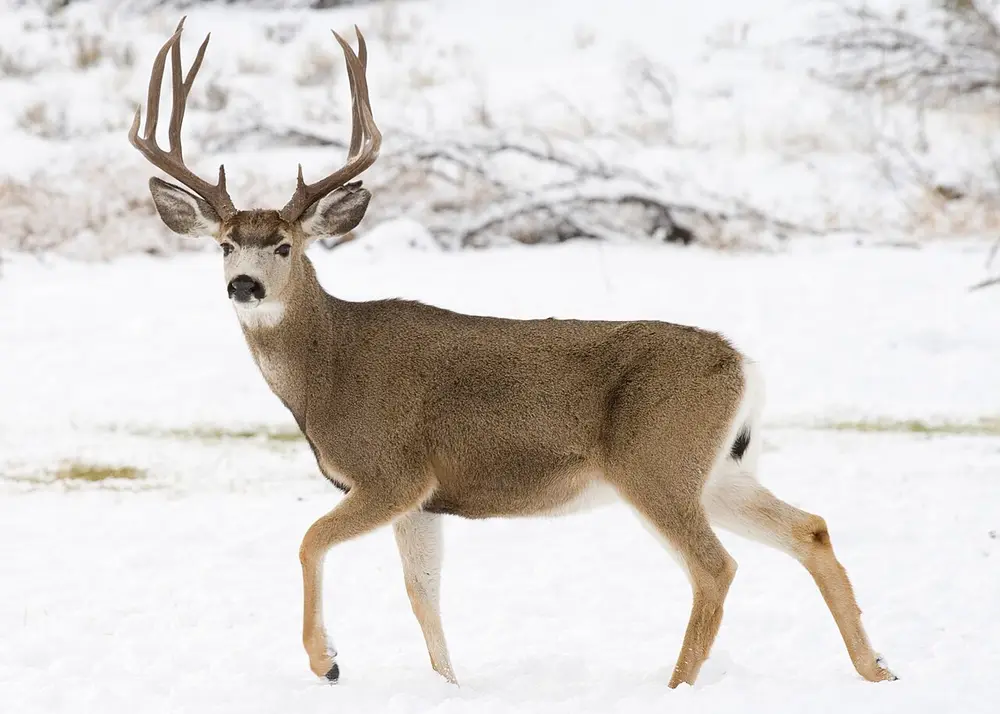
The white-tailed deer, also known as the whitetail or Virginia deer, is a medium-sized deer species native to North and South America. It's the most widely distributed mainland ungulate herbivore in the Americas, and together with its natural predator, the mountain lion, it ranks among the most widely distributed terrestrial mammal species in the world. Its adaptability shows in the range of ecosystems it occupies, from arid grasslands to the Amazon and Orinoco basins, the Llanos, and the high-elevation terrain of the Andes.
The coat is reddish-brown in spring and summer, turning grey-brown through fall and winter. The species is named for the white underside of its tail, which it raises when alarmed to warn the predator that it has been detected. Older deer tend to have longer snouts and grayer coats than younger animals. One notable population in New York, centered on the former Seneca Army Depot in Romulus, is almost entirely white except for the nose and hooves — not albino, but a distinct color variant that has thrived there thanks to conservation efforts. The species has a horizontally slit pupil suited to good night vision along with color vision by day, and whitetails process visual images faster than humans, giving them an edge at detecting motion in low light. Their vision is dichromatic, built around blue and yellow, so they poorly distinguish the oranges and reds that stand out to human eyes — the reason hunter orange works as a safety color without alarming the deer.
Size varies enormously across the range, generally following the ecological pattern of larger bodies farther from the equator. North American bucks usually weigh 68 to 136 kg (150–300 lb), though bucks over 180 kg (400 lb) have been recorded in the northernmost parts of the range, in Minnesota, Ontario, and Manitoba; a Minnesota buck taken in 1926 weighed 183 kg (403 lb) field-dressed, estimated at 232 kg (511 lb) alive. Does typically weigh 40 to 90 kg (88–198 lb). Deer from the tropics and the Florida Keys run markedly smaller, averaging 35 to 50 kg (77–110 lb), with some adult females as light as 25 kg (55 lb), while Andean deer are larger than other tropical populations and carry thick, slightly woolly fur. Across all races, body length ranges from 95 to 220 cm (37–87 in), including a 10 to 37 cm (4–15 in) tail, with shoulder height of 53 to 120 cm (21–47 in).
Behavior and diet
Diet
Herbivore; legumes, shoots, leaves, grasses, forbs, acorns, fruit, and corn
White-tailed deer are crepuscular, meaning they're most active at dawn and dusk, resting sporadically through the rest of the day and night. Males regrow a set of antlers every year, beginning growth in late spring under a covering of highly vascularized tissue called velvet; roughly one in 10,000 females also grows antlers, usually linked to a condition called freemartinism. Bucks without branching antlers are called "spikehorns" or spike bucks, distinct from young male fawns known as "button bucks," which carry only skin-covered nubs during their first winter. Antler size and branching depend on nutrition — particularly protein intake and calcium availability — along with age and genetics, and while antlers generally get larger with age, the number of points or their length isn't a reliable way to judge a buck's age because local environment plays such a large role. Antlers can be typical, with symmetrical points growing straight up from the main beam, or atypical, with points projecting at odd angles; scoring systems such as Boone and Crockett or Pope and Young measure how much asymmetry is present. A buck's inside antler spread can run from 8 to 60 cm (3–25 in). Bucks shed their antlers once all females in the area have been bred, sometime between late December and February.
White-tailed deer eat large amounts of food, mostly legumes, shoots, leaves, grasses, and prairie forbs, along with acorns, fruit, and corn, and their diet shifts with the seasons. The species is just as adaptable in its habitat use: while often thought of as a forest animal relying on small clearings and edges, the white-tailed deer adjusts just as readily to open prairie, savanna woodland, and sage habitat, as seen in the southwestern United States and northern Mexico. Deer adapted to these savanna habitats tend to carry relatively large antlers and tails for their body size, and show a more pronounced size difference between males and females than forest populations do.
Range and habitat
Habitat
forests, open prairie, savanna woodlands, and sage communities
In North America, the white-tailed deer is common — even considered a nuisance in places — east and south of the Rocky Mountains, including southwestern Arizona, but it's absent from the American West Coast and Baja California, where the black-tailed deer and mule deer fill its ecological niche. An exception exists in mixed deciduous riparian corridors and lower foothills of the northern Rockies, from Wyoming west to eastern Washington and Oregon and north into northeastern British Columbia and southern Yukon. The westernmost population, the Columbian white-tailed deer, once ranged widely through mixed forests of the Willamette and Cowlitz river valleys in western Oregon and southwestern Washington, but numbers there have fallen sharply, and the IUCN classifies this population as near-threatened; it's now separated from other white-tailed deer populations.
Texas holds by far the largest state, provincial, or national population of white-tailed deer, an estimated 5.3 million animals including both wild and farmed herds. Other regions with high populations include the Edwards Plateau of central Texas and much of Illinois, Indiana, Iowa, Maryland, Michigan, Minnesota, Mississippi, Missouri, New Jersey, New York, North Dakota, Ohio, Pennsylvania, and Wisconsin. Conversion of land near the Canadian Rockies to agriculture, along with partial clear-cutting of conifers favoring deciduous growth, has extended the species' range as far northwest as the Yukon, and similar agricultural conversion around the Great Lakes has let white-tailed deer expand north and west as local caribou, elk, and moose populations decline. The species has also been introduced, mainly for sport hunting, to New Zealand, parts of Canada's Maritime provinces, several Caribbean islands including Cuba, Jamaica, Hispaniola, and Puerto Rico, and a handful of European countries including the Czech Republic, Finland, France, Germany, Romania, and Serbia. In South and Central America, the species ranges from Guatemala south to Peru, though overhunting and limited protection make these populations harder to study, and some areas no longer support deer at all.
Conservation status
The white-tailed deer as a whole is rated Least Concern on the IUCN Red List, in a 2016 assessment, reflecting its huge range and, in many U.S. states, population levels high enough to be considered a nuisance. That overall status masks trouble for specific subspecies: the Florida Key deer (O. v. clavium) and the Columbian white-tailed deer (O. v. leucurus) are both listed as endangered under the U.S. Endangered Species Act, and the Columbian population in particular has declined steeply from its historical range in Oregon and Washington.
Where to see white-tailed deer in the U.S.
30 zoos across 20 states
Find the closest one
Rank the 24 zoos holding white-tailed deer by how far they are from you. Your location is used in your browser to sort this list and is never sent to us.
6 more zoos hold white-tailed deer but have no coordinates on file yet, so they aren't ranked here. They're in the full list below.
Arizona· 1
Connecticut· 1
Florida· 2
Georgia· 1
Idaho· 1
Illinois· 1
Kansas· 2
Louisiana· 3
Maryland· 1
Massachusetts· 1
Michigan· 2
Minnesota· 1
New Hampshire· 1
New Jersey· 1
North Carolina· 1
Pennsylvania· 1
Tennessee· 1
Texas· 2
Virginia· 1
Wisconsin· 5
AZAThe Association of Zoos and Aquariums. Accredited members have passed an independent inspection of animal care and welfare, safety, conservation and education, repeated every five years. Many smaller facilities never apply, so “not accredited” isn't a verdict on its own. What accreditation means · How we check this
Built from each zoo's own published animal list.
White-tailed Deer: common questions
Is the white-tailed deer endangered?
No. The species overall is rated Least Concern on the IUCN Red List (2016), but two subspecies, the Florida Key deer and the Columbian white-tailed deer, are listed as endangered under the U.S. Endangered Species Act.
How big does a white-tailed deer get?
North American bucks usually weigh 68 to 136 kg (150–300 lb), with some exceeding 180 kg (400 lb) in the northernmost range; does typically weigh 40 to 90 kg (88–198 lb).
Where do white-tailed deer live in the wild?
Across North and South America, in habitats ranging from forests and open prairie to savanna woodland, sage country, and the high Andes.
Which U.S. zoos have white-tailed deer?
Ten U.S. zoos, including Connecticut's Beardsley Zoo, Fossil Rim Wildlife Center, and Virginia Living Museum.