- Where to see one
- 8 U.S. zoos in our directory hold mule deer, confirmed against each zoo's own animal list.
- Native range
- Western North America, from Yukon and the Northwest Territories south to northern Mexico, east to the western Great Plains
- Size
- 80–106 cm (31–42 in) at the shoulder; 1.2–2.1 m (3.9–6.9 ft) long; bucks 55–150 kg (121–331 lb), does 43–90 kg (95–198 lb)
- Lifespan
- About 22 years recorded in captivity
- Gestation
- About 190–207 days; usually twins
- Gait
- Stotting, a bounce with all four feet landing together
Conservation status
Least Concernassessed 2016
IUCN Red List category LC — step 1 of 7.
The mule deer is a deer of western and central North America, named for ears as large as those of a mule. Its range stretches from the western Great Plains to the Rocky Mountains, the southwestern United States, northern Mexico and the west coast. Males carry antlers that fork as they grow rather than branching from one main beam, and the tail is black-tipped. Mule deer are intermediate feeders that mainly browse but also eat forbs, a little grass and fruits such as acorns and berries. Does usually give birth to two fawns in spring after a gestation of about 190 to 200 days.
About the mule deer
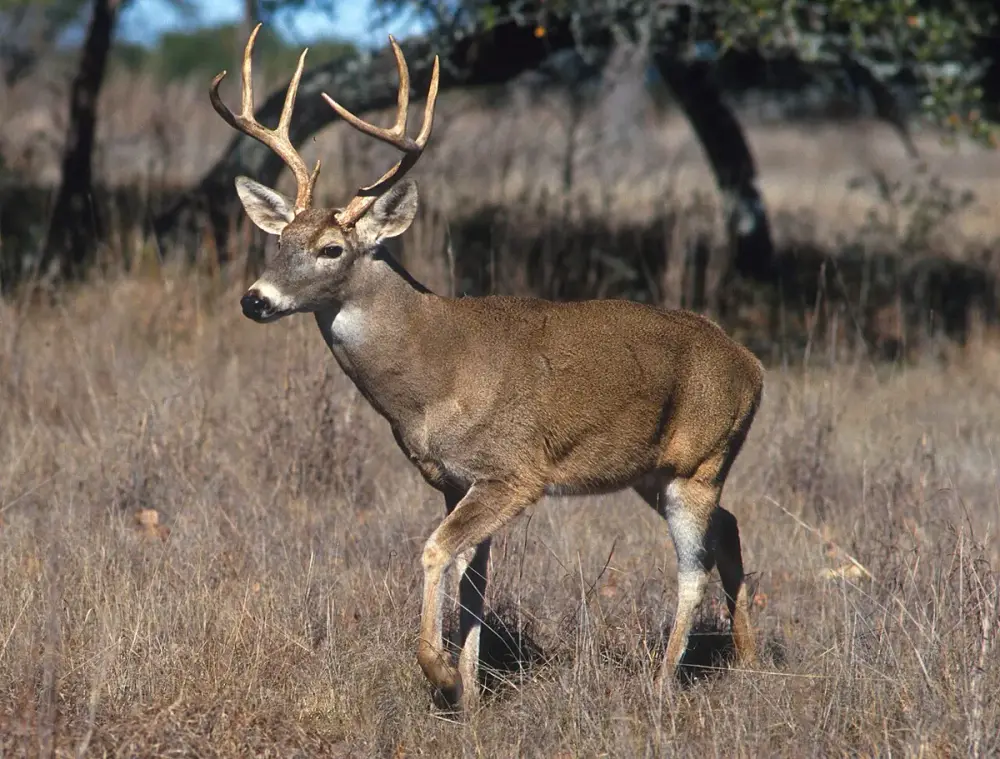
The mule deer is a large deer native to western North America, named for its oversized ears, which resemble a mule's. It is a close relative of the white-tailed deer, sharing the genus Odocoileus. Mule deer range from the western Great Plains and Rocky Mountains to the Pacific coast and south into northern Mexico.
The species, Odocoileus hemionus, includes two broad groups: the mule deer in the strict sense and the black-tailed deer of the Pacific coast. The two were once treated as separate species, but they interbreed, and nearly all recent authorities treat them as one. Ten subspecies are recognized, from the Rocky Mountain mule deer of the interior to the small Sitka black-tailed deer of Southeast Alaska.
On average, the mule deer is the largest of the three Odocoileus species. Adults stand 80–106 cm (31–42 in) at the shoulder and measure 1.2–2.1 m (3.9–6.9 ft) from nose to tail. Bucks usually weigh 55–150 kg (121–331 lb), averaging around 92 kg (203 lb), and exceptional animals reach 210 kg (460 lb). Does typically weigh 43–90 kg (95–198 lb). The Sitka subspecies is much smaller, with males averaging about 54.5 kg (120 lb).
Coat color ranges from brownish grey and ash-grey to brown or reddish. Mule deer have a white throat patch and a white or yellowish rump patch, and the white tail usually ends in a tuft of black hair. Many have a dark V-shaped mark running up from between the eyes, more obvious in males.
Bucks grow antlers that fork as they grow, splitting in two rather than branching off a single main beam. They shed them in winter, usually around mid-February, and start regrowing almost immediately. The annual antler cycle is controlled by changes in day length.
Behavior and diet
Diet
Browse (leaves and twigs of shrubs and trees), forbs, some grass, acorns, berries and mushrooms
Mule deer are intermediate feeders. They mainly browse leaves and twigs of shrubs and trees but also eat forbs, small amounts of grass, and fruits such as acorns, beans, pods and berries. Ninety-nine diet studies together recorded about 788 plant species eaten. Big sagebrush, mountain mahogany, bitterbrush, aspen and Gambel oak are among the most common foods, and in late summer and fall they also eat wild mushrooms. In the Sierra Nevada, a lichen is an important winter food.
As ruminants, they ferment plant material before digesting it, but they can't live on woody twigs alone and need highly digestible, succulent forage. Their metabolism follows the seasons: they eat more and store fat in summer, then run at a lower energy level in winter. Body fat peaks in October and bottoms out in March.
Socially, mule deer are flexible. Between 35 and 64 percent of animals are seen alone, and most groups hold five or fewer deer. Females live in clans related through their mothers, while males travel alone or in loose groups. Deer communicate with scent from five skin glands. The gland on the lower hind leg releases an alarm scent, and another between the toes leaves a scent trail.
Their defense starts with those ears and sharp eyes. Males can spot and track another animal as far as 600 m (about 660 yd) away. Depending on the threat, a mule deer may hide, slip away through cover, leave the area entirely, or bound rapidly uphill, which makes a chase costly for a predator. Coyotes, wolves and cougars are the three main predators besides humans. Bobcats, lynx, wolverines, black bears and grizzly bears mostly take fawns or weakened deer, and golden eagles are also among their predators.
The rut runs in late fall, peaking from late November through mid-December. A dominant buck guards a female in estrus until mating or until another male displaces him, and the largest males with the biggest antlers do most of the breeding. After a gestation of about 190–207 days, does usually give birth to twins in June, though first-time mothers often have one fawn. Fawns weigh 2–5 kg (4.4–11 lb) at birth and are weaned by about 16 weeks.
Range and habitat
Habitat
Nearly every western habitat, from desert and chaparral to sagebrush, mountain forest and coastal rainforest
Mule deer live across western North America, from about 23° to 60° north. The eastern edge of their usual range runs from southwestern Saskatchewan through the Dakotas, Nebraska and Kansas to western Texas. They have also been introduced to Argentina and to Kauai in Hawaii. Their range is smaller than that of the white-tailed deer, which covers most of the continent east of the Rockies.
They are remarkably adaptable. Of at least 60 natural vegetation types west of the 100th meridian in the United States, all but two or three are or were once used by mule deer. Habitats range from Sonoran and Mojave desert and California chaparral to sagebrush steppe, the Great Plains, mountain forest and boreal forest, while black-tailed deer live in the coastal temperate rainforests of the Pacific Northwest.
Many populations migrate between high summer ranges and low winter ranges to escape deep snow, and in spring follow the emergence of new growth. The longest known mule deer migration, in Wyoming, covers 150 mi (240 km) between winter and summer range. Evidence suggests deer follow remembered routes year after year.
Mule deer vs white-tailed deer
Mule deer and white-tailed deer overlap in parts of the West and occasionally hybridize, though hybrids are rare in the wild.
| Feature | Mule deer | White-tailed deer |
|---|---|---|
| Ears | Very large, mule-like | Smaller |
| Tail | White with a black tip | No black tip |
| Antlers | Fork as they grow | Tines branch from one main beam |
| Size across range | Fairly uniform | Varies markedly by region |
| Range | Western North America | Most of North America east of the Rockies, plus Rocky Mountain valleys |
Conservation status
The mule deer is listed as Least Concern on the IUCN Red List. It remains widespread, and many populations are large enough to support hunting.
Pressures are growing, though. Highways kill deer and block migration, fencing changes their movements, natural gas development can push them out of migration areas, and housing developments replace their habitat. Researchers have recorded declines where development has expanded, especially in Colorado. Climate change can also shift the timing of plant growth and make learned migration routes less useful.
Chronic wasting disease, first seen in captive deer in Colorado in 1967, has since spread widely through wild mule deer. Wildlife agencies discourage people from feeding deer in winter, because crowding at feed sites spreads disease. Wildlife crossings, fencing with escape routes, protected migration corridors and the purchase of critical winter range are among the tools used to protect them.
Where to see mule deer in the U.S.
8 zoos across 3 states
Find the closest one
Rank the 6 zoos holding mule deer by how far they are from you. Your location is used in your browser to sort this list and is never sent to us.
2 more zoos hold mule deer but have no coordinates on file yet, so they aren't ranked here. They're in the full list below.
Arizona· 5
California· 1
Idaho· 2
AZAThe Association of Zoos and Aquariums. Accredited members have passed an independent inspection of animal care and welfare, safety, conservation and education, repeated every five years. Many smaller facilities never apply, so “not accredited” isn't a verdict on its own. What accreditation means · How we check this
Built from each zoo's own published animal list.
Mule Deer: common questions
Why is it called a mule deer?
Because of its ears. They are large and long, like those of a mule.
How big do mule deer get?
Adults stand 80–106 cm (31–42 in) at the shoulder. Bucks usually weigh 55–150 kg (121–331 lb), and does 43–90 kg (95–198 lb).
What is the difference between a mule deer and a white-tailed deer?
Mule deer have bigger ears, a black-tipped tail and antlers that fork as they grow. White-tailed deer have smaller ears, no black tail tip and antler tines branching from a single main beam.
What do mule deer eat?
Mostly leaves and twigs of shrubs and trees, plus wildflowers, some grass, acorns, berries and mushrooms. Studies have recorded nearly 800 plant species in their diet.
How long do mule deer live?
A mule deer has been recorded living about 22 years in captivity.
Is a black-tailed deer a mule deer?
Yes. Black-tailed deer are two Pacific coast subspecies of the mule deer, and most authorities treat them as the same species.
Do mule deer migrate?
Many do. They move between high summer ranges and lower winter ranges, and one Wyoming migration spans 150 mi (240 km) from winter to summer range.
What eats mule deer?
Coyotes, wolves and cougars are the main predators besides people. Bears, bobcats, lynx and wolverines mostly take fawns or weak animals, and golden eagles also prey on mule deer.